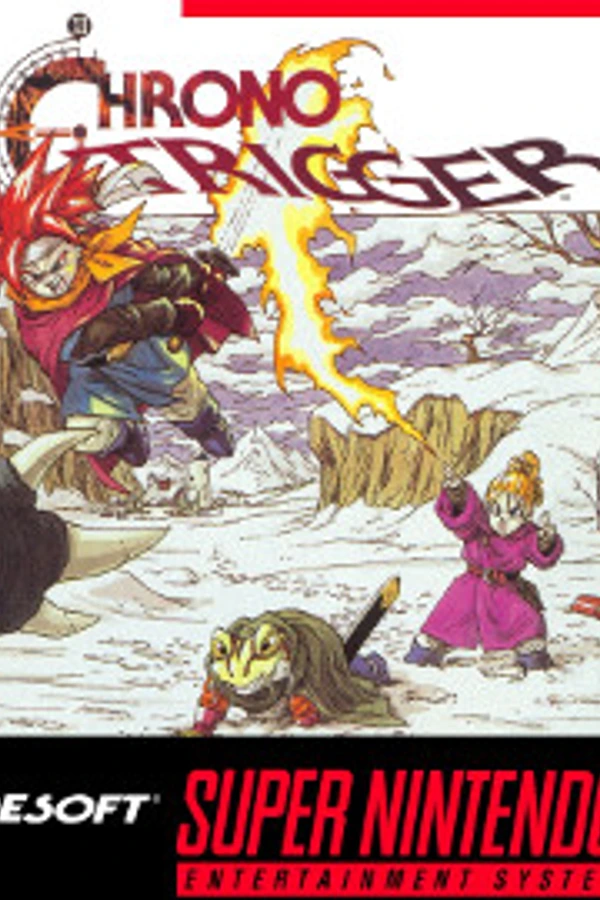
Chrono Trigger (PC)
Chrono Trigger
OrigenSuper Nintendo
TecnologíaPort Nativo C/C++ (Reimplementación de Motor)
Disponible paraWindows
Ver proyecto oficialSobre el proyecto
Chrono Trigger es un videojuego de rol desarrollado y publicado por Square para la videoconsola Super Nintendo Entertainment System (SNES). Es el primero de los títulos que componen la saga Chrono. Fue lanzado por primera vez el 11 de marzo de 1995 en Japón y el 22 de agosto de 1995 en Estados Unidos. La historia del juego sigue a un grupo de jóvenes aventureros que fueron transportados a través del tiempo accidentalmente y descubrieron que el mundo iba a ser destruido en un futuro lejano.
Información oficial del proyecto
ct-recomp

Static recompiler for Chrono Trigger (SNES, US 1.0) 65816 code to C, plus a C runtime.
The recompiler and runtime are game-agnostic; everything specific to Chrono
Trigger lives in game/ct/.
Planned features after boot (MSU-1, achievements, save states, widescreen and more) are listed in ROADMAP.md.
Progress
<!-- progress:start -->69.4% recompiled: 1414 of 2036 known functions are compiled to C.
- Native at runtime: 97.6% of the instructions in a 1500-frame boot run as compiled C (the rest run in the interpreter).
- Milestones: 3 of 7 closed.
Updated by tools/progress.py with every push; details in game/ct/PROGRESS.md.
Layout
recomp/— the translator (Python): decoder with static M/X tracking, C emitter.runtime/— CPU, bus, cycle model, interpreter, frame scheduler; the vendored PPU/DMA/APU core lives inthird_party/snes/.frontend/— SDL2 frontend;tools/ct_boot.c— headless boot probe.test/— engine tests; they run on a synthetic ROM generated at build time.game/ct/— everything specific to Chrono Trigger:game.toml(ROM identity),funcs.toml/unresolved.toml(symbols), extern hooks, game tools, the ROM-dependent tests, andPROGRESS.md.
Build
Requirements: CMake 3.20+, a C11 compiler, Python 3.11+, SDL2 (optional, for
ct_sdl).
Engine only (no ROM needed; what CI runs):
cmake -S . -B build && cmake --build build -j && ctest --test-dir build -LE rom
With the game. Supply your own headerless US 1.0 ROM; it is checked against
game/ct/game.toml at configure time:
export CT_ROM=/path/to/chrono_trigger.sfc   # headerless, 4 MB
cmake -S . -B build && cmake --build build -j && ctest --test-dir build
This builds game/ct (generated C goes to build/game/ct/out/) and two
programs at the top of build/. For investigations, a Debug tree builds in
about 30 seconds (runtime at -Og, generated code at -O1, see CT_GEN_OPT):
cmake -S . -B build-dbg -DCMAKE_BUILD_TYPE=Debug. The build uses ccache when
it is installed.
build/ct_sdl                           # play: window, audio, keyboard/controller
mkdir -p shots && build/ct_boot --frames 1500 --dump shots   # headless: PNGs of what changed
ct_sdl keys: arrows, Z=B, X=A, A=Y, S=X, Q=L, W=R, Enter=Start, Right Shift=Select;
a game controller works too. Ctrl+Q or closing the window quits.
ct_sdl --record FILE saves your pad input as a script; ct_boot --script FILE --frames N replays it exactly (N is on its last line), and ct_sdl --script FILE plays it back in the window. A reset F line in a script presses the reset button as
frame F begins. ct_boot also takes --input F1-F2:BUTTONS
to script the pad, --wav FILE for audio, --hash-log FILE for per-frame
state hashes (tools/lockstep.py compares native and interpreted runs with
them), and --needed-hw FILE to report where emulation stops.
Reference comparison: tools/ref_compare.py --probe build/ct_boot --mesen PATH --rom $CT_ROM --frames N [--script FILE] runs the same input in
Mesen 2 (used as a tool, headless under
xvfb-run, with a private settings folder) and reports the first frame where
WRAM or the picture differs, with the differing WRAM ranges.
tools/trace_diff.py --probe build/ct_boot --mesen PATH --rom $CT_ROM --from F --to G [--script FILE] runs both untraced up to frame F and compares every
instruction of frames F-G (address, clock, X, Y), reporting the first
difference; about a minute for a window 12,000 frames in.
tools/tas_convert.py MOVIE OUT turns a TASVideos BizHawk .bk2 or lsnes
.lsmv movie (from power-on) into an input script for both, resets included. Replays of a new
game into Leene Square and into the first battle are in game/ct/test/replay/.
The ROM is never committed, and CI never sees it.
Symbol names partly derived from dscotton/ct_disassembly (public domain) and ChronoRET.
License
This code is MIT-licensed (see LICENSE). The Chrono Trigger ROM and its
assets are not included and remain the property of their copyright
holders — you must supply your own legally obtained ROM via $CT_ROM.
Symbol names are credited to dscotton/ct_disassembly (public domain) and
ChronoRET. See THIRD_PARTY.md for vendored/adapted third-party code.