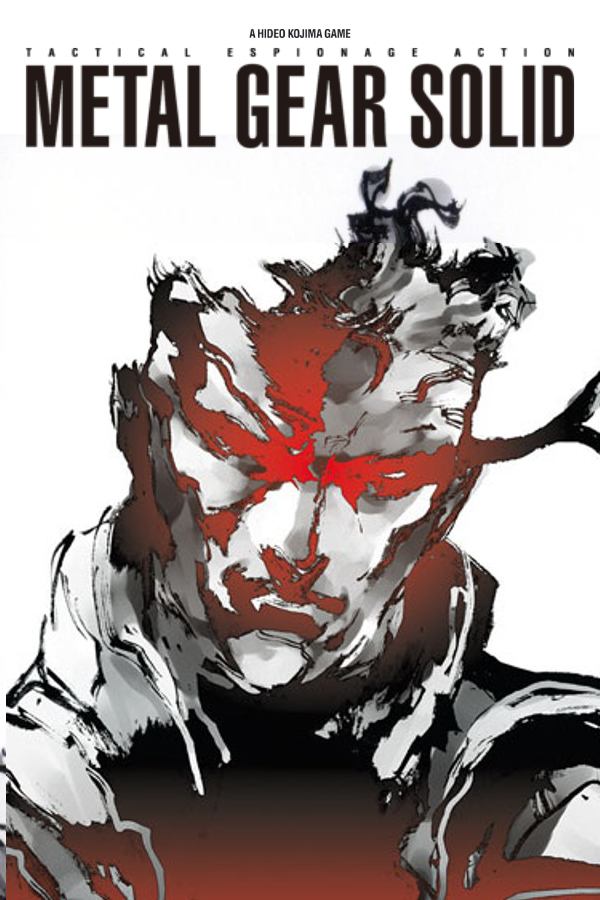
Midnight Ghost Stone (Metal Gear Solid, PS1)
Metal Gear Solid
OrigenPlayStation
TecnologíaRecompilación Estática (C/C++ nativo)
Disponible paraWindows
Ver proyecto oficialSobre el proyecto
Metal Gear Solid es un videojuego de acción-aventura y sigilo de 1998 desarrollado por Konami Computer Entertainment Japan, publicado por Konami para la consola PlayStation y dirigido por Hideo Kojima. Fue lanzado el 3 de septiembre de 1998 en Japón, el 21 de octubre de 1998 en Norteamérica y el 26 de febrero de 1999 en Europa. El juego fue desarrollado y pensado únicamente para la consola Playstation, según la entrevista que dio Kojima a la Revista Famitsu en la celebración de los 20 años de Playstatión.
3 versiones de Metal Gear Solid
Estás viendo: Midnight Ghost Stone (Metal Gear Solid, PS1)
Información oficial del proyecto
Midnight Ghost Stone
A native PC recompilation of Metal Gear Solid for PlayStation, with a modern Vulkan presentation built around the original game assets. Repository: mgsone-recomp.
AI-MADE PROJECT. MGSOne-specific development is AI-generated, under human direction. The donor projects, third-party libraries and original game are the work of their respective creators; this label applies to the project-specific work built on those foundations.
Credit Where It Belongs
Before the shaders, bubbles and increasingly elaborate surveillance cameras: this project builds on a tremendous amount of work by other people.
- FoxdieTeam / mgs_reversing provides the decompilation research behind our understanding of the game, its actors, scripts and graphics. The imported texture module is attributed separately in the source and notices.
- PS1Recomp is the engine foundation, inherited through the local Crash Bandicoot 3 recompilation. SwanStation is our instrumented donor and reference for checking original behavior.
- Rex, MGS-KMD-Noesis and mint helped make the original formats understandable. PSXRecomp, RecompOne and Alexbeav's MGS recomp are additional research references, with reuse recorded in the documentation.
- Godot / Intel ASSAO, N8AO, SDL, Dear ImGui and the controller-mapping community supply important rendering and interface foundations.
And, of course, Konami and the original Metal Gear Solid team, who made the game worth doing all this for. Credits, provenance and license scope.
alpha.1 — UNTESTED Experimental Linux and Windows builds, published for early testing. These release packages are not gameplay- or platform-qualified. A continuous completed campaign, every boss fight and physical Steam Deck compatibility have not been certified. Keep backups and ordinary in-game Codec saves.
About
Midnight Ghost Stone follows the same general idea as the modern recomp projects: let the game run natively, then give its presentation room to breathe. I wanted to play Metal Gear Solid again. Naturally, this turned into a project about water refraction, Codec screens and whether a cardboard box needs ambient occlusion.
The visual goal is a modern rendering of the original image, with its atmosphere and visual identity intact. Vulkan can use original meshes, floating-point animation, per-pixel lighting and modern effects without recreating the PlayStation's drawing method. Underneath, gameplay keeps its original timing and behavior. Changes to the presentation are documented so that a nicer-looking effect cannot quietly become an unexplained regression.
Most game logic currently uses static MIPS-to-native recompilation. Selected decompiled C routines replace it where they have been adapted and checked against the USA executable. This is an ongoing migration, not a claim that the entire game has already been rewritten in clean C.
The project-specific work is AI-made, under human direction. That describes the project-specific work, not the mature donor projects and libraries above. As with TriAevum, there is a fair amount of concentrated AI slop here. The regression tests are an attempt to make it accountable.
Install and build
The current game target is USA v1.0, both discs: SLUS-00594 and SLUS-00776. You need your own original BIN images or single-track MODE2/2352 CUE/BIN pairs. Other regions, Integral and modified images are not currently supported by the native game build. No BIOS download is required. Discs, extracted assets and generated game translations are prepared locally and are excluded from this repository.
Download alpha.1 — UNTESTED
Choose your package from the alpha.1 prerelease:
| Platform | Download | Start |
|---|---|---|
| Linux / SteamOS x86_64 | AppImage | Make executable, then open it |
| Linux / SteamOS x86_64 | Flatpak | Install the bundle, then open MGS Recomp |
| Windows x64 | ZIP | Extract the entire ZIP, then run MGSRecomp.exe |
In the launcher, import both original USA v1.0 discs and choose PLAY. No compiler or separate Python installation is needed for these packages. The release includes SHA256SUMS and matching source archives. GitHub's automatically generated source archives are not playable packages.
On SteamOS, install in Desktop Mode, add the application as a non-Steam game
and use Steam Input's Gamepad layout with launch option --big-picture.
These are experimental packages, not a Deck Verified claim. See the
installation guide for requirements and data paths.
Linux development build
Requires Python 3.11+, CMake 3.20+, Ninja, a C++20 compiler, SDL 2.26+, Vulkan
development files, glslc, and a working Vulkan GPU driver. On Ubuntu 24.04,
the build packages are:
sudo apt-get install git cmake ninja-build g++ libsdl2-dev libvulkan-dev glslc python3
git clone https://github.com/coccofresco/mgsone-recomp.git
cd mgsone-recomp
bash scripts/build_alpha.sh '/path/to/disc1.cue' '/path/to/disc2.cue'
python3 scripts/mgs_alpha.py --user-dir "$PWD/data/alpha-build"
This verifies and imports both discs, generates the native game code, builds
the runtime and runs its tests. The last command opens the launcher using
that same imported profile. Compilation of the generated game code can take
time and substantial memory; BUILD_JOBS=2 reduces build parallelism.
The dependencies under engine/third_party are included; no local donor
checkout or recursive submodule clone is needed for this build.
Windows, SteamOS and portable packages
Windows x64 uses the same game and renderer sources. The current build path cross-compiles from Linux using pinned dependencies; see Windows build and validation. The existing Windows validation ran the real PE executables through Wine on a physical Vulkan GPU. Testing on native Windows hardware remains necessary.
Linux packaging targets AppImage and Flatpak, with a controller-navigable launcher for desktop use and Steam Big Picture. Steam Input uses the standard Gamepad layout. Physical Deck, controller transport and suspend/resume testing remain on the acceptance list. See installation and settings, SteamOS packaging and controller compatibility. The downloadable alpha.1 packages retain the UNTESTED qualification; earlier development checks do not certify these release artifacts.
Keep ordinary in-game Codec saves as well as quick states. Alpha savestate compatibility can change between builds. The launcher separates application files from user data and provides explicit save backups and diagnostic exports.
Graphics and controls
- Original KMD/ZMD meshes, PCX textures and animated poses feed the Vulkan presentation, with a resident asset cache prepared from both discs.
- True 4K output by default, selectable lower resolutions and fixed 16:9 framing that does not stretch with the window.
- Floating-point geometry and articulated poses, per-pixel lighting and modern color precision. Original low-resolution rendering remains a separate reference for development checks.
- Ambient occlusion adapted from Godot / Intel ASSAO, with a distance-dependent radius informed by N8AO.
- Modern water, depth fog, bubbles, particles, screen effects and temporal trails. Surveillance and Codec effects reconstruct a simulated CRT / RGB phosphor image, keeping subtitles readable outside the effect.
- Experimental 60 FPS presentation interpolation between original game
states. The game retains its original 30/20 Hz logic; this does not turn
gameplay into 60 Hz physics. Currently opt-in through the developer runtime
(
PS1_MGS_FRAME_INTERPOLATION=1withscripts/run_native.sh), not a launcher setting. Implementation and measured evidence. - Fast loading, automatic disc 1 → disc 2 change, persistent memory cards, quick-state slots, a host pause menu and controller-port switching.
- Keyboard and SDL controllers, Steam Input integration, device selection, deadzone settings and an input test screen.
The original textures are still the original textures. Rendering them at 4K does not invent detail they never contained. Effects and resolution also cost GPU time; choose settings that suit your hardware.
| Action | Default control |
|---|---|
| Move | Arrow keys / D-pad / left stick |
| Cross / Circle / Square / Triangle | Z / X / A / S |
| L1 / R1 / L2 / R2 | Q / W / E / R |
| Start / Select | Enter / Backspace |
| Host pause menu | Esc / right-stick click (R3) |
| Save / load quick state | F5 / F9 |
| Previous / next state slot | F6 / F7 |
| Toggle fullscreen | F11 |
Testing and contributing
The useful question is not just whether the intro looks nice, although I have spent an unreasonable amount of time on that. It is whether the game behaves correctly when a door opens, a cutscene finishes, a card is saved or the second disc takes over.
Checks cover independent scenarios on both discs, mandatory transitions, death and Continue, torture branches, PAL terminals, prepared REX/Liquid phase exits, both endings, credits and the final save. Native behavior is compared with the instrumented donor. Some tests deliberately prepare a particular state: they prove that transition, not the entire fight leading up to it. Actual Vulkan GPU checks are recorded separately from headless runtime tests.
Full fights, jeep combat and a continuous start-to-finish playthrough still need work. People willing to play, investigate and report reproducible problems are especially welcome. See the gameplay coverage and open cases, mandatory-path checks and original-asset GPU validation.
Please report issues with the commit/build, OS, GPU and driver, selected settings, disc, difficulty, location and exact steps to reproduce. Mention whether the session came from an in-game save or a quick state. Screenshots and inspected diagnostic exports help. Do not attach discs, extracted assets or full memory savestates to public issues. Contributions and forks are welcome; include a reproducible check for the behavior being changed.
Public CI builds the launcher, shaders and source-only tests without game data. That checks the published source; it is not a substitute for the private retail-input or physical-GPU validation. Developer details are in the runtime progress log and presentation contract.
Source and license
The engine uses GPL-3.0; see LICENSE. Third-party code retains its own notices and terms. The attributed FoxdieTeam texture adaptation is documented separately; the engine license does not assign a new license to that upstream work. See the full notices and engine provenance.
This is an independent, unofficial project, not affiliated with or endorsed by Konami. Metal Gear Solid and its assets belong to their respective owners.
At least the cardboard box has somewhere modern to hide.