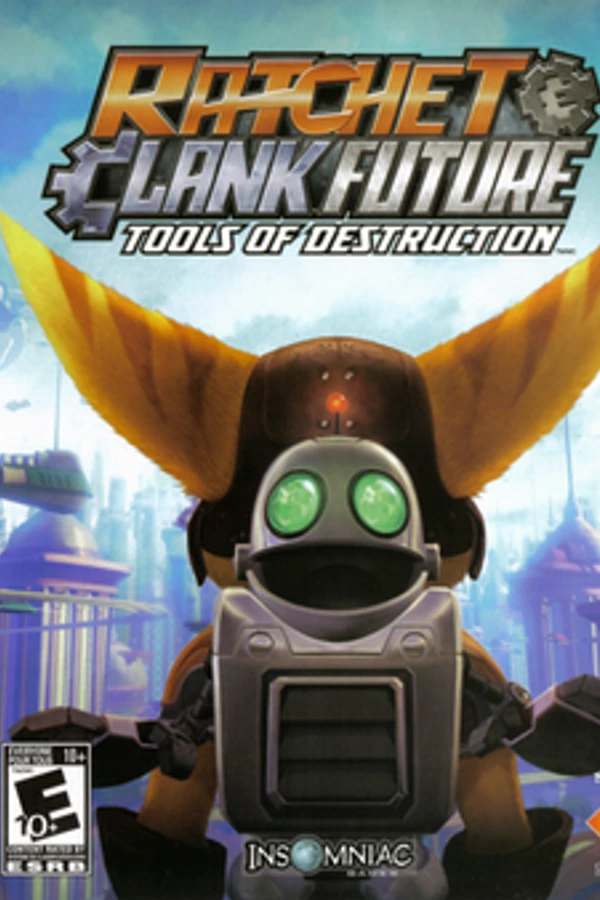
Ratchet & Clank: Tools of Destruction Recompiled
OrigenPlayStation 3
TecnologíaRecompilación Estática (C/C++ nativo)
Disponible paraWindows
Ver proyecto oficialInformación oficial del proyecto
Ratchet & Clank: Tools of Destruction for PC (Ratchet & Clank Future: Tools of Destruction): a native Windows port of the PlayStation 3 game, built by static recompilation. No emulator, Direct3D 12, up to 4K and 60 fps.







<a href="https://github.com/Re-TeRo17/ratchet-tod-recomp/releases"><img src="docs/images/nav_download.png" alt="Download" width="250"></a> <a href="#installing"><img src="docs/images/nav_install.png" alt="Install" width="250"></a> <a href="#settings"><img src="docs/images/nav_settings.png" alt="Settings" width="250"></a> <a href="#known-issues"><img src="docs/images/nav_known_issues.png" alt="Known issues" width="250"></a> <a href="#reporting-bugs"><img src="docs/images/nav_report_bug.png" alt="Report a bug" width="250"></a> <a href="#support-the-project"><img src="docs/images/nav_support.png" alt="Support" width="250"></a>
</div>A native PC port of Ratchet & Clank: Tools of Destruction (Ratchet & Clank Future: Tools of Destruction, PlayStation 3, European release BCES00052) for Windows, made by static recompilation of the game's code on the ps3recomp toolkit.
The game's PowerPC (PPU) and SPU code is translated to C/C++ ahead of time and built into a normal executable, with the PS3's system libraries replaced by native implementations and the RSX graphics by Direct3D 12. There is no emulation at run time.
Version 1.1 is out (4 November 2026): a save slot list, the voices that were missing in some levels, less stutter and a faster renderer. See the changelog. Version 1.0 was the first public release (2 November 2026; development started on 20 October 2026). The game is playable from the first planet onwards, but it is not finished: see Status and Known issues before you start.
Nothing of the game is in this download. You need your own copy of the game (the disc). The installer takes it from there.
Highlights
- Native, not emulated. The game's code is recompiled ahead of time into a Windows executable.
- Any resolution, and the 3D scene really is 4K. The internal resolution is a free multiple of the game's 1280x720: 1080p, 1440p, 4K and beyond, with MSAA or FXAA and 16x anisotropic filtering. The game renders its 3D scene at 960x704 and stretches it afterwards; in 1.0 that stretch is undone, so the scene is sharp at 4K instead of being enlarged by a third in width.
- Character ground shadows are back, with reworked shadow bias.
- New in 1.1: pick your save slot. Saving and loading show the game's own slot list, so you choose which save to load, overwrite or create.
- New in 1.1: the missing voices are back. Dialogue and ambient sound that some levels stream from separate files now play.
- A 60 fps target (the original runs at 30 fps in many places), helped by native fast paths for the game's animation and collision code. On a Ryzen 5 3600 + RTX 3070 at 4K with MSAA x8, Cobalia holds 60 fps, Pirate Base went from about 52 to 58, the Imperial Fight Fest arena from 49 to 54 and the opening of Metropolis from 24 to 31. The heaviest areas are still below 60: see Known issues.
- Optional ray-traced ambient occlusion on DXR 1.1 graphics cards.
- In-game settings page (F1, or hold SELECT on a controller): resolution, window mode, VSync, FPS limit, anti-aliasing, game language, button prompts, and a Controls tab to rebind every key and mouse button.
- DualSense adaptive triggers that follow the weapon in Ratchet's hands (click, heavy pull, rattle, flamethrower drag), with a kick at every shot; on by default, adjustable in F1.
- In-game Cheats tab (F1): god mode, infinite ammo, bolts, all weapons, the game's own cheats; off at every start.
- One-click installer that builds the game folder from your own decrypted disc dump and checks that it is the right disc. Nothing of the game is shipped.
- Game language of your choice (text, voices and subtitles that the disc offers), and button prompts that follow your controller: PlayStation 3/4/5, Xbox, Switch or keyboard.
- Shader cache that remembers what it has compiled, so stutter goes away after the first pass through a level. About 23% fewer shader pipelines have to be compiled than before, so there is less stutter on the first visit.
- Discord Rich Presence: the planet you are on and the time played, while Discord is running.
- Experimental, off by default: ultrawide (21:9 / 32:9, in
tod.ini) and mouse camera (F1 > Controls); see Experimental options. - Free and open source (MIT). The repository holds the port's own code and the scripts to build it from your own disc.
Screenshots
<table> <tr> <td width="50%"><img src="docs/screenshots/01_metropolis_kerwan.jpg" alt="Metropolis (Kerwan)"><br><sub><b>Metropolis (Kerwan)</b> - the opening city, under attack</sub></td> <td width="50%"><img src="docs/screenshots/02_meridian_city.jpg" alt="Meridian City"><br><sub><b>Meridian City</b> - meteors over the capital</sub></td> </tr> <tr> <td width="50%"><img src="docs/screenshots/03_arena_imperial_fight_fest.jpg" alt="Imperial Fight Fest"><br><sub><b>Imperial Fight Fest</b> - close combat in the arena</sub></td> <td width="50%"><img src="docs/screenshots/04_rykan_v.jpg" alt="Rykan V"><br><sub><b>Rykan V</b> - the planet's fiery depths</sub></td> </tr> <tr> <td width="50%"><img src="docs/screenshots/05_space_combat.jpg" alt="Space combat"><br><sub><b>Space combat</b> - a ringed gas giant and nebula</sub></td> <td width="50%"><img src="docs/screenshots/06_kerchu_city.jpg" alt="Kerchu City"><br><sub><b>Kerchu City</b> - the pirate-raided city under fire</sub></td> </tr> </table><sub>Captured at 3840x2160 internal 4K (RSX_SCALE=3), MSAA x8, 16x anisotropic filtering, then downscaled and saved as JPEG for this page.</sub>
Videos
<table> <tr> <td width="50%"><a href="https://www.youtube.com/watch?v=9Zxq7EdYPfs"><img src="https://img.youtube.com/vi/9Zxq7EdYPfs/hqdefault.jpg" alt="Ratchet & Clank Tools of Destruction on PC with ray tracing in 4K (video)"></a><br><sub><b>4K with ray tracing</b> - RTX 5080 + Ryzen 7 9800X3D, by ANGEL4EVA</sub></td> <td width="50%"><a href="https://www.youtube.com/watch?v=scb1zhBkfrg"><img src="https://img.youtube.com/vi/scb1zhBkfrg/hqdefault.jpg" alt="Ratchet & Clank Future: Tools of Destruction PC Recomp on an RTX 3070 (video)"></a><br><sub><b>On an RTX 3070</b> - by danxo</sub></td> </tr> </table><sub>Both videos were recorded with version 1.0. Made a video with the port? Open an issue with the link and it can be added here.</sub>
Features
Graphics
- Direct3D 12 renderer (feature level 12_0) driven by the console's RSX command stream.
- Internal resolution from 0.5x to 8x the game's 1280x720 (
RSX_SCALE): 720p, 1080p, 1440p, 4K and beyond. It is independent of the window size. - Anti-aliasing: FXAA or MSAA x2 / x4 / x8. Anisotropic filtering up to 16x.
- Display modes: windowed (any size), borderless window or exclusive fullscreen; VSync on or off.
- Optional ray-traced ambient occlusion (DXR 1.1: RTX 20 / RX 6000 series or newer), with three quality levels.
- Optional screen-space reflections (off by default, expensive at 4K).
- True 4K for the 3D scene: the game's 960x704 scene render is no longer stretched 4/3 in width
(
RSX_HSTRETCH_FIX, on by default), so Ratchet and the world are as sharp as the rest of the image. - Character ground shadows restored and the shadow bias reworked (polygon offset in the vertex epilogue and a faithful border for lookups outside the shadow map).
- Rendering fixes made along the way for the bloom chain (the bloom halos are fixed), shadows and fog (see the changelog and Known issues for what is still open).
- A frame counter (FPS, or FPS with frame time and 1% low) that you can switch on.
Performance
-
A 60 fps target (
TOD_FPS), with an optional cap above it. -
Native fast paths for two of the game's heaviest SPU jobs (skeletal animation and collision queries), so they run as plain native code instead of the lifted SPU version. In 1.0 the animation evaluator and the collision code are faster, and 17 graphics job modules use a round-toward-zero fast float path.
-
Reference numbers (Ryzen 5 3600 + RTX 3070, 4K, MSAA x8), before and after the 1.0 work:
Area Before 1.0 Cobalia 60 60 Pirate Base ~52 ~58 Imperial Fight Fest (arena) ~49 ~54 Metropolis (opening) ~24 ~31 The heaviest areas are limited by the CPU, so lowering the resolution helps them little; see Known issues.
-
In 1.0 the graphics command list is recorded on its own thread, and the vertex cache is large enough for the busiest scenes (in Metropolis it used to be emptied every few frames, a hitch of about 35 ms each time).
-
A pipeline (PSO) and shader cache in
cache\: pipelines seen before are pre-built at start, to avoid compile stutter. About 23% fewer shader pipelines need compiling in 1.0, so the first visit to an area stutters less. -
The hitch when the game autosaves is shorter (about 620 ms before, about 400 ms now).
-
New in 1.1: less stutter in busy scenes (the vertex cache no longer rebuilds in bursts), a faster graphics thread (about 2.5 ms per frame in Metropolis), faster collision (about 1 ms per frame) and a profile-guided build of the graphics code. Each one can be turned off in
tod.ini. -
The game's SPU code runs on your CPU cores, so a fast 6+ core CPU matters most.
Audio and video
- Audio with a safety margin against crackle; an experimental low-latency output is optional. The music streaming threads now get enough priority, so the music no longer starves.
- The output follows Windows' default audio device when it changes (optional, on by default).
- Dialogue and ambient sound that some levels stream from separate files play since 1.1 (in 1.0
much of Cobalia's dialogue, for example, was silent).
TOD_LEVEL_STREAMS = 0turns it off. - Cutscenes and movies play through the game's own video decoder.
- Skip a movie: hold Start on the pad (or Enter, Esc or Space on the keyboard) for
2 seconds while a pre-rendered movie plays. This works for the video cutscenes (the ones the PS3
streams from disc), not for the scenes rendered by the game engine.
TOD_FMV_SKIP = 0turns it off.
Input
- Controllers through SDL2 and XInput: Xbox, DualShock 4, DualSense, Switch Pro and others.
- The button icons in the game follow the pad you use (PlayStation 3/4/5, Xbox, Switch) or the keyboard.
- Keyboard and mouse: every key is rebindable in F1 > Controls (written to
tod.iniasKEY_*), including keys for the camera (the right stick), unbound by default; the experimental mouse camera below is the other way to steer it. See Controls. - Xbox impulse triggers (1.1): on an Xbox One / Series controller the motor in the right trigger
kicks at every shot. On by default; F1 > System > Xbox impulse triggers (
TOD_XB_TRIGGERS). - DualSense adaptive triggers: the right trigger follows the equipped weapon (a click for single
shots, a hard pull for heavy weapons, a rattle for automatic fire, a steady drag for the
flamethrower and the beams) with a kick at every shot, and goes slack in menus, in pause, in
cutscenes and when the weapon is out of ammo. On a DualSense the right trigger (R2) fires and R1
takes R2's role, so you fire with the trigger that has the motor (
TOD_DS_FIRE_R2 = 0restores the PS3 layout).TOD_DS_TRIGGERS,TOD_DS_TRIGGER_STRENGTHandTOD_DS_FIRE_R2are also in F1 > System. The trigger effects are from RACiT (MIT).
Experimental options (off by default)
Both are switched on in tod.ini (next to tod.exe): remove the # at the start of the line and
set the value, then restart the game (the mouse camera also from F1 > Controls, at once). They are new in 1.0 and not as well tested as the rest.
- Ultrawide:
TOD_ASPECT = 21:9(or32:9, orautoto take the shape of the window). The 3D view widens (same vertical field of view, you see more at the sides). Set the window to the same shape, e.g.RSX_WINDOW = 3440x1440, and useRSX_SCALE2-3. Limits: the HUD and the 2D menus are stretched with the image, and cutscenes stay 16:9 with bars. - Mouse camera:
TOD_MOUSE = 1, or F1 > Controls > Mouse camera. The mouse drives the right stick (camera and aim); left button = R1 (fire), right button = L1 (strafe / lock-on), middle button = Triangle (quick select), wheel = D-pad left/right,Esc= Start.TOD_MOUSE_SENS(default 1.0),TOD_MOUSE_INVERT_YandTOD_MOUSE_WHEEL = offfine-tune it (the mouse buttons can be reassigned in F1 > Controls). Because it feeds the right stick, the top turning speed is the game's own Camera Speed option: raise it in the game's Options. F1 releases the cursor.
Saves, language and installation
- Save slot list (1.1): saving and loading show the game's slot list, so you choose the slot.
TOD_SAVE_PICKER = 0turns the list off: then loading picks your newest save and a manual save makes a new slot. - Saves are kept next to the game, in
gamedata\dev_hdd0\home\00000001\savedata, and are written by the game's own save code. F1 > System > Saves folder opens the folder;PS3_SAVEDATA_ROOTintod.inimoves it. OneBCES00052_SAVE_<n>folder per save, the same layout RPCS3 uses, so copying saves between the two should work (not tested yet). - The game language (text, voices, subtitles) can be changed from the settings page.
Install.bat/tod_setup.exeinstalls from a decrypted.isoor a disc folder;Play.batstarts the game and keeps the last two logs (log\tod.log,log\tod.previous.log).- Shows Discord Rich Presence (current level and time played, with a GitHub button) while the Discord app is running; hide it in Discord's Settings > Activity Privacy.
- Mods folder (on by default,
TOD_MODS = 0turns it off): a file inmods\next totod.exeis read instead of the game file at the same path undergame\disc\, e.g.mods\PS3_GAME\USRDIR\built\movies\l01_s01_ntro_fmv\l01_s01_ntro_fmv.bikreplaces the intro movie (thePS3_GAME\level is optional). Reads only: saves and the game's own files are never touched, and deleting the mod file restores the original. Mods are your own files; the project ships none.
Requirements
| OS | Windows 10 or 11, 64-bit |
| CPU | AVX2 and FMA (Intel Haswell / 4th gen Core or newer, any AMD Ryzen). Older CPUs crash at start with an "illegal instruction" error. A fast 6+ core CPU matters most: the game's SPU code runs on your CPU cores. |
| GPU | Direct3D 12 (feature level 12_0). Optional ray-traced ambient occlusion needs DXR 1.1 (RTX 20 / RX 6000 or newer). 8 GB of video memory is comfortable at 1080p-1440p. |
| RAM | 16 GB recommended |
| Disk | About 24 GB free for the installed game files, plus a little for shader caches and saves |
| Software | Microsoft Visual C++ Redistributable 2015-2022 (x64) (most PCs already have it) |
| A controller | Recommended. Any XInput or SDL2-supported pad works (Xbox, DualShock 4, DualSense, Switch Pro...). Keyboard and mouse work too: every key is rebindable in F1 > Controls, camera keys included. |
| The game | Your own copy of the European disc, BCES00052, version 1.00, see below |
Not tested: Intel 12th gen and newer hybrid (P/E core) CPUs, AMD GPUs and Intel GPUs. The port was developed on a Ryzen 5 3600 with an RTX 3070. Reports from other hardware are very welcome.
Which game files work
- Ratchet & Clank: Tools of Destruction, European release, Title ID
BCES00052, disc version01.00. The disc is the multi-language one (English, Japanese, French, German, Spanish, Italian, Dutch, Portuguese, Swedish, Norwegian, Danish, Finnish, Chinese, Korean). - Other regions (the US, Japanese and Asian releases) and the digital (PSN) versions are
not supported: the port is built from the European executable. The installer checks the Title
ID and the SHA-256 of
EBOOT.BINand refuses anything else. - No game update is needed or used. Only the disc.
The installer needs the disc decrypted, either as
- a decrypted
.iso, or - the folder that contains
PS3_GAME(a disc dump copied to a folder).
How to get one from your own disc and a Blu-ray drive that can read PS3 discs:
PS3 Disc Dumper produces a decrypted dump. A raw
redump-style .iso is still disc-encrypted: decrypt it first with the disc's key (for example with
ps3dec and the .dkey file) and then use the result. If you pick
an encrypted image, the installer tells you so and refuses it.
Installing
- Download
tod-recomp-1.1-win64.zipfrom the Releases page and unzip it anywhere you like exceptProgram Files(the game writes its saves and shader cache next totod.exe). About 24 GB must be free on that drive. - Run
Install.bat. (You can also drag the.isoor the disc folder ontoInstall.bat.)- Choose your decrypted
.iso(button ".iso...") or the disc folder ("Folder..."). - The installer checks that it is the right disc and says so in green.
- Choose the game language (default English; you can change it later in the game with F1).
- Press Install. It copies the disc into the
gamefolder and makeself\EBOOT.ELFfrom the disc'sEBOOT.BIN. It takes a few minutes. Nothing leaves your PC.
- Choose your decrypted
- Press Play (or run
Play.batany time later).
Windows SmartScreen may warn the first time because the program is not signed: "More info", then "Run anyway". Some antivirus programs flag unsigned freshly built executables; the source code is public if you want to check or build it yourself.
The installer can be run again at any time (it replaces only the game files it installed). With the game already installed, it can also just change the language.
Updating from an older version:
From 1.1 on, run Update.bat in the game folder: it checks GitHub, asks before doing anything,
downloads the new version and replaces only the port's files. To update by hand instead (and to go
from 1.0 to 1.1, since 1.0 has no Update.bat):
- Close the game.
- Open the 1.1 zip. Inside there is a folder
tod-recomp-1.1: copy everything inside it into your game folder (the one withtod.exe). When Windows asks, choose Replace the files in the destination. - Start the game with
Play.batas usual.
You do not need to run Install.bat again: the installed game (game\, elf\) stays as it is.
Your settings (tod.ini), your saves (gamedata\) and your shader cache (cache\) are kept,
because the download holds tod.default.ini instead of tod.ini and has no saves or cache in it.
The game tells you on the title screen and
in F1 > System > Updates when a newer version is out (TOD_UPDATE_CHECK = 0 turns the check off;
nothing is downloaded by itself). To keep the installed game (game\disc) on another drive: close the game, move the
game\disc folder there and write its new path in tod.ini, for example
PS3_VFS_ROOT = D:\Games\ToD\disc.
Command-line equivalent: tod_setup.exe --install --base <folder> <iso or disc folder> (and
tod_setup.exe --check <file> to see what the installer makes of a file).
What is installed where
tod.exe, SDL2.dll, z.dll   the port (released with this download)
tod.default.ini            the default settings (from the download)
tod.ini                    your settings, made from tod.default.ini at the first start (also written by F1)
game\disc\                 a copy of your disc (PS3_GAME, PS3_DISC.SFB)   <- from your disc
elf\EBOOT.ELF              the decrypted game executable                  <- from your disc
cache\                     shader cache, built by the game while you play
gamedata\                  your saves
mods\                      optional, yours: files the game reads instead of its own (see Features)
log\tod.log                the log of the last run (Play.bat), tod.previous.log the one before
The game executable is decrypted on your PC from your own disc. This download contains no part of the game: no executable, no data, no shaders, no saves.
Settings
Edit tod.ini (every line is explained inside), or press F1 in the game (on a controller: hold
SELECT for two seconds) to open the settings page: internal resolution, window mode, VSync, FPS
limit, anti-aliasing, anisotropic filtering, FPS counter, ray-traced ambient occlusion, the game
language, and the button prompts (PlayStation 3/4/5, Xbox, Switch, keyboard). "Apply and save"
writes tod.ini; some rows apply at once, others ("requires restart") at the next start.
Defaults of this release: 1080p internal resolution (RSX_SCALE = 1.5), MSAA x4, anisotropic x16,
borderless window, VSync on, 60 fps target, English.
| Key | Meaning |
|---|---|
RSX_SCALE | Internal resolution as a multiple of 1280x720: 1 = 720p, 1.5 = 1080p, 2 = 1440p, 3 = 4K (range 0.5 to 8). This is the biggest performance lever. |
RSX_AA | off, fxaa, msaa2, msaa4, msaa8. MSAA x8 at 4K is heavy and not recommended below an RTX 3080. |
RSX_ANISO | Anisotropic filtering, 1 to 16 (default 16). |
RSX_DISPLAY, RSX_WINDOW | windowed (with a size such as 1920x1080), borderless, fullscreen. |
RSX_VSYNC | 1 = sync to the monitor (default), 0 = off. |
TOD_FPS | A cap (30, 60, 120...) or lock60. Above 60 VSync is switched off by itself and the physics uses a smaller time step. 60 is what the port is tuned for. |
TOD_FPS_COUNTER | 0 = off, 1 = FPS, 2 = detailed (FPS, frame time, 1% low of the last 5 s). |
RT_AO, RT_AO_QUALITY | Optional ray-traced ambient occlusion (DXR 1.1 GPU), off by default; quality 0 (low), 1 (medium, default) or 2 (high). |
RSX_SSR | Optional screen-space reflections, off by default (costs a lot at 4K). |
TOD_PROMPTS | Button icons: auto (follows the last used device), ps3, ps4, ps5, xbox, switch, keyboard. |
PS3_LANG | Game language, see below. |
AUDIO_LATENCY_MS, AUDIO_LOWLAT | Audio safety margin (default 32 ms) and the experimental low-latency output (default off, the stable choice). |
TOD_SAVE_PICKER | 1.1: the save slot list when saving and loading (on by default; 0 = off). |
TOD_LEVEL_STREAMS | 1.1: the dialogue and ambient sound some levels stream from separate files (on by default; 0 = off). |
RSX_VCKEY_NODEF, RSX_TEXMASK_MEMO, RSX_FPSCAN_MEMO, TOD_COLL_HAND | 1.1 speed-ups, all on by default. If something looks wrong on your PC, set one to 0 at a time and tell me which one helped. |
TOD_UPDATE_CHECK, TOD_VERSION_TAG | 1.1: check for a newer version at start, and the version shown on the title screen (both on; 0 = off). |
PS3_VFS_ROOT | Where the installed game is, if you moved the game\disc folder to another drive (for example D:\Games\ToD\disc). Empty = game\disc next to tod.exe. |
Language
The language is what the console would report: it selects the text, the voices and the
subtitles the disc offers for it. The installer asks for it; you can change it in F1 > System
(applies at the next start) or by editing PS3_LANG in tod.ini. Values: english, english_gb,
french, german, spanish, italian, dutch, portuguese, swedish, norwegian, danish,
finnish, korean, chinese_t, japanese. (Not every language has its own spoken dub; the game
falls back to what the disc contains.)
Frame rate and shader stutter
- The game was made for 30 fps in many places.
TOD_FPS = 60runs the game at 60 fps; above 60 the physics step is reduced and some effects may misbehave. Please report problems you see at 60 first. - Shaders are compiled the first time you see an effect and kept in
cache\. The first time through a level you will see short stutters; later runs are much smoother. (A cache is not shipped, because it would contain the game's own shaders.) Do not deletecache\unless asked to.
Controls
A controller is recommended; it is read through SDL2 (and XInput), so most pads work. The game's own control scheme is used; on a DualSense the right trigger fires (see Input). The default keyboard layout is below; every key can be changed in F1 > Controls (Enter or click a row, then press the new key), and keys for the camera (the right stick) can be added there:
| PS3 | Keyboard |
|---|---|
| D-pad / left stick | Arrow keys |
| Cross / Circle / Square / Triangle | Z / X / A / S |
| L1 / R1 | Q / W |
| L2 / R2 | 1 / 2 |
| Start / Select | Enter / Tab |
| Settings page | F1 (controller: hold Select for 2 s) |
| Quit | the window's close button, Alt+F4 or Shift+Esc (Esc alone does not quit) |
Status
| Area | State |
|---|---|
| Boot, menus, saving and loading | Works |
| Playing through the planets | Works. Every level loads; the early game has been played a lot, the later planets less |
| Frame rate | 60 fps in most places at 1080p. At 4K with MSAA x8 on an RTX 3070 / Ryzen 5 3600: Cobalia 60, Pirate Base ~58, the arena ~54, the opening of Metropolis ~31; Clank sections run at roughly 40-47 fps |
| Graphics | Direct3D 12 renderer, any internal resolution, MSAA/FXAA, anisotropic filtering, optional ray-traced ambient occlusion. A Vulkan renderer exists but is experimental (RSX_BACKEND = vulkan) |
| Audio and music | Works. Low-latency output is off by default for stability |
| Cutscenes / movies | Play (the game's own video decoder). Some stutter on first view while shaders build |
| Controllers | Works (Xbox, PlayStation, Switch pads); the button icons follow the pad. DualSense adaptive triggers per weapon (not yet tested on many pads) |
| Keyboard and mouse | Works; every key rebindable in F1 > Controls. The mouse camera is experimental and off by default |
| Save data | Works. Saves are in gamedata\dev_hdd0\home\00000001\savedata (F1 > System > Saves folder opens it; PS3_SAVEDATA_ROOT in tod.ini moves it), one BCES00052_SAVE_<n> folder per save in the layout RPCS3 uses. Copying saves to and from RPCS3 should work but is not tested yet. Not compatible with a real console (saves are not encrypted) |
| Online / PSN features | Not available (the game has none that matter) |
| Other regions / PSN versions | Not supported |
Known issues
Version 1.1 is playable from the first planet onwards, but a few rough edges remain. Everything below is on the list for the next updates. If you run into something that is not here, please report it.
- The heaviest scenes do not reach 60 fps yet. On the reference PC (Ryzen 5 3600 + RTX 3070, 4K with MSAA x8) Cobalia holds 60 fps, Pirate Base about 58 and the arena about 54. The opening of Metropolis (about 31 fps, up from 24 before 1.0) and parts of the Apogee Space Station (about 40) are limited by the CPU, so a lower resolution helps them little. Raising them is the main goal of the next updates.
- Shaders are built the first time an effect appears, so a new area can stutter briefly on the
first visit. They are kept in
cache\, and later visits are smooth. (A cache cannot be shipped: it would contain the game's own shaders.) - Short pauses on autosave (about 0.4 s, down from 0.6 s) and while a level or a cutscene loads.
- Audio: an occasional short crackle, mostly while the frame rate dips or an area loads. Raising
AUDIO_LATENCY_MSintod.ini(for example to 48) may help; a fix is planned for the next update. - Water: a few surfaces can be invisible or incomplete (for example the large round pool on Fastoon), and underwater can show as a flat colour.
- Shadows: the character ground shadows are back in 1.0, but an occasional artefact can still appear in some scenes. (Small plants and crates casting no shadow is how the PS3 original looks too.)
- Apogee holograms: the platforms and lasers that vanished against the sky are fixed in 1.0. If you still find one, please tell me where.
- Very long sessions: a rare freeze has been reported after many hours of play. Saving now and then is a good habit.
- Experimental options, off by default: ultrawide (
TOD_ASPECT: the 3D view widens, while the HUD and menus are stretched and cutscenes stay 16:9) and the mouse camera (TOD_MOUSE: it drives the right stick, so its top speed is the game's Camera Speed option). - Freezes on some Intel 12th-14th gen CPUs: one player reports the game freezing in the same spots on an i9-13900 (#10). I'm looking into it; the issue has things to try.
- Hardware not tested yet: AMD and Intel GPUs. Reports are very welcome.
The current list of reported problems is on GitHub Issues. Please read it before filing a new report.
Roadmap
What comes next, roughly in this order:
- A rock-solid 60 fps in heavy scenes, including the Clank sections.
- Fixes for the visual problems listed under Known issues.
- An improved in-game settings menu.
- More polish, and fixes for what you report.
Reporting bugs
Please use GitHub Issues and the bug report form. The more of this you include, the faster it can be fixed:
- What happened, what you expected, and where (planet / level name, what you were doing).
- A screenshot or short clip if it is visual (Windows' Win+Alt+PrtScn or Xbox Game Bar, or
Win+Shift+S). - Your setup: Windows version, CPU, GPU and driver version, RAM, the release version (1.0), and
which disc dump you used (decrypted
.isoor folder). - Your settings: attach
tod.ini(resolution scale, MSAA, FPS limit, language...). - The log:
log\tod.logfrom right after the problem (before you start the game again: the previous run is kept aslog\tod.previous.log). If the game crashed or froze, the last lines are the most useful part.
Do not attach game files, disc images or saves from other people. A gamedata\...\savedata
folder is fine if it is your own and the bug depends on it.
Building from source
This repository contains the port's own code (runtime glue, installer, settings page, tools) and the
build scripts. It does not contain any code or data generated from the game: the game's PowerPC
(PPU) and SPU code is translated from your own EBOOT.ELF on your machine, into the git-ignored
folders recompiled\ and spu\. You need your own copy of the disc (European release, BCES00052,
v1.00) to build a working tod.exe.
The released tod.exe is built the same way (plus the optional step 7 below).
1. Tools
| Windows 10/11 x64 | The build is Windows-only (Direct3D 12). |
| Visual Studio 2022 or newer, or its Build Tools | "Desktop development with C++" workload with the Windows SDK (provides the MSVC headers, lib.exe, vcvars64.bat). |
LLVM with clang-cl | The lifted code is compiled with clang-cl (MSVC cl.exe is not supported for it). In PATH or C:\Program Files\LLVM. |
| CMake 3.20+ and Ninja | winget install Kitware.CMake Ninja-build.Ninja |
| Python 3.11+ | For the lifter and the tools (a virtual environment is created below). |
| vcpkg | vcpkg install zlib:x64-windows sdl2:x64-windows. Expected in C:\vcpkg, or set VCPKG_ROOT. |
| Git |
Plan for about 16 GB of RAM (the generated source files are 30-50 MB each) and about 5 GB of disk for
recompiled\, spu\ and build\. From a clean checkout the whole procedure (steps 3-6) took about
16 minutes on a Ryzen 5 3600 (6 cores): PPU lift ~7 min, SPU lift <1 min, compile and link ~8 min.
2. Get the source
ps3recomp (the runtime this port is built on) is a git submodule, a fork of
soyjxck/ps3recomp that carries this port's runtime changes:
git clone --recurse-submodules https://github.com/Re-TeRo17/ratchet-tod-recomp.git
cd ratchet-tod-recomp
(If you already cloned without --recurse-submodules: git submodule update --init.)
3. Python environment
python -m venv .venv
.venv\Scripts\pip install -r ps3recomp\requirements.txt
4. The game executable (elf\EBOOT.ELF)
The lifter works on the decrypted ELF of the game's EBOOT.BIN. Take it from your own decrypted
disc dump (the folder that contains PS3_GAME, or a decrypted .iso: see
Which game files work). Either
- use the installer of the release (
tod_setup.exe --install --base . <iso or disc folder>), or the builttod.exe --install <iso or disc folder>once you have one; both also copy the disc intogame\disc, which you need to play; or - decrypt the file yourself:
.venv\Scripts\python tools\self2elf.py <path to PS3_GAME\USRDIR\EBOOT.BIN> elf\EBOOT.ELF.
The result must be the ELF with SHA-256 cd2c37351e840fb3... (the installer checks this for you).
elf\ is git-ignored.
5. Generate the code from the ELF
powershell -ExecutionPolicy Bypass -File tools\lift_ppu.ps1   # PPU: elf\EBOOT.ELF -> recompiled\ (minutes, ~600 MB of C++)
powershell -ExecutionPolicy Bypass -File tools\lift_spu.ps1   # SPU: policy module, 21 job modules, 2 raw collision programs -> spu\
lift_ppu.ps1 runs ps3recomp\tools\ppu_loader.py and ppu_lifter.py (function discovery, then
translation to C++) and computes --code-end from the ELF's section headers. lift_spu.ps1 extracts
the SPU programs embedded in the ELF, lifts them with ps3recomp\tools\spu_lifter.py and writes the
registries the build links. Both are re-runnable (lift_spu.ps1 -Force redoes everything).
6. Configure and build
tools\build_win.bat # = configure + build; output: build\tod.exe, SDL2.dll, z.dll, tod.ini
tools\build_win.bat finds Visual Studio (vswhere), clang-cl, CMake, Ninja and vcpkg, then runs
cmake -S . -B build -G Ninja -DRECOMP_DIR=<repo>/recompiled -DCMAKE_BUILD_TYPE=Release ^
      -DCMAKE_C_COMPILER=clang-cl -DCMAKE_CXX_COMPILER=clang-cl ^
      -DCMAKE_TOOLCHAIN_FILE=<vcpkg>/scripts/buildsystems/vcpkg.cmake -DVCPKG_TARGET_TRIPLET=x64-windows
cmake --build build
Useful options: -DSPU_DIR=<dir> (where the lifted SPU images are, default spu\),
-DPS3RECOMP_DIR=<dir> (use another ps3recomp checkout), -DTOD_SYMBOLS=OFF (no debug info; much
smaller tod.exe), -DTOD_CONSOLE=OFF (windowed program, no console), -DTOD_X86_LEVEL= /
-DTOD_SPU_X86_LEVEL= (the default x86-64-v3 needs AVX2/FMA; x86-64-v2 is the SSE4.1 level for
the SPU code). build_win.bat build repeats only the compile step. Build output paths are not
embedded in the executable (-fmacro-prefix-map, /PDBALTPATH).
7. Optional: dynamic SPU overlays (speed)
Some of the game's SPU code is loaded at run time and cannot be found in the ELF. Without extra work those regions run in ps3recomp's SPU interpreter (correct, but slower). The release build has them lifted too, from regions captured while playing:
$env:SPU_DUMP_UNLIFTED = "spu_dumps"        # then play through the game's levels once; the runtime saves the regions it had to interpret
build\tod.exe
.venv\Scripts\python -I tools\lift_dynovl.py --dumps spu_dumps --out spu      # lift them; writes spu\dynovl_register.c
tools\build_win.bat                          # re-run CMake: the new images are picked up
The release also uses two native fast paths for the game's heaviest SPU jobs: skeletal animation
(SPU_HLE_WID0, on by default; =0 turns it off) and the collision tickets (SPU_COLL_SYNC, on by default;
=0 turns it off). They need source files that are a mechanical translation of SPU functions of the game
(ps3recomp\runtime\spu\anim_gen_*.inc, spu_coll_l2_gen_*.inc, spu_coll_l2_img.inc, spu_coll_sync_regs.inc) and
small hooks inserted into the lifted jobs. All of that is game-derived, so it is not in the repository: without it
CMake switches the collision path off by itself (message TOD_COLL_SYNC: generated collision tables not present)
and the animation code refuses every command, so a build from this source runs the game's own lifted animation and
collision SPU programs instead (same result, slower: about 2.4 ms per frame in animation and about 1.4 ms in collision
in dense scenes such as Ardolis).
The release's lifted job modules are also post-processed with tools\rz109_apply.py <in spu_recomp.c> <out spu_recomp.c>
(float-heavy loops and functions of the SPURS job modules run with the host's round-toward-zero float operations;
RZ109=0 turns it off at run time, --check compares every operation with the exact path). The patched modules are
generated code, so they are not published either; without the step the exact path is used.
spu_dumps\ is git-ignored (it is game code). Other optional post-lift helpers, only for profiling and
debugging: tools\patch_ppu_timeline.py (TOD_TIMELINE hooks), tools\patch_ppu_hints.py (PPU pause
hints), tools\fntrace_patch.py (function tracing).
8. Run
Install the game next to the built executable (build\), as the release does:
cd build
.\tod.exe --install ..\path\to\disc.iso      # or the disc folder; --check <file> to see what it would do
.\tod.exe
or copy build\tod.exe, SDL2.dll, z.dll, tod.ini and the files of release\ into a folder
and use Install.bat / Play.bat as in the release.
What is where
src\                  the port: main.cpp (loader, frame clock), install\ (disc installer), settings.cpp (tod.ini),
                      ui\ (F1 settings page, Dear ImGui), patches\ (button prompts, SIXAXIS), input\, kernel\, stubs\
tools\                lift_ppu.ps1, lift_spu.ps1, lift_dynovl.py, tod_spu.py, self2elf.py, build_win.bat, build_setup.bat (tod_setup.exe), ...
tools\analysis\       small read-only analysis helpers used while reverse engineering (need your own extracted data)
release\              Install.bat, Play.bat and the PowerShell scripts shipped in the release zip
docs\                 developer notes (partly in Italian): SPU inventory, raw SPU collision programs, frame rate, camera, textures...
third_party\imgui\    Dear ImGui 1.92.9b (MIT)
ps3recomp\            git submodule: the recompiler and runtime (fork of soyjxck/ps3recomp, MIT)
Credits
- ps3recomp by sp00nznet: the recompiler, the runtime and the PS3 library implementations. This port's runtime is a fork of soyjxck/ps3recomp.
- dod3-recomp by soyjxck: the model of this port's installer, settings file and settings page.
- RPCS3: the reference for much of the PS3's behaviour.
- Dear ImGui by Omar Cornut: the settings page.
- RACiT by HighDrexler: the DualSense trigger effects and the Discord Rich Presence code are adapted from it (MIT).
- Other third-party components and their licences: THIRD_PARTY_NOTICES.md.
Legal
This project is not affiliated with or endorsed by Sony Interactive Entertainment, Insomniac Games or any other rights holder. Ratchet & Clank and Tools of Destruction and all of the game's assets belong to their owners. None are included in this download or repository, and the port only runs from a copy of the game you own. You are responsible for dumping your own disc legally in your country.
The code of this project is released under the MIT License. It builds on ps3recomp (MIT) and includes Dear ImGui (MIT) and, through ps3recomp, an ATRAC3 decoder under the LGPL-2.1+; see THIRD_PARTY_NOTICES.md.
Support the project
If this is useful to you, you can buy me a coffee. It is entirely optional: the port is and stays free.
<a href="https://buymeacoffee.com/tero17"><img src="docs/images/support_coffee.png" alt="Buy me a coffee" width="300"></a>
- Bugs and questions: GitHub Issues
- Downloads: Releases
A note from the developer
Ratchet & Clank was my first video game series, and I have loved its PlayStation 3 chapters ever since. It always bothered me to see them stuck on a single, ageing console, so I wanted everyone to be able to enjoy this wonderful series at its best: natively on PC, at high resolution and 60 fps.
This is a passion project, made in my spare time, so I will keep improving it whenever I can. If you would like to support it, you can buy me a coffee.
A big thank you to dod3-recomp and RACiT: ideas and code from both went into the latest fixes of this port.
Once this one is finished, I would love to bring the other PlayStation 3 Ratchet & Clank games to PC as well.
Thank you for playing.