
Shadow the Hedgehog
TecnologíaPort Nativo C/C++ (Reimplementación de Motor)
Disponible paraWindows, Linux, macOS
Ver proyecto oficialSobre el proyecto
Shadow the Hedgehog es un videojuego de plataformas de 2005 desarrollado por Sega Studios USA —la antigua división estadounidense de Sonic Team— y publicado por Sega como parte de la serie Sonic the Hedgehog. Sirviendo de secuela de Sonic Heroes, el juego sigue a Shadow the Hedgehog, una creación del abuelo del Doctor Eggman, el Prof. Gerald Robotnik con la ayuda de Black Doom, mientras intenta aprender sobre su pasado mientras sufre de amnesia.
2 versiones de Shadow the Hedgehog
Estás viendo: Shadow the Hedgehog
Información oficial del proyecto
Shadow the Hedgehog


<img src="https://decomp.dev/dev-camo/shadow-decomp.svg?w=512&h=256" width="512" height="256">
<!-- decomp.dev progress badges See https://decomp.dev/api for an API overview. -->A work-in-progress decompilation of Shadow the Hedgehog.
This repository does not contain any game assets or assembly whatsoever. An existing copy of the game is required.
Supported versions:
GUPE8P: Rev 0 (USA)GUPJ8P: Rev 0 (Japan)GUPP8P: Rev 0 (Europe / Australia)
AI Use Disclosure
This project uses large language model (LLM) assistance tools to support decompilation analysis, code development, build troubleshooting, and documentation.
Dependencies
Install uv, then run these commands from the repository root:
uv sync --locked
The project requires Python 3.14 or newer. uv creates .venv and installs the
Ninja version recorded in uv.lock, obtaining a compatible Python if needed.
Use uv run --locked for project commands; activating the environment is optional.
Keep pyproject.toml and uv.lock together when setting up another checkout.
If --locked reports an inconsistent lockfile, resolve the manifest/lockfile mismatch
instead of bypassing the check or upgrading dependencies as part of a normal build.
The build downloads its pinned decomp-toolkit, objdiff CLI, compiler package,
and other native tools into build/. These are separate from uv's Python
environment. On Linux/macOS, the build uses wibo to run the Windows compiler tools;
on Windows, use native tooling. Cross-host filesystem watching can affect objdiff
automatic rebuilds, so rebuild explicitly if changes are not detected.
Building
-
Clone the repository:
git clone https://github.com/dev-camo/shadow-decomp.git -
Copy your game's disc image to
orig/{GUPE8P,GUPJ8P,GUPP8P}.- Supported formats: ISO (GCM), RVZ, WIA, WBFS, CISO, NFS, GCZ, TGC
- After the initial build, the disc image can be deleted to save space.
-
Configure:
uv run --locked python configure.pyTo use another region, run
uv run --locked python configure.py --version GUPJ8Poruv run --locked python configure.py --version GUPP8Pbefore building. Runninguv run --locked python configure.pyselects the defaultGUPE8P(USA). -
Build:
uv run --locked ninja
Diffing
Once the initial build succeeds, an objdiff.json should exist in the project root.
If launching objdiff outside the uv environment on Linux/macOS, configure with
uv run --locked python configure.py --ninja .venv/bin/ninja so automatic rebuilds
use the project's Ninja. Include --version GUPJ8P or --version GUPP8P when
working on those regions. On Windows, use .venv/Scripts/ninja.exe for this option.
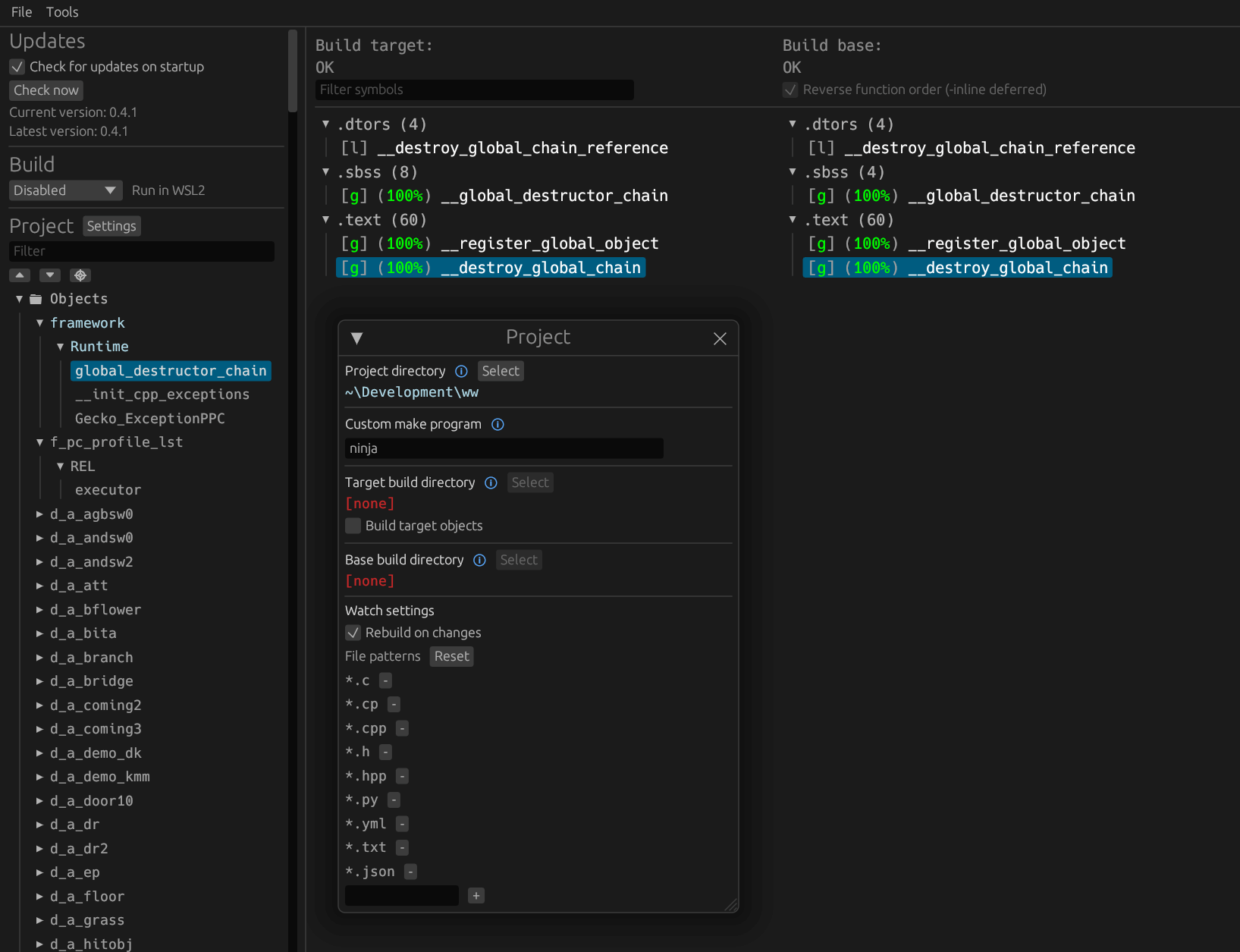
Download the latest release from encounter/objdiff. Under project settings, set Project directory. The configuration should be loaded automatically.
Select an object from the left sidebar to begin diffing. Changes to the project will rebuild automatically: changes to source files, headers, configure.py, splits.txt or symbols.txt.
Attribution
This decompilation builds on work published by other decompilation and reverse-engineering projects. Their sources were used as references for the code, names and layouts listed below; every reconstructed file is still verified against this game's own executable.
| Project | Used for |
|---|---|
| Resident Evil 4 (GameCube) | CRI middleware sources used as the basis for most of src/CRI/: ADX (ADXF, ADXB format decoders, ADXSJD, ADXT init, header decoding, ADXPD, ADXRNA, ADXAMP, errors), LSC, SJ, SVM, CVFS and the MFCI/GCCI device interfaces, Sofdec MPV/MPS/SFD and UTY helper units and the MWSTM stream glue; the CRI interface and Sofdec layout headers; the Dolphin SDK headers (include/dolphin, include/libc) and SDK sources in src/dolphin/; names for CRI and Dolphin SDK functions |
| Dolphin SDK 2004 decompilation | Origin of the Dolphin SDK sources and headers (taken via the Resident Evil 4 project) behind src/dolphin/, include/dolphin and include/libc, including the SDK_REVISION handling of the Nov 2004 GX/OS builds; also used directly for CARDOpen.c, CARDNet.c, __start.c, __ppc_eabi_init.c, dsp_debug.c and odenotstub.c in src/dolphin/ |
| Mario Party 4 PC port (partyboard) | OdemuExi2 DebuggerDriver.c source used for src/dolphin/DebuggerDriver.c (taken via the Resident Evil 4 project) |
| The Legend of Zelda: Twilight Princess | CodeWarrior runtime and MSL C sources and headers (src/PowerPC_EABI_Support/): fdlibm math, mem, mem_funcs, direct_io, signal, string, strtoul, strtold, wchar_io, arith, buffer_io, char_io, ctype, extras (file layout), file_io, FILE_POS, critical_regions, errno, ansi_files, uart_console_io_gcn, __va_arg, ptmf and NMWException, and the GC/2.7 runtime build flags; the MSL alloc.c pool structures and __pool_free, and the Gecko_ExceptionPPC fragment registration, used by src/Runtime.PPCEABI.H/ |
| Mortal Kombat: Deception (GameCube) | CRI svm.c, lsc.c and adx_fini.c references: function order and names such as SVM_ExecSvrMain/Fs/Vsync/MwIdle, SVM_SetCbBdr, LSC_SetLpFlg and LSC_Start; the inlined cosine helper dctac_Cos in CRI dct_ac.c |
| Street Fighter III: 3rd Strike | Newer CRI lsc.c reference: source order, error-code numbering and names such as LSC_ResetEntry and the LSC stream queries; CRI adx_fs.c function bodies and ADXF/ADXSTM function names; CRI adx_lsc.c function names, order and error codes; CRI adx_tlk2.c (ADXT_StartFname, ADXT_StartAfs) and ADXT names such as ADXT_StopWithoutLsc and ADXT_GetTimeReal |
| Teenage Mutant Ninja Turtles 2: Battle Nexus (PC reimplementation) | CRI adx_fs.c structure: public ADXF_* entries wrapping adxf_* workers, and names such as adxf_OpenRange |
| The World Ends With You | CRI adx_crs.c function order and the names ADXCRS_Enter and ADXCRS_Leave; CRI adx_stmc.c structure (public ADXSTM_* entries over adxstm_* workers) |
| Dragon Ball Z: Budokai Tenkaichi 3 | CRI adx_fs.c worker and wrapper naming notes |
| Xenoblade Chronicles | CRI sj_crs.c names SJCRS_Init and SJCRS_Finish |
| Sonic Heroes | CRI cri_cvfs.c and adx_fini.c comparison references |
| The Legend of Zelda: The Wind Waker and Twilight Princess | Metrowerks runtime and Dolphin OS references for GCN_mem_alloc.c, abort, signal and heap function names; the CPlusLibPPC.cp runtime file layout (Wind Waker) |
| Pikmin 2 | Metrowerks MSL allocator references (alloc.c function names and sizes); the MSL __strtold body used for strtold.c, the ansi_fp.c, printf.c, scanf.c and mbstring.c functions, the MetroTRK sources and headers, and the float.c and locale.c data; original sizes of the dead-stripped MSL string.c functions |
| Metroid Prime and Mario Kart: Double Dash!! | Metrowerks MSL allocator comparison references |
| fdlibm via newlib | The single precision acos (ef_acos.c, float conversion by Ian Lance Taylor, Cygnus Support) adapted for the keyframe interpolation in src/rw/fn_80445CF4.c; its notices are kept with the code |
| Boost 1.32 (Boost Software License 1.0) | The headers in include/boost/ (config (exception configuration), checked_delete, scoped_ptr, scoped_array, shared_ptr with its shared_count, weak_ptr, throw_exception, get_pointer, mem_fn, bind, visit_each, function, utility/addressof) are adapted from the Boost 1.32 sources and checked against the game's code; each file keeps its Boost copyright notice and include/boost/LICENSE_1_0.txt is the license text |
| decomp-toolkit, dtk-template and objdiff | Project tooling, build template and object diffing |