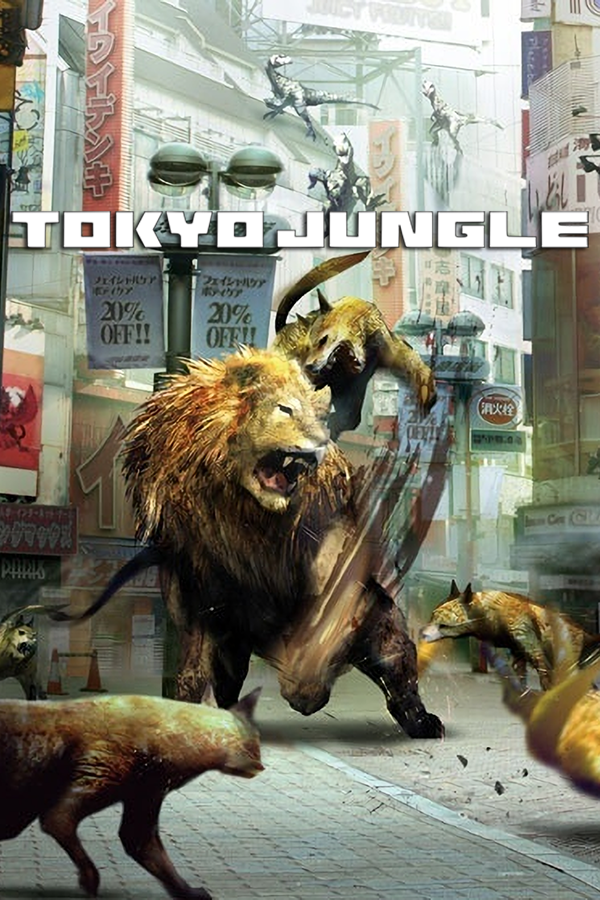
Tokyo Jungle Recompiled
Tokyo Jungle
OrigenPlayStation 3
TecnologíaRecompilación Estática (C/C++ nativo)
Disponible paraWindows, Linux, macOS
Ver proyecto oficialSobre el proyecto
Tokyo Jungle es un juego de supervivencia y acción de ciencia ficción desarrollado por Crispy's! y Japan Studios y publicado por Sony Computer Entertainment para la Playstation 3. El juego se ambienta en un desierto y futurista Tokyo, en el que la ciudad ha sido transformada en un feroz páramo de vida silvestre.
Información oficial del proyecto
Tokyo Jungle Recompiled

<sub>The title screen, live: recompiled PPU code, the game's own SPU workloads, and its RSX command stream on D3D12. No emulator.</sub>
A Pomeranian walks into post-apocalyptic Tokyo. No, seriously.
Tokyo Jungle (2012) is the most wonderfully absurd game Sony ever published — a survival action game where you play as animals fighting for dominance in a Tokyo abandoned by humanity. One moment you're a tiny Pomeranian sneaking past lions in Shibuya, the next you're a dinosaur asserting territorial control over Yoyogi Park. It's brutal. It's beautiful. It has no business being as good as it is.
And it's about to disappear.
Why This Exists
Tokyo Jungle was a PS3 exclusive. The Western release was digital-only — no disc, no physical backup. Both of its developers are gone (Japan Studio dissolved 2021, Crispy's dormant since 2015). The PS3 store is running on fumes. Sony's PS Plus cloud streaming for PS3 titles has been broken for months. Nobody is coming to save this game.
So we're doing it ourselves.
Tokyo Jungle Recompiled is a native PC port built using ps3recomp — a static recompilation toolchain that translates PS3 PowerPC binaries into native C code, then compiles them as x86-64 executables. No emulation at runtime. No compatibility layers. Just raw, recompiled native code.
Status: Phase 8 — Boots to a Window, Audio Initialises, Geometry Not Yet Drawing
This is the first 3D title to attempt ps3recomp. The game boots end-to-end, opens a D3D12 window, runs its PSN data-install flow, brings up SPURS and all twelve of its SPU job images, loads its game data, and completes audio initialisation. Its own clear colour reaches the screen. It no longer hangs, crashes or exits — it now parks in its main loop waiting on a single counter that nothing in the emulator writes. It does not yet draw geometry.
A note on the function count. Earlier builds advertised 35,208 lifted
functions. That number was wrong, and the current one is lower on purpose:
find_functions was treating intra-function basic blocks as separate function
entries, inventing tens of thousands of phantoms. It now covers those blocks
properly. The fix was checked against ground truth on a different title that
ships an unstripped debug build (+90 real functions recovered, 0 phantoms
introduced) — Tokyo Jungle's own binary is stripped, so its count cannot be
verified directly. The honest figure is 7,924. A count going down was progress.
| Milestone | Status |
|---|---|
| Binary analysis & function discovery | Done — 7,924 functions, ground-truth verified |
| PPU disassembly & code lifting | Done — 7 body overrides (heap, abort, pure-virtual) |
| Project scaffold & build system | Done — clang-cl + Ninja |
| ELF loading & VM setup | Done — 4 GB space, 256 MB VRAM, callback stacks, GCM page |
| CRT initialization | Done — argv, TLS (r13), guest heap redirected |
| LV2 syscall dispatch | Done — plus PS3_SCTRACE with guest-caller resolution |
| Import table resolution (PLT/NID) | Done — slots derived from the module descriptors |
| Guest threads | Done — thread entry trampoline (every thread was a silent no-op) |
| Graphics backend (RSX → D3D12) | Partial — window opens, clears present, no geometry |
| PSN data-install flow | Done — DataCheck / CreateGameData handshake completes |
| SPU job manager (SPURS) | Done — chains walk, job guards work, all 12 images lifted, 0 dispatch misses |
| Game data / asset loading | Done — every file the boot asks for opens; sound banks load |
| Audio (cellAudio) | Partial — init / PortOpen / PortStart succeed, no output device yet |
| Input (cellPad → XInput/SDL) | Not Started |
| Survival Mode playable | Not Started |
| Story Mode playable | Not Started |
| DLC species support | Not Started |
What's Working
- 7,924 PPU functions recompiled to native C++ and compiled to x86-64
- A window with the game's own pixels in it —
CELL_GCMCLEAR_SURFACEreaches the D3D12 backend and presents; the frame colour is the guest's, not ours - The PS3 data-install flow — the title's installer runs to completion, which
needed all three of ps3recomp's independent path roots configured (
sys_fssyscalls, thecellFsHLE prefix table, andcellGame's content path) - Guest threads actually run —
ppu_install_thread_trampoline; without it everysys_ppu_thread_createthread spawned, reported FINISHED, and executed nothing - SPURS job chains — the walker handles JOB / SYNC / NEXT / GUARD, and job guards are implemented, so a chain waits for its notify instead of running against parameters the game has not filled in yet
- All 12 SPU images lifted and dispatched — captured with
SPU_DUMP_MISS, matched by content fingerprint, 4,751 SPU functions, zero dispatch misses. The sound jobs run to completion, read their work descriptors and DMA their results - Every file the boot asks for opens — the disc, hdd-game and
app_homeroots all resolve into the title's real data (input/USRDIR/, 1,053 files); the sound banks load. Zero failed opens across a run - Complete lifting coverage — all 7,410 functions the binary's
.opdtable declares are present in the lifted set, so "the caller was never lifted" is ruled out as an explanation when something does not run - Audio initialisation —
cellAudioInit,cellAudioPortOpen,cellAudioSetNotifyEventQueueandcellAudioPortStartall complete - Diagnostics that earn their keep —
TJ_GENMAP(stub address → import name),TJ_OPD_GUARD(write-protect the OPD arena),PS3_SCTRACE,TJ_IMPTRACE, and a watchdog that reports the HLE and lv2 syscall a wedged thread is inside (in_hle=/syscall=) plus the counter it is polling (TJ_POLLWATCH,TJ_TIMEWATCH). The watchdog'sCTRis the lastbctrltarget and goes stale the moment a call returns — it namedsys_lwmutex_unlockfor a thread that had long since left it, which is why the per-thread tables exist.
Measure with
PS3_VERBOSE=0. The per-event logging is heavy enough to change what the title does, not just how fast: every guest thread writes through oneFILElock, and at the ~6k lines/s a SPURS audio chain produces a thread can starve on it for seconds. This title presents four frames in 40 s with the log discarded and one with it redirected to a file. Note thatps3_log_verbose()treats a non-tty stderr as "be verbose", so redirecting to a file turns the firehose on unless you say otherwise.
Current Blocker
One counter the title waits on is never written. The boot no longer hangs,
crashes or exits: every worker thread stays alive, the vblank handler runs at
~60 Hz, and the frame presents. The main loop then parks in func_00213A14,
which waits on two things — an outstanding-request count, already zero, and
[r31+0x1A0] + 3 >= [[TOC+0x1860] + 0x18] (guest 0x00C04A68)
That second field reads 0 forever. Nothing writes it: not guest stores, not
an HLE, not SPU DMA — all three checked, the last two only after extending the
write-watch to cover the inline vm_write* family that libs/ uses. Ticking it
by hand (TJ_TICK_GAMECLOCK, off by default) takes the log from ~3,400 lines to
559,486 and the title runs on, so it is definitively what holds the boot. What
should write it is still unknown, and that is the next thing to solve.
Everything downstream of it is consequence, not cause — including no geometry.
Also outstanding, but not what is blocking:
cellFontis held back on the title's own stubs (TJ_KEEP='cellFont*'), so no UI text renders- No audio output device — the pipeline initialises and the SPU jobs run, but nothing is wired to a host audio backend
Recently Fixed
Three that each moved the boot forward a stage:
- The title sat forever "waiting for device mounting".
cellFsStat('/dev_hdd0')resolved one directory too high, so the device never appeared and the main thread never returned to the render loop. The mapping carried a../that assumed the process ran frombuild/, while the program loads its ELF relative to the project root. - Every asset open missed, which made the title quit. The disc, hdd-game and
app_homeroots pointed at the VFS root rather thaninput/, sodata/snd/static.sgdand everything beside it failed to open. Losing the sound bank made SGX fail, tear itself down, and return −1 frommain. - SGX teardown deadlocked against its own audio thread. The shutdown joins
sgx-audio-thr, which waits on the SPURS completion queue with an infinite timeout — andcellSpursFinalizehas already stopped the job chains, so no completion can ever arrive. ps3recomp now cancels the queues SPURS attached; waiters getCELL_ECANCELED, which the title's audio loop already treats as "leave the loop".
And two older ones worth naming, because both spent a long time wearing a convincing disguise:
cellAudioPortOpenwas allocating its audio buffer on top of the HLE OPD arena. It used a hardcoded0x01000000, commented "free window" — which is exactly where this port keeps its import descriptor table. Opening an audio portmemset128 KB of it to zero, after which every import resolved through those descriptors dispatched to a null address. A nullbctrreturns with r3 untouched, so the guest reads its own first argument back as a status code. The middleware duly reportedfailed to set notify queue (23A0)— and0x23A0was not an error code at all, it was the event-queue key it had just passed in.- SPURS never signalled the application.
cellSpursAttachLv2EventQueuediscarded the queue id, so a thread blocked insys_event_queue_receivewaiting for job completion could never be woken. The title sat there for its entire boot.
How It Works
PS3 ELF binary
    ↓ decrypt & parse
PPU PowerPC assembly
    ↓ disassemble & lift
Generated C source code (thousands of files)
    ↓ compile with MSVC/GCC/Clang
Native x86-64 executable
    + ps3recomp runtime (HLE OS services)
    + Graphics backend (RSX → D3D12)
    + Audio/Input backends
    ↓
Tokyo Jungle on your PC
The ps3recomp toolchain handles the heavy lifting of translating PowerPC instructions to equivalent C code. We provide game-specific configuration, function stubs, and fixes on top.
Building
Prerequisites
- CMake 3.20+
- C++20 compiler — MSVC 2022 (19.35+), GCC 12+, or Clang 14+
- Python 3.10+ with packages:
pycryptodome,capstone,construct,tabulate,tomli,tqdm - ps3recomp — clone from sp00nznet/ps3recomp
- A legitimate copy of Tokyo Jungle (NPUA80523 / BCAS20219) — you must legally own the game
- Ninja (recommended build system)
Steps
# Clone with submodule
git clone --recursive https://github.com/sp00nznet/tokyojungle.git
cd tokyojungle

# Install Python dependencies
pip install -r requirements.txt

# Set up your decrypted ELF (you must provide this yourself)
cp /path/to/your/EBOOT.ELF input/

# Run the analysis pipeline (function discovery + lifting)
python scripts/analyze.py

# Post-lift processing (patches, stubs, dispatch table)
python scripts/gen_stubs.py

# Configure and build
cmake -B build -G Ninja
cmake --build build --config Release

# Run
./build/Release/tokyojungle.exe
Note: You must supply your own legally obtained game files. This project does not include, distribute, or link to any copyrighted game data.
Game IDs
| Region | ID | Format |
|---|---|---|
| NA (Digital) | NPUA80523 | PSN |
| JP (Disc) | BCAS20219 | Blu-ray |
| EU (Digital) | NPEA00421 | PSN |
Project Structure
tokyojungle/
├── config/
│   └── tokyojungle.toml       # ps3recomp configuration
├── src/
│   ├── main.cpp                # Entry point, VM init, ELF loading
│   ├── stubs.cpp               # Game-specific HLE overrides (trophy, network)
│   ├── recomp_bridge.h         # Memory access, indirect call dispatch, syscalls
│   ├── import_resolver.h       # PLT import table population & heap allocator
│   ├── hle_imports.h           # 61 HLE handlers (cellGcm, cellPad, malloc, etc.)
│   └── elf_loader.h            # ELF segment loader
├── scripts/
│   ├── analyze.py              # Binary analysis pipeline
│   ├── gen_stubs.py            # Post-lift processing (TOC fix, bctr, stubs)
│   └── add_traces.py           # Debug tracing for game functions
├── input/                      # Your game files go here (gitignored)
├── generated/                  # Recompiled C output (~150MB, gitignored)
│   ├── ppu_recomp_0NN.cpp      # 7,924 lifted PPU functions
│   ├── ppu_recomp.h            # Function declarations
│   ├── ppu_stubs.c             # Manual CRT overrides (_start, init stubs)
│   ├── dispatch_table.c        # Guest addr -> host func lookup table
│   └── functions.json          # Function boundary list for lifter
├── build/                      # Build output (gitignored)
└── docs/
    ├── PROGRESS.md             # Detailed progress log
    └── TECHNICAL.md            # Technical notes & findings
Contributing
This is an ambitious preservation project and help is very welcome. The biggest areas of need:
- The stalled counter — the current blocker, described above: find what should write
0x00C04A68([[TOC+0x1860]+0x18]). Ruled out already: guest stores, HLE stores, SPU DMA, and any lifting gap. Everything else, including the missing geometry, is downstream of it. - RSX Graphics Reverse Engineering — Working out why the game's draw calls never reach the D3D12 backend. The frame clears and presents correctly, so the path is open; something upstream is not submitting geometry.
- SPU Program Analysis — The title dispatches around 100 SPU jobs per run across
12 distinct images, and only one ("soc-job", the sound down-mix) is lifted. The
others are raw SPURS job binaries loaded from the game's own data files, so they
have to be captured at runtime with
SPU_DUMP_MISSbefore they can be lifted. - Game Logic Debugging — Once code is lifted, tracking down crashes and behavioral bugs
- Testing — Comparing behavior against RPCS3 reference runs
If you've worked with PS3 internals, RPCS3, N64Recomp, or similar recompilation projects, your expertise would be invaluable.
License
The code in this repository is MIT licensed — see LICENSE. That covers our code only: the port scaffold, HLE glue, and build scripts. It does not and cannot cover Tokyo Jungle itself, and no game data is included here.
Legal
This project is a clean-room recompilation toolchain output. It does not contain any proprietary Sony or game code. You must provide your own legally obtained game files. This project exists solely for game preservation purposes.
Tokyo Jungle is a trademark of Sony Interactive Entertainment. This project is not affiliated with, endorsed by, or connected to Sony, Japan Studio, or Crispy's in any way.
A Love Letter
Tokyo Jungle is one of those rare games that could only exist because someone at Sony said "sure, why not" to a pitch about a Pomeranian surviving the apocalypse. It's weird. It's wonderful. It sold over 500,000 copies. It got a perfect score from Famitsu. And in a few years, without intervention, it will exist only in YouTube videos and fond memories.
Games like this don't deserve to vanish just because the hardware they ran on becomes obsolete. If you've ever watched a golden retriever take down a crocodile in the streets of Shibuya, you know exactly why this project exists.
Let's keep Tokyo Jungle alive.
Built with ps3recomp | Star this repo if you want to pet the Pomeranian