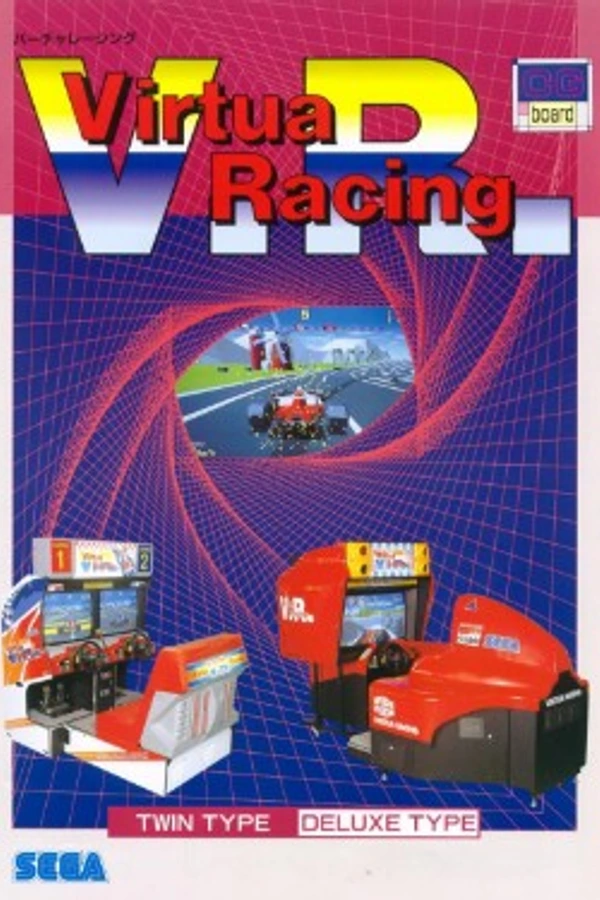
Virtua Racing
TecnologíaPort Nativo C/C++ (Reimplementación de Motor)
Disponible paraWindows, Linux, macOS
Ver proyecto oficialSobre el proyecto
Virtua Racing o también llamado V.R., es un videojuego arcade de Fórmula 1 que salió en recreativas en octubre de 1992, desarrollado por Sega-AM2 para su nueva placa "Model 1". Es el tercer juego de coches en usar entornos, personajes y automóviles totalmente poligonales. Virtua Racing también introdujo algo novedoso para aquel año, el "V.R. View System", que permitía al jugador elegir entre cuatro vistas diferentes. Este sistema también se usó en otros juegos de Sega como Daytona USA. Virtua Racing fue la primera recreativa que usó la relación de aspecto 16:9.
Información oficial del proyecto
(NEW) Check my just completed dissassembly of Aerobiz Supersonic at https://github.com/matiaszanolli/aerobiz-disasm
Virtua Racing Deluxe (32X) — Full Disassembly & 60 FPS Optimization
Status: 40 FPS achieved, 60 FPS one blocker away
A complete, buildable disassembly of Virtua Racing Deluxe for the Sega 32X with deep architectural understanding of the game's internals — now actively optimized to push the hardware to its limits. The original game runs at ~20 FPS; this project has doubled that to 40 FPS via camera interpolation and is one hardware constraint away from 60 FPS.
Looking for the unmodified disassembly? The byte-identical original code is preserved in the
v5.0-freezebranch.
Current State (March 2026)
Display FPS:  ~40  (camera interpolation, stable frame pacing)
Game logic:    20 FPS (unchanged — physics, AI, collision at original speed)
Next target:   60 FPS (1 hardware blocker remaining)

CPU Utilization (40 FPS, profiled):
  68000:       █████████░░░░░░░░░░░  48%   ← Idle 52% (STOP #$2300)
  Master SH2:  ██████░░░░░░░░░░░░░░  0-36% ← Command router + block copies
  Slave SH2:   ██████████████░░░░░░  73%   ← ALL 3D rendering (bottleneck)
What's Working
- 40 FPS display via camera interpolation — game logic at 20 FPS, display at 40 FPS by rendering 2 interpolated camera frames per game tick. Zero physics changes.
- Complete architectural understanding — 68K scene handlers, V-INT dispatch, dual SH2 dispatch, COMM protocol, rendering pipeline, all documented
- SH2 coord_transform inlined (S-6) — ~5% Slave reduction, 4 call sites relocated to expansion ROM
- Command protocol optimized (B-003/B-004/B-005) — 64% overhead reduction
- 823 68K modules fully organized, 736 translated to mnemonics
- All 92 SH2 functions integrated and documented
What's Next: 60 FPS
One blocker remains: Frame buffer swap (FS bit) writes outside VBlank are deferred by hardware. A swap-only V-INT handler (~30 bytes) is needed to perform FS toggles during VBlank for the interpolated frames. The V-INT dispatch table has 4 unused slots available. Design is ready in VINT_HANDLER_ARCHITECTURE.md §6.
How It Works
68K Game Architecture
The game uses a two-level dispatch system:
-
Scene handler (
$FF0002) — Self-modifying main loop calls a handler pointer each frame. Changing it switches game modes (loading, display init, racing, menus). Over 20 distinct handlers manage the full lifecycle from boot through racing to results. -
State dispatcher (
$C87E) — Within each scene handler, a sub-dispatcher indexes a jump table by game state. States advance by 4 each frame; state 8 runs the full game frame. The V-INT frame swap handler resets$C87Eto 0 when the SH2 signals "render done" via COMM1. -
V-INT dispatch (
$C87A) — Each state handler writes a V-INT state that controls which VBlank handler runs. 16+ entries handle everything from minimal VDP reads to full frame buffer swaps with palette DMA.
Dual SH2 Architecture
Master and Slave SH2 have completely independent dispatch loops polling different COMM registers:
| CPU | Polls | Role | Utilization |
|---|---|---|---|
| Master | COMM0_HI | Game commands: block copies, scene init, DMA | 0-36% |
| Slave | COMM2_HI | ALL 3D rendering via dual pipeline | ~73% |
No direct cross-trigger. The 68K submits to each independently. COMM7 is an async doorbell for pixel work.
Slave rendering pipeline (the bottleneck):
- Pipeline 1: On-chip SRAM ($C0000000, 1748 bytes). Self-contained, zero wait states, 36 entities/frame. Untouchable.
- Pipeline 2: SDRAM cache. coord_transform (12%), frustum_cull (12%), span_filler (8%). This is the optimization target.
Camera Interpolation (A-1)
State 0 (TV1): Snapshot camera → DMA to SH2 → SH2 renders frame A
State 4 (TV2): Block-copy A → swap → interpolate camera → re-DMA → SH2 renders frame B
State 8 (TV3): Existing swap displays frame B
Result: 2 swaps / 3 TV frames = 40 FPS display, 20 FPS game logic
Quick Start
# Build the ROM
make all

# Test in emulator (PicoDrive only — BlastEm has no 32X support)
picodrive build/vr_rebuild.32x

# Profile (30 seconds, headless)
cd tools/libretro-profiling
./profiling_frontend ../../build/vr_rebuild.32x 1800 --autoplay
Project Structure
32x-playground/
├── disasm/
│   ├── vrd.asm                    # Main build file
│   ├── sections/                  # Buildable section sources (12 code + data + SH2 + expansion)
│   ├── modules/
│   │   ├── 68k/                   # 823 modularized 68K modules (17 categories + 15 game subcats)
│   │   └── shared/definitions.asm # Master symbol table (all HW register equates)
│   ├── sh2/                       # SH2 functions + expansion code
│   │   ├── 3d_engine/             # 92 SH2 functions (descriptive names)
│   │   ├── generated/             # 89 SH2 function includes
│   │   └── expansion/             # SH2 expansion ROM code ($300000+)
│   └── sh2_symbols.inc            # 107 SH2 function symbols
│
├── analysis/                      # Reverse engineering & architecture docs
│   ├── SCENE_HANDLER_ARCHITECTURE.md     # 68K scene dispatch, $C8A8, handler chain
│   ├── VINT_HANDLER_ARCHITECTURE.md      # V-INT dispatch table, frame swap, R-002 design
│   ├── SLAVE_SH2_DISPATCH_ARCHITECTURE.md # Dual SH2 dispatch, pipelines
│   ├── GAME_MODE_TRANSITIONS.md          # Boot→menu→racing→results flow
│   ├── MASTER_FUNCTION_REFERENCE.md      # 799+ named functions (auto-generated)
│   ├── sh2-analysis/                     # SH2 command handlers, 3D engine, rendering
│   ├── architecture/                     # Memory maps, registers, state machines
│   └── optimization/                     # Optimization research & designs
│
├── docs/                          # Hardware manuals & guides (markdown transcriptions)
│
├── tools/
│   ├── libretro-profiling/        # Custom PicoDrive profiler (cycle-accurate)
│   ├── translate_68k_modules.py   # Batch dc.w→mnemonic translator
│   ├── m68k_disasm.py             # 68K disassembler
│   └── sh2_disasm.py              # SH2 disassembler
│
└── build/
    └── vr_rebuild.32x             # Output ROM (4MB)
ROM Layout
Address Range    Size      Contents
──────────────────────────────────────────
$000000-$2FFFFF  3.0 MB    Game Code (68K + SH2)
$300000-$3FFFFF  1.0 MB    SH2 Expansion Space (~2.5KB used, 99.8% free)
──────────────────────────────────────────
Total            4.0 MB    Full Cartridge
The expansion space contains optimized SH2 handlers: inlined coord_transform (S-6), single-shot command protocols (B-004/B-005), and async infrastructure.
Key Architectural Findings
| Finding | Evidence | Impact |
|---|---|---|
| Slave SH2 is the true bottleneck | 73% utilization, ~300K cycles/frame | All optimization must target Slave |
| 68K has 52% idle time | STOP #$2300, 48% active work | 68K is NOT the bottleneck anymore |
| Camera interpolation works | 40 FPS achieved (A-1, commit b6bd487) | Display FPS decoupled from game logic |
| $C8A8 = $0102 always (cmd $02) | Verified fall-through analysis | Per-frame DMA is always scene orchestrator |
| Entity descriptors unused during racing | 4 independent profiling tests (S-1d) | LOD culling at $0600C344 is a dead end |
| On-chip SRAM pipeline is untouchable | 1748B, zero external calls | Only Pipeline 2 (SDRAM) is optimizable |
| V-INT table has 4 unused slots | $0040, $0048, $004C, $0050 | Swap-only handler can use any of these |
| Master SH2 is underutilized | 0-36%, mostly idle | Available for vertex transform offload (S-8) |
Documentation
Architecture (start here)
| Document | What It Covers |
|---|---|
| SCENE_HANDLER_ARCHITECTURE.md | 68K scene dispatch, handler chain, $C8A8 lifecycle, Phase B crash analysis |
| VINT_HANDLER_ARCHITECTURE.md | V-INT dispatch table (16+ entries), frame swap mechanism, R-002 60 FPS design |
| SLAVE_SH2_DISPATCH_ARCHITECTURE.md | Dual SH2 dispatch, Slave command routing, pipeline sequencing |
| GAME_MODE_TRANSITIONS.md | Boot→menu→racing flow, $C8A8 correction, safe intervention points |
| SH2_COMMAND_HANDLER_REFERENCE.md | All 7 Master SH2 command handlers decoded |
| SYSTEM_EXECUTION_FLOW.md | Per-frame execution with cycle budgets |
| RENDERING_PIPELINE.md | End-to-end rendering flow |
Engine Internals
| Document | What It Covers |
|---|---|
| SH2_3D_ENGINE_DEEP_DIVE.md | 3D algorithms: frustum cull, span filler, coord transform |
| SH2_RENDERING_ARCHITECTURE.md | Dual pipeline (SRAM + SDRAM), entity batching |
| MASTER_FUNCTION_REFERENCE.md | 799+ named functions (auto-generated) |
| 68K_SH2_COMMUNICATION.md | COMM protocol, B-003/B-004/B-005 designs |
| COMM_REGISTERS_HARDWARE_ANALYSIS.md | Hardware hazards, handshake patterns |
Project Management
| Document | What It Covers |
|---|---|
| BACKLOG.md | Prioritized task queue |
| KNOWN_ISSUES.md | Pitfalls, hardware hazards, abandoned approaches |
| OPTIMIZATION_PLAN.md | Strategic roadmap (Phases 1-3) |
| CLAUDE.md | Agent briefing, ground rules, build instructions |
Requirements
- Python 3.x
- GCC and Make (for vasm)
- Unix-like environment (Linux, macOS, WSL)
ROM (NOT INCLUDED)
You must provide your own legal ROM dump:
- File:
Virtua Racing Deluxe (USA).32x(inroms/directory) - Size: 3,145,728 bytes (original)
- MD5:
72b1ad0f949f68da7d0a6339ecd51a3f
Technical Details
| Component | Details |
|---|---|
| Platform | Sega 32X (Mega Drive add-on) |
| 68000 CPU | 7.67 MHz — game logic, scene management, SH2 coordination |
| Master SH2 | 23.01 MHz — command dispatch, block copies (0-36% util) |
| Slave SH2 | 23.01 MHz — ALL 3D rendering, dual pipeline (73% util, bottleneck) |
| Z80 CPU | Sound processing |
| ROM Size | 4 MB with 1 MB expansion space |
| Original FPS | ~20 (blocking sync, conservative design) |
| Current FPS | ~40 (camera interpolation, A-1) |
| Next Target | 60 FPS (swap-only V-INT handler, R-002) |
Support
If you'd like to support this project, consider becoming a patron:
patreon.com/virtua_racing_60fps
Credits
- Original Game: SEGA (1994)
- Disassembly & Analysis: Claude Code with human guidance
- Tools: vasm by Volker Barthelmann & Frank Wille
- Profiler: Custom PicoDrive libretro patches
License
Reverse engineering project for educational and preservation purposes. Original game © SEGA 1994. No copyrighted content included — you must provide your own legal ROM.