CTR: Crash Team Racing · CRT Native DS (Dual Screen)
CTR: Crash Team Racing
About the project
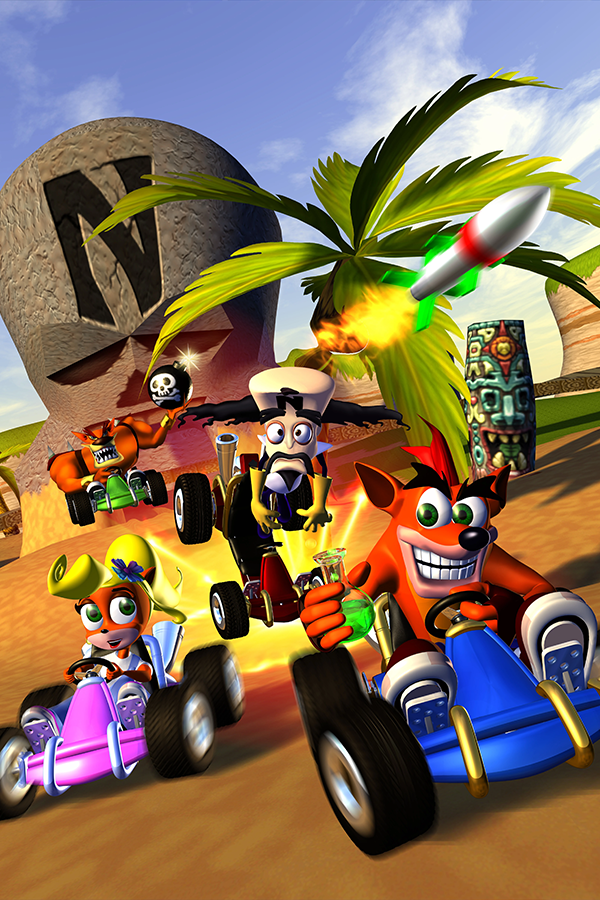
Crash Team Racing es un videojuego de carreras de karts desarrollado por Naughty Dog y publicado por Sony Computer Entertainment para PlayStation. Es la cuarta entrega de la serie Crash Bandicoot y el último hecho por Naughty Dog. La historia se centra en los esfuerzos de Crash Bandicoot, el Doctor Neo Cortex y otros personajes variopintos, que deben competir contra el ególatra Nitros Oxide para salvar la Tierra de la destrucción. En el título, los jugadores pueden controlar a uno de los quince personajes de la saga, aunque al principio solo están disponibles ocho.
Official project information
CTR-DS
A fork of CTR Native that adds a second screen, a 64-bit build, and a set of graphics and frame-rate options.
CTR Native is itself a native port of Crash Team Racing (PS1, 1999) built on the CTR-ModSDK decompilation. This fork does not change what the game is; it changes where it can run and what it can be told to do.
What this fork adds
A companion screen. On a dual-screen handheld the HUD, the live map and a settings panel move to the bottom display, leaving the top one entirely to the game. The map draws driver portraits rather than coloured dots, because there is room for them.
A 64-bit build. The original targets 32-bit only. CTR_FORCE_32BIT=OFF
builds LP64, which is what lets it run on a device with no 32-bit runtime at all
— a modern phone, for instance. Pointers no longer fit the 32-bit fields the PSX
structures use, so they are resolved through a region registry instead.
Frame caps above 30. The game was written for a 30fps frame and a 60Hz VBlank, and a great deal of it counts one or the other. Anything that does now reads a clock that advances at the retail rate whatever the cap is, so a 120fps race does not play at four times speed.
Internal resolution up to 8x. Geometry is drawn into a target of
240 × scale lines and presented to the panel. Past roughly 3x on a handheld
this is supersampling rather than detail.
Widescreen, an HD replacement path for the 2D HUD art, CHD disc images, on-screen touch controls, and a launcher for picking a disc and settings without editing a file.
Devices this has run on
| device | notes |
|---|---|
| AYN Thor | dual-screen handheld; the companion display is the reason this fork exists |
| OnePlus 15 | 64-bit only, so it needs the LP64 build; single screen |
| Linux desktop | both 32- and 64-bit, used for most debugging |
Building
The upstream README.md covers prerequisites and the standard build. Two things are specific to this fork.
64-bit desktop
cmake -S . -B build64 -DCTR_FORCE_32BIT=OFF -DCMAKE_BUILD_TYPE=RelWithDebInfo
cmake --build build64 -j$(nproc)
Put ctr-u.bin (or ctr-u.chd) in build64/assets/ and run build64/ctr_native
from that directory.
Android
cd android && ./gradlew assembleDebug
adb install -r app/build/outputs/apk/debug/app-debug.apk
The debug variant compiles the native side with -O2 (see app/build.gradle).
Without that the Android plugin passes no -O flag at all, and a recompiled PS1
game runs roughly three to four times slower — enough to miss a 120fps cap that
it otherwise holds comfortably.
Settings
ctrds.cfg lives beside the disc image — on Android at
/sdcard/Android/data/com.ctrnative/files/assets/. The launcher writes it, the
in-game panel writes it, and lines it does not recognise are preserved.
| key | values | meaning |
|---|---|---|
target_fps | 30, 60, 90, 120, … | frame cap; VBlanks are emitted at this rate |
internal_scale | 1–8 | render target is 240 × scale lines |
aspect_mode | 0, 1 | 0 is retail 4:3, 1 follows the display |
fxaa, crt | 0, 1 | post-processing |
touch_controls | 0, 1, 2 | off, on, automatic |
swap_face_buttons | 0, 1 | swap cross and circle |
online* | — | built but there is no public server to reach |
Not offered in the launcher, but read if present:
| key | meaning |
|---|---|
hd_art | use replacement HUD art from assets/hd/ |
hd_dump, hd_log | author the replacements: dump icons out of VRAM, report indices |
skip_av | disc has no intro video or XA audio (also auto-detected) |
prim_reject | oversize primitive cull; 2 reports what it drops |
perf | write per-frame bucket timings next to the config |
widescreen | derived from the aspect; override only if you know why |
Diagnostics
The frame line, on by default, is the fastest way to see what the game is doing:
FPS: 120.0 of 120 reachable (cap 120, 1 vblanks per flip, race, 6x) audio 60.0/s disc 0/0
reachable is the cap the current cadence allows — menus deliberately flip every
cap/30 VBlanks, so 30 is the correct answer there and a lower number is not a
fault. audio should read 60/s at any cap; it is the rate the sound is consumed
at, and it made a doubled-speed bug visible that the ear had already caught.
A watchdog aborts the process if no VBlank is emitted for twelve seconds while
the window is in front. That is deliberate: a frozen process tells you nothing,
while an abort produces a tombstone with a native backtrace for every thread.
CTRDS_WATCHDOG=0 disables it.
Setting perf=1 writes perf/frame_times.csv with a column per timing bucket.
Known issues
- Small flat lavender quads appear on some level geometry, and a rectangle in the lower-left of the main screen. Present on both 32- and 64-bit builds, at both 4:3 and widescreen, with the HD art path and the oversize-primitive cull both disabled — so none of those is the cause. Not yet found.
- The dual-screen path presents at the frame cap in menus while the game logic advances at 30, so the same frame is presented repeatedly. Wasted GPU rather than a speed fault.
- Online is implemented but has no server to connect to.
Licence
Same as upstream; see LICENSE.