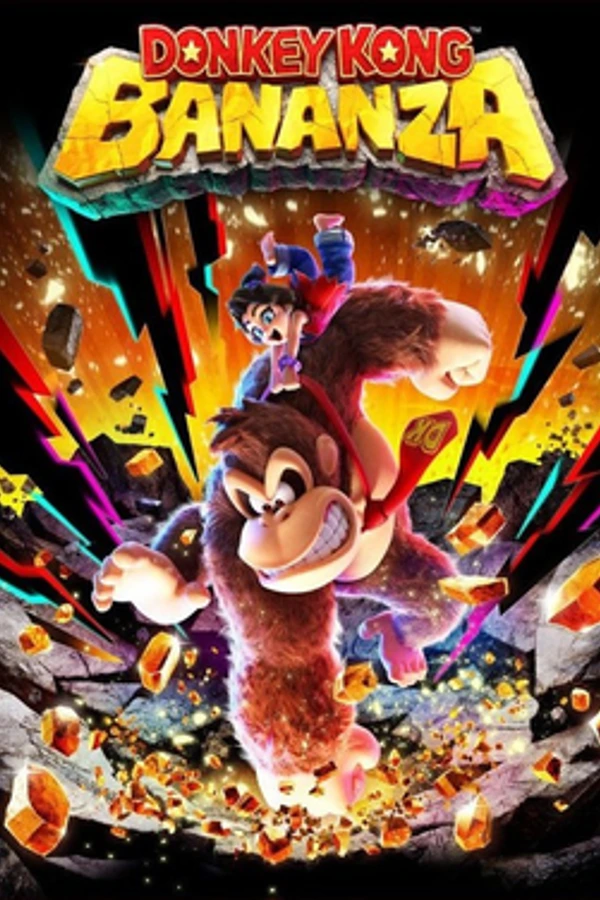
Donkey Kong Bananza PC Recomp
Donkey Kong Bananza
OriginNintendo Switch
TechnologyStatic recompilation (native C/C++)
Available forWindows
View official projectAbout the project
Preservation and reverse-engineering project indexed on PortsNative. Allows running Donkey Kong Bananza (originally for Nintendo Switch) natively on modern platforms such as Windows with performance enhancements and gamepad support.
Official project information
DKB Recomp






DKB Recomp is a static recompilation of Donkey Kong Bananza (Nintendo Switch 2, 2025) into a native Windows x86-64 application with a Vulkan renderer. There is no emulator at run time: the game's ARM64 code is translated to C ahead of time and compiled into one executable, and its graphics calls are answered by a host implementation of NVN 2. It is built on TotK Recomp, which does the same for Tears of the Kingdom on the original Switch.
As far as we know, no other static recompilation of a Switch 2 game is public.
[!IMPORTANT] No game files are included, and none ever will be. You need your own copy of Donkey Kong Bananza, dumped from your own console. Instructions for obtaining those files will not be provided. There are no downloadable builds: everyone builds from their own dump.
Status
Not playable yet. The game boots, goes through the title screen into the tutorial cave, renders the 3D scene and answers the controller: you can walk and punch through the mining tunnel, with the guide movies playing, and one hand-played run reached the Ingot Isle Cave-In section. It still can crash (on NVIDIA two light quads are skipped to avoid a GPU fault, #9), and many effects are missing. There is no release. An installer builds the game from your own dump: docs/installer.md. Progress, day by day: docs/devlog.md.
| Phase | State | |
|---|---|---|
| F0 CPU | ✅ | main and sdk (180,061 functions) lift with no unsupported instruction (ARMv8.3 pointer authentication and LDAPR added). Differential tests against Unicorn pass. |
| F1 OS | ✅ | Boots on TotK Recomp's Horizon host with the Switch 2 differences: RomFS, save, audio, controller. |
| F2 NVN 2 | ✅ | 700 NVN 2 entry points answered; the game loop runs. 51 new command buffer calls (mesh shaders, VRS, DLSS, push constants…) are accepted but not recorded yet. |
| F3 Shaders | ✅ | All 4,820 Ampere shader stages of the first 3D scene go through Eglantine's Ampere-to-Maxwell lowering and TotK Recomp's translator to SPIR-V. |
| F4 Vulkan | ✅ | The title screen and the tutorial's 3D scene render. |
| F5 Playable | 🚧 | Controller, guide movies (VP9) and push constants work. Open: a GPU fault some minutes in on NVIDIA, the black destructible terrain (its geometry stage, #45), some textures, performance outside the tutorial. |
The plan, phase by phase: docs/bananza-plan.md. What is open right now: Roadmap to playable.
How it works
flowchart LR
    subgraph offline["At build time, on your PC"]
        exefs["Your dump: main + sdk<br/>(ARM64)"] --> lifter["Lifter<br/>recomp/"] --> c["C code"] --> clang["Clang"] --> exe["dkb.exe"]
    end
    subgraph runtime["At run time"]
        exe --> host["Horizon host<br/>threads, files, audio, input"]
        exe --> nvn["NVN 2 front end<br/>runtime/nvn_*"] --> vk["Vulkan back end"]
        sass["Ampere shaders"] --> lower["Eglantine lowering<br/>Ampere → Maxwell"] --> xlate["Translator<br/>tools/xlate"] --> spirv["SPIR-V"] --> vk
    end
The longer version is in docs/architecture.md (shared with TotK Recomp) and docs/bananza-shaders.md (the NVN 2 shader work).
How to help
Each open problem is a separate, well-bounded job with its own issue. Pick one, say in the issue that you are on it,
and keep each pull request to one topic. Issues labelled
in progress are
already taken, and the top of the roadmap says what is
being worked on right now.
No code needed, only your PC and your own copy of the game:
- #3 Test on your GPU. Everything so far was checked on one NVIDIA card. Runs on AMD, Intel and other NVIDIA cards, with logs, show what breaks there.
- #7 Play past the tutorial and report where it stops.
- #9 The GPU fault after the first guide movie: seen on three NVIDIA drivers (617.14, 617.42, 621.01); runs on AMD and Intel would show whether it is NVIDIA's.
Code (help wanted):
- #5 Checkerboard textures on some rock surfaces. The Switch 2 GOB layout (f4f7b17) fixes the gold rock in the tutorial cave; the other surfaces still need a check.
- #6 NVN 2 calls not recorded yet: mesh shaders, VRS, DLSS and others.
- Symbols. Function names help debugging. They come from GRAnimated/DKBananza, which welcomes contributions too.
Your first contribution, step by step:
- Build from your own dump (Building from source).
- Run it as in docs/dkb-testing.md and note how far it gets on your machine.
- Report it on #3 or #7, or pick an issue above.
Before you open a pull request, read CONTRIBUTING.md. Its hard rule: nothing that came out of the
game goes into the repository, not in commits, issues or pull requests. Run python tools/check_content.py --staged
before committing; CI runs the same check. Questions go to
Discussions. Everyone taking part follows the
code of conduct.
Support the project
If you want to support the work without writing code, tips go to ko-fi.com/lucasblippng. A tip pays for time on the project; it buys no game files, builds or early access, and everything stays open source here. Starring the repository and sharing it with people who know GPUs, ARM64 or the Switch also helps.
Building from source
The toolchain is TotK Recomp's (docs/building.md): MSYS2 UCRT64 Clang, Ninja, Python 3.12 and the .NET SDK for the shader translator. With the Bananza ExeFS and RomFS from your own dump:
.venv\Scripts\python tools\build_xlate.py
.venv\Scripts\python recomp\gen.py --exefs <exefs> --out generated\dkb100 --modules main,sdk --patches recomp\patches-dkb100.txt
.venv\Scripts\python tools\dkb_expected.py --exefs <exefs> --name dkb100 --display 1.0.0
.venv\Scripts\python tools\dkb_pack_romfs.py --dir <romfs folder> --out build\extracted\dkb100\romfs
.venv\Scripts\python tools\build_game.py --version dkb100 --expected tools\data\expected-dkb100.json --exefs <exefs> --romfs build\extracted\dkb100\romfs
Everything the build writes stays under build\ and generated\, which git ignores. The game uses about 13 GB of
RAM, so 16 GB is the minimum for now. Running and testing: docs/dkb-testing.md.
FAQ
Can I play it? Not yet. It reaches the tutorial and crashes often. Follow the roadmap or the devlog.
Will there be a download? No. The executable is made from the game's own code, so it cannot be shared. Everyone builds it from their own dump; the installer does this for you (docs/installer.md).
Which version of the game? Base 1.0.0. Update 458752 has a different layout and is not supported yet.
Linux? TotK Recomp's toolchain supports Linux, so it is possible; nobody has tried with Bananza yet.
Why GPL? The shader lowering comes from Eglantine (Eden Emulator Project), which is GPL. Files that came from TotK Recomp keep their MIT terms.
How is AI used? Most of the code and documentation is written by AI coding agents (Claude Code), as in TotK Recomp, and checked by running the game and the differential tests. AI-assisted pull requests are welcome; you are responsible for having read and run them.
Credits
- TotK Recomp by valentderah, the base of everything here, and the projects it builds on: LAS Recomp, MacNativeGames, nxnative, SavageWindRecomp, Ryujinx, deko3d, hactool and the rest listed in THIRD_PARTY_NOTICES.md.
- GRAnimated/DKBananza for the game's symbols and research.
- Eglantine (Eden Emulator Project) for the Ampere-to-Maxwell shader lowering and its Switch 2 notes, and Mesa NAK for the SM70+ encodings both build on.
- libvpx for the movies.
- Switchbrew for the Switch 2
GetInfoids, and the Switch homebrew community.
License
DKB Recomp as a whole is under the GNU GPL v3 or later, because it includes Eglantine's GPL Ampere shader
lowering (runtime/third_party/eglantine/). The files that came from TotK Recomp keep their
MIT License; third-party code keeps its own license (THIRD_PARTY_NOTICES.md).
The license grants nothing for Nintendo's game.
DKB Recomp is an independent, non-commercial fan project, not affiliated with or endorsed by Nintendo. Donkey Kong Bananza and Nintendo Switch 2 are trademarks of Nintendo.