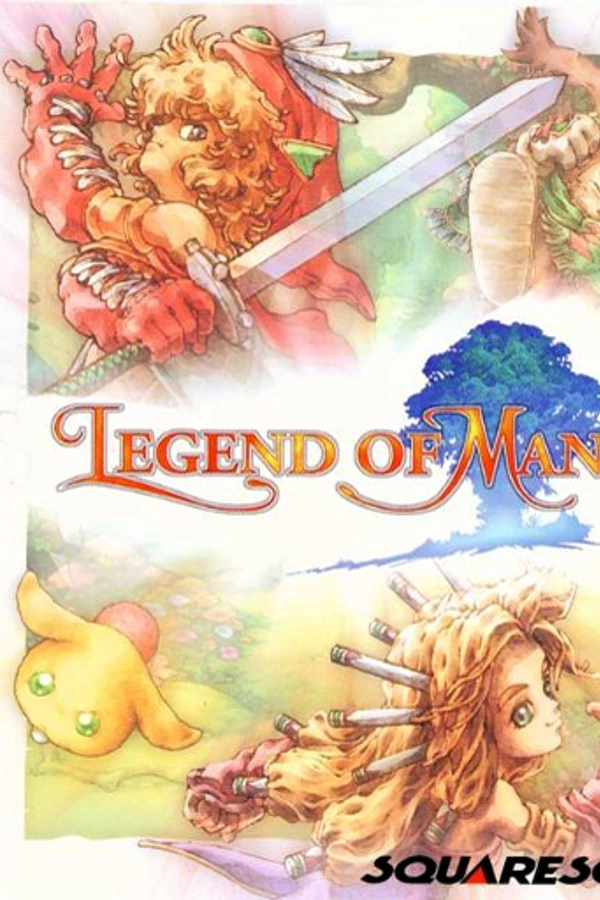
Legend of Mana Decompilation
Legend of Mana
OriginPlayStation
TechnologyDecompilation and reconstruction in C/C++
Available forWindows, Linux, macOS
View official projectAbout the project
Legend of Mana, conocido en Japón como Seiken Densetsu: Legend of Mana es la cuarta entrega de la serie Mana. El juego se lanzó para PlayStation en Japón el quince de julio de 1999 y en Estados Unidos el 7 de junio del año siguiente, con cierta demora en Canadá con respecto a Estados Unidos. La desarrolladora y distribuidora del videojuego fue Squaresoft, aunque la labor de distribución fue llevada en Norteamérica por su filial Square Electronic Arts. En España, no vio la luz hasta el 1 de abril de 2000.
Official project information
Legend of Mana PSX Decompilation
Languages: English | 日本語


A matching decompilation of the PlayStation game Legend of Mana. The project reconstructs readable C source code that compiles to the same machine code as the original game. The North American and Japanese releases are both fully linked from the same C sources.
This project is a decompilation. It is not a recompilation. It is not a source port. The repository does not include the game executable, overlay binaries, artwork, audio, or other copyrighted game data. You must provide the required files from your own legally obtained copy of the game.
The goal of this project is to preserve the original game's logic and behavior for research and modding.
Status
For both versions, every module - the main executable and all 17 overlays - is fully linked. This means the same thing as in other decompilation projects, with one additional requirement: the compressor output must match the .BIN file on the disc byte for byte. That extra check was a useful way to track progress. A module is fully linked when two conditions hold:
- The build produces an ELF whose bytes match the original decompressed file, and
- Running the project's compressor on that ELF (stripped to a raw binary) reproduces an exact replica of the
.BINfile as it appears on the disc.
In other words, the round trip is bit-identical:
- Start with the original
.BINfrom the disc. - Decompress it.
- Compile the C source into an ELF.
- Compress the ELF.
- The result is the same
.BIN.
The main executable is not compressed, so for SLUS_010.13 and SLPS_021.70 condition 1 is the whole check: the linked ELF, converted to a raw binary, equals the disc file.
(Check out the compressor! It's honestly really amazing that it is bit identical and kind of extraneous, but cool nonetheless!)
Run make verify-bins to check every module, or make verify-bins VERSION=jp for the Japanese version.
Supported versions
| Item | North America | Japan |
|---|---|---|
| Disc serial | SLUS-01013 | SLPS-02170 |
| Main executable SHA-1 | d11dfdd50d412ac3fa3e2eb80fbde138da118f27 | b067188a92e4de9a4db7bb7e5343c757e9884bfa |
Disc image (.bin) SHA-1 | c1b536c99f0d390584eb30462a7e37f2bbef3902 | 7a314615be8a482cf3f81b4101cc19aaa738f36d |
Other regional versions are not currently supported.
Documentation
Browse the documentation index for architecture guides and project references. Useful starting points include:
- Tools index - asset tools, scene extraction and test commands.
Requirements
You need:
- Git
- Docker - Docker Desktop on Windows/macOS or Docker Engine on Linux.
- A legally obtained copy of Legend of Mana, North American or Japanese.
- A tool that can extract files from a PlayStation disc image.
Everything else is provided by the development container.
Getting started
These steps use the North American version. For the Japanese version, put its files under disc/jp/ and add VERSION=jp to each make command.
1. Clone the repository
git clone --recursive https://github.com/celophi/lom-decomp.git
cd lom-decomp
If you already cloned without submodules:
git submodule update --init --recursive
2. Add the original game files
Extract the main executable and the BIN directory from your disc image into disc/us/:
disc/
`-- us/
    |-- SLUS_010.13
    `-- BIN/
        |-- ADDHERO.BIN
        |-- CARDA.BIN
        `-- ...
The build only needs these files. The scene extraction tools also read the disc's ANA/ directory, which you can pass in from wherever you keep it.
disc/is gitignored. Never commit original game files.
3. Build the Docker images
Run these from the repository root. You only need to do this once.
docker build -t old-gcc/gcc-2.8.0-psx -f tools/external/old-gcc/gcc-2.8.0-psx.Dockerfile tools/external/old-gcc
docker build -t old-gcc/gcc-2.7.2-cdk -f tools/external/old-gcc/gcc-2.7.2-cdk.Dockerfile tools/external/old-gcc
docker build -t old-gcc/gcc-2.6.0-psx -f tools/external/old-gcc/gcc-2.6.0-psx.Dockerfile tools/external/old-gcc
docker build -t old-gcc/gcc-2.7.2-psx-gnu -f dockerfiles/gnu-as.dockerfile tools/external/old-gcc
docker build -t lom-toolchain -f dockerfiles/toolchain.dockerfile .
docker build -t lom-dev -f dockerfiles/dev.dockerfile .
4. Start the container
Run this from the repository root.
PowerShell, bash, or zsh:
docker run --rm -it -v "${PWD}:/lom" lom-dev
Windows Command Prompt (cmd.exe):
docker run --rm -it -v "%cd%:/lom" lom-dev
The remaining commands run inside the container.
5. Split the original binaries
make splat
This checks your files against the expected SHA-1 hashes, then generates the assembly, linker scripts, and assets the build needs.
6. Build and verify
make everything
make verify-bins
make everything builds the main executable and all 17 overlays into build/us/. make verify-bins checks that every one of them is fully linked.
Troubleshooting
make splat reports a missing file or SHA-1 mismatch
Make sure the files are at disc/us/SLUS_010.13 and disc/us/BIN/*.BIN (or disc/jp/SLPS_021.70 and disc/jp/BIN/*.BIN for the Japanese version), without renaming them. A SHA-1 mismatch with the right paths usually means the files come from a different release or a bad dump; compare them with Supported versions.
Docker cannot find an old-gcc/... image
Initialize the Git submodules, then build the Docker images in the order shown in step 3 of Getting started.
GCC reports Value too large for defined data type
The old 32-bit compilers cannot read files on Windows-backed Docker mounts, so the Makefile copies sources to /staging inside the container and compiles from there. Use the Makefile instead of compiling directly from /lom. Run make recopy if the staged tree needs to be refreshed.
Make targets
| Target | Purpose |
|---|---|
make | Build the main SLUS_010.13 ELF. |
make bin | Also produce build/us/SLUS_010.13.bin. |
make <overlay> | Build one overlay, such as make field. |
make overlays | Build all 17 overlays. |
make everything | Build the main executable and all 17 overlays. |
make splat | Decompress the overlays and split every binary into assembly, linker scripts, and assets. |
make objdiff-objects | Build target and reconstructed objects for objdiff. |
make objdiff-config | Regenerate objdiff.json. Open the repository root in objdiff to compare functions. |
make progress | Generate build/us/progress.json. |
make diff-all | Run objdiff across all configured units. |
make diff-text | Report functions that do not match yet, under build/us/diffs/. |
make dump-objs | Disassemble built objects for code-generation analysis. |
make validate-assets | Round-trip and validate format-aware assets. |
make verify-main | Check that the linked main executable equals disc/us/SLUS_010.13 (verify-slus is an alias). |
make verify-<overlay> | Check one overlay against its disc file, such as make verify-field. |
make verify-bins | Check the main executable and all 17 overlays against the disc files. |
make verify-compressor | Verify the compressor against the 17 original overlay files of the selected version. |
make recopy | Force source/config files to be copied to /staging again. |
make clean | Remove build output and /staging. |
Every target builds the North American version by default. Add VERSION=<name> to select another release, e.g. make VERSION=jp.
Tool tests and data extraction targets are listed in tools/README.md.
Repository layout
lom-decomp/
|-- src/
|   |-- common/        # Code shared by several overlays
|   |-- main/          # Main executable
|   |-- overlays/      # The 17 overlays
|   `-- psyq/          # Psy-Q SDK libraries
|-- include/           # Headers
|-- config/<version>/  # Splat configs, symbols, relocations
|-- mk/                # Build rules
|-- tools/             # Build, data, and verification tools
|-- docs/              # Architecture and reference docs
|-- dockerfiles/       # Development and CI images
`-- disc/<version>/    # Your game files (gitignored)
asm/, linker/, assets/ and build/ are generated per version and gitignored.
Compiler and assembler toolchains
A critical detail of this project is that not every source file uses the same compiler configuration. Honestly, it was a lot of "fun" dealing with this. Especially the GNU one let me tell you.
The build defines 7 pipeline variants across four historical compiler builds. Compiler and assembler flags live in mk/toolchains.mk. Source routing is in mk/main-sources.mk for the main executable and mk/overlay-registry.mk for the overlays. Per-file overrides for the main executable are in mk/main.mk; mk/overlays.mk applies the overlay variants.
| Pipeline | Compiler flags | Assembly path |
|---|---|---|
| GCC 2.8.0 G0 (default) | -O2 -G0 -gcoff -fsigned-char | maspsx, ASPSX 2.77, expanded division |
| GCC 2.8.0 G0, unoptimized | -O0 -G0 -gcoff -fsigned-char | maspsx, ASPSX 2.77, expanded division |
| GCC 2.8.0 G4 | -O2 -G4 -gcoff -fsigned-char | maspsx, ASPSX 2.77, expanded division |
| GCC 2.8.0 G4, no division expansion | -O2 -G4 -gcoff -fsigned-char | maspsx, ASPSX 2.77, bare division |
| GCC 2.7.2 CDK G0 | -O2 -G0 -msoft-float -gcoff | maspsx, ASPSX 2.67, expanded division |
| GCC 2.7.2 GNU G0 | -O2 -G0 | Historical GNU as with -O -EL |
| GCC 2.6.0 G0 | -O2 -G0 -gcoff -msoft-float | maspsx, ASPSX 2.34, expanded division |
Reverse-engineering provenance
This project was created independently by analyzing the publicly released retail version of Legend of Mana and reconstructing its behavior and machine code through disassembly, decompilation, binary comparison, runtime analysis, and publicly available technical documentation and tools.
No leaked or otherwise non-public Legend of Mana source code, debug symbol files, internal symbol maps, developer documentation, or other confidential materials from Square or Square Enix have been used in the creation of this project.
Function names, variable names, data structures, translation-unit boundaries, and other source-level details are reconstructed or inferred from the retail binaries and observed behavior unless otherwise documented. They should not be assumed to be the names or organization used by the original developers.
This repository will never include leaked source code, private debug symbols, confidential documentation, or other non-public materials from the original game's development.
Legal
See LICENSE and THIRD_PARTY_NOTICES for licensing details.
The MIT License applies to original material authored for this project to the extent that the contributors hold the rights necessary to license that material. It does not grant rights to preexisting copyrighted material originating from the original game or from third-party SDKs, libraries, or development software.
This repository is an independent reverse-engineering and preservation project. It is not affiliated with or endorsed by Square, Square Enix, Sony, or any other rights holder.
No original game executable, overlay binaries, artwork, audio, or other copyrighted game data should be committed to this repository. You must supply required data from your own legally obtained copy of the game.
Legend of Mana and related names and assets are the property of their respective owners.
Thanks
Thanks to Squaresoft and everyone who worked on Legend of Mana. The art, the music, and all the strange little ideas make this a game worth coming back to. You can tell the team was willing to try things, and that's a big part of what makes it interesting.
Figuring out how it all works has been a lot of fun. There's still plenty to understand, but hopefully this project helps preserve that work and gives other people a chance to explore it too.
Tools and acknowledgements
This project builds on tools and research from the wider decompilation community, including: