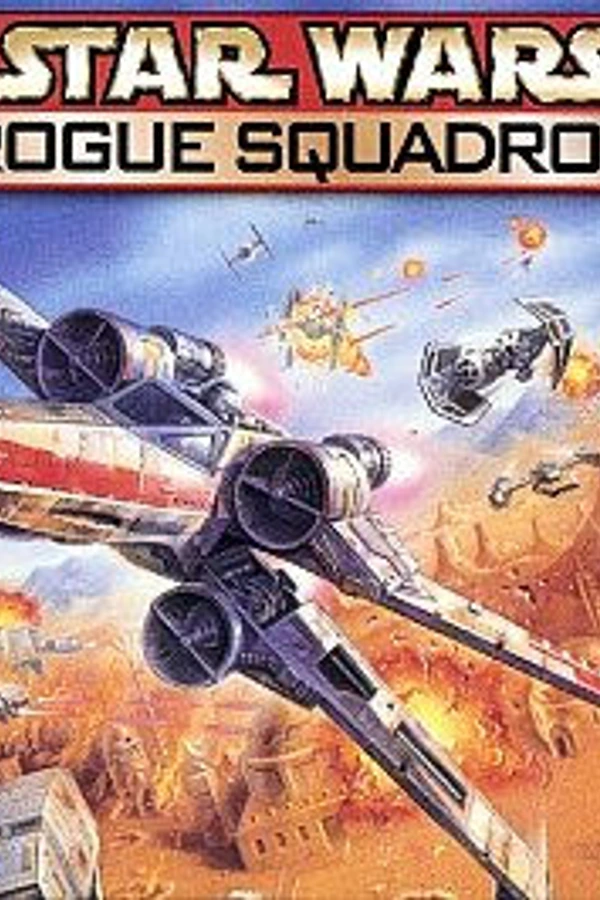
Star Wars: Rogue Squadron (PC)
Star Wars: Rogue Squadron
OriginNintendo 64
TechnologyStatic recompilation (native C/C++)
Available forWindows, Linux, Android
View official projectAbout the project
Star Wars: Rogue Squadron es un videojuego de acción y aventura publicado por Lucasfilm Games en 1998.
2 versions of Star Wars: Rogue Squadron
You're viewing: Star Wars: Rogue Squadron (PC)
Official project information
Rogue Squadron 64 Recompiled
</div>A static recompilation of Star Wars: Rogue Squadron (USA v1.0) for the N64 built with N64Recomp and N64ModernRuntime, rendering through a forked RT64 that understands Factor 5's custom display-list format.
[!IMPORTANT] Heavily AI-assisted. Most of the debugging, architectural decisions, and code here were produced with Claude.
<div align="center">
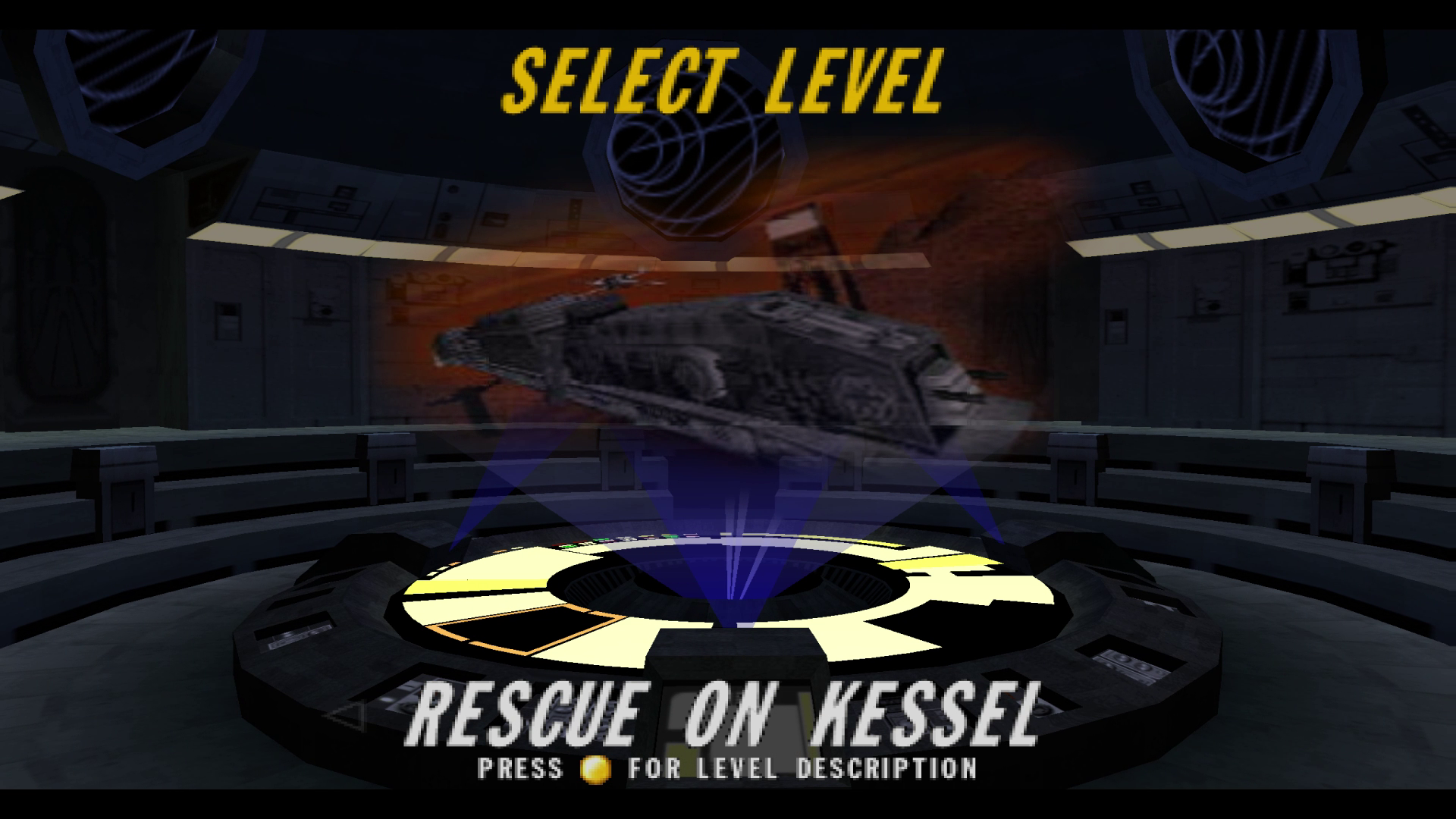
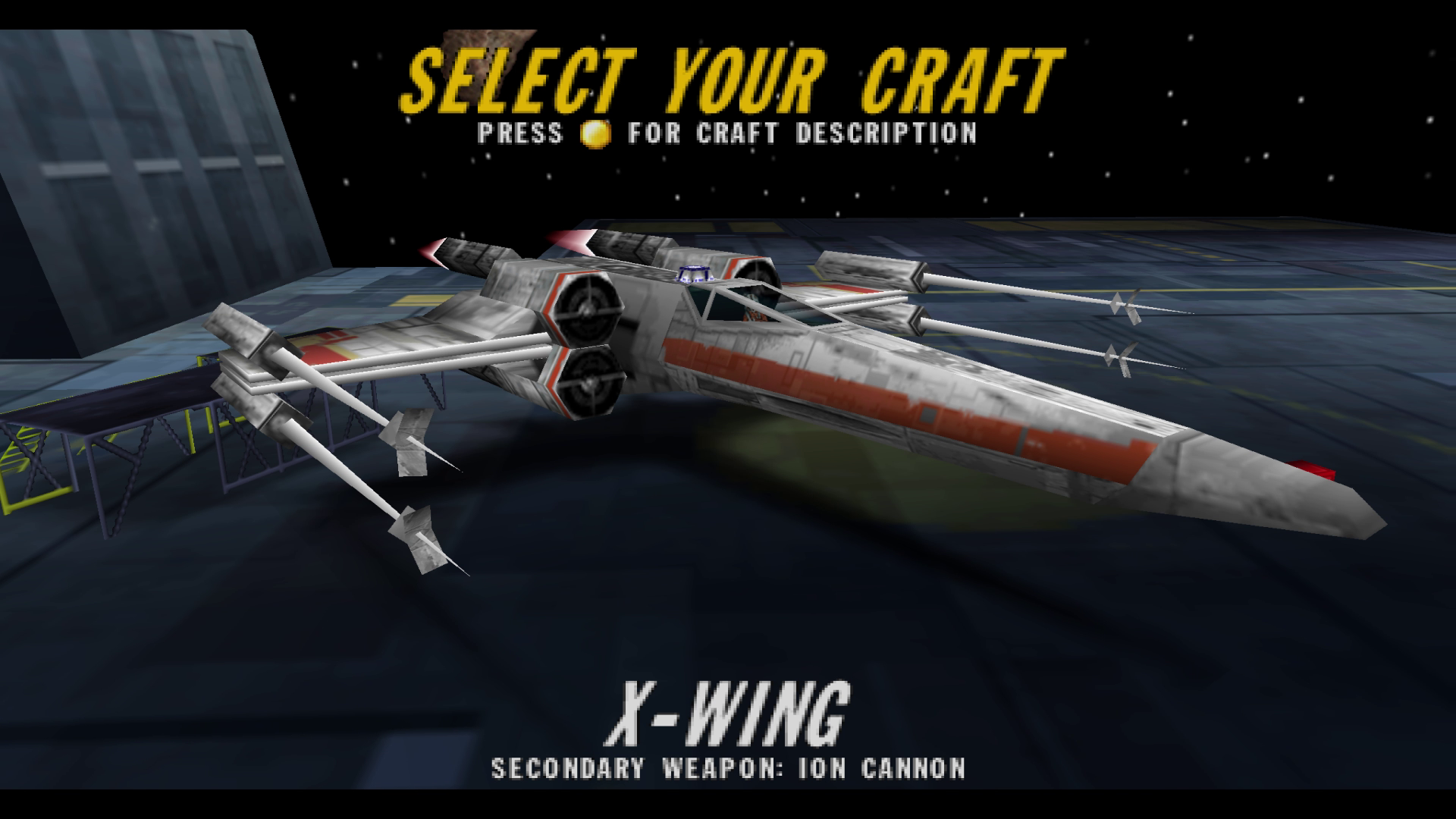
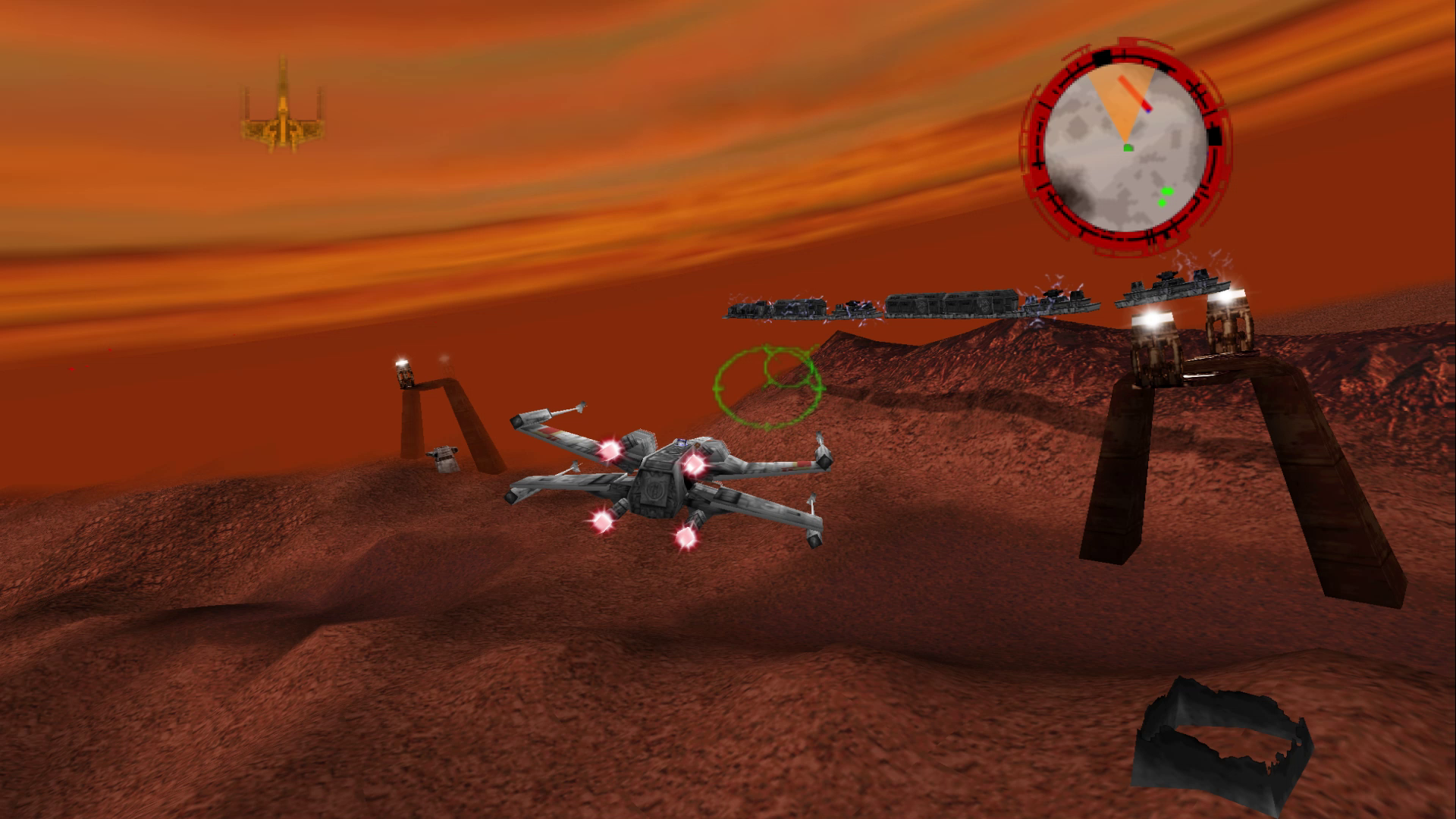
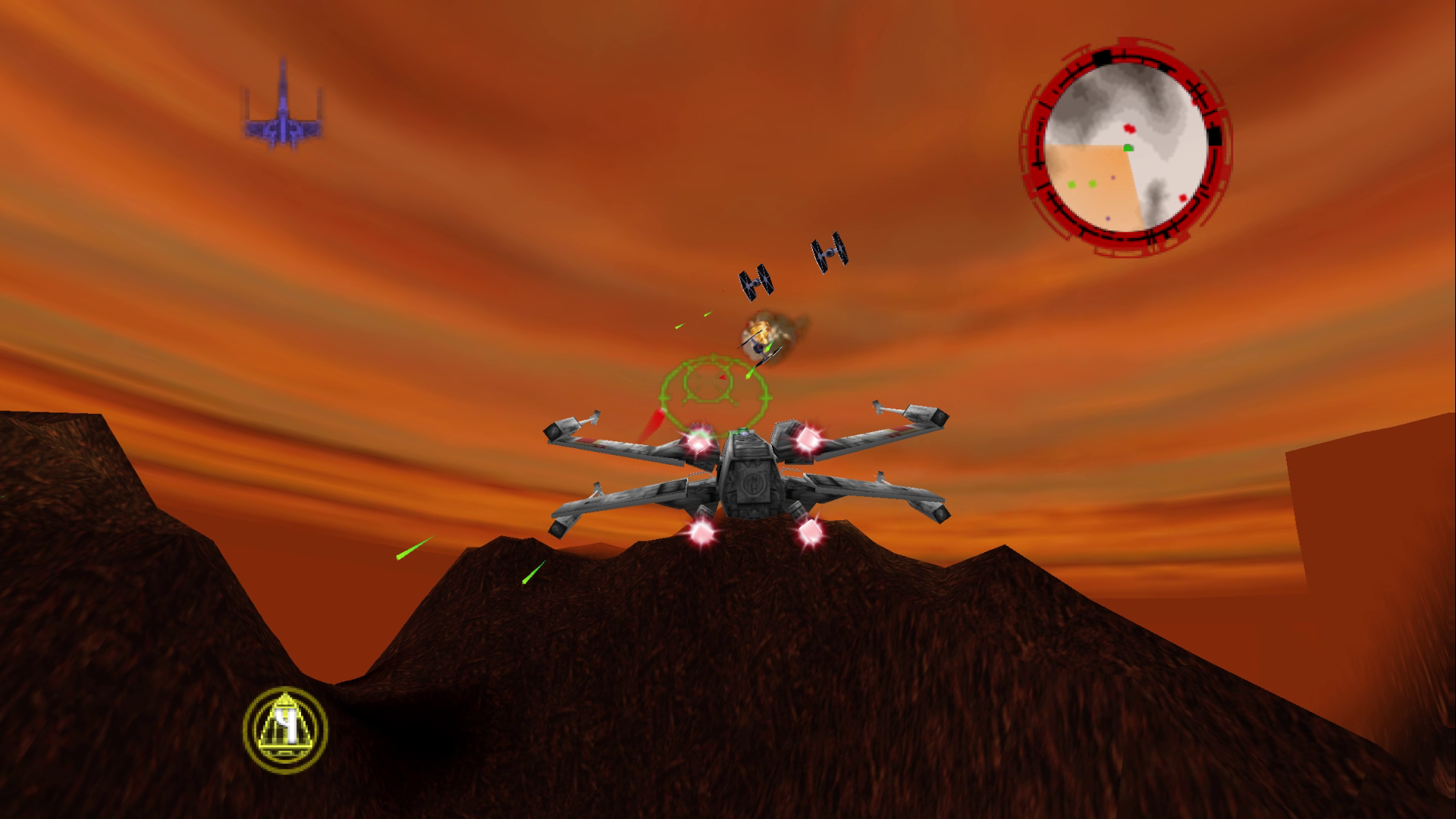
Screenshots
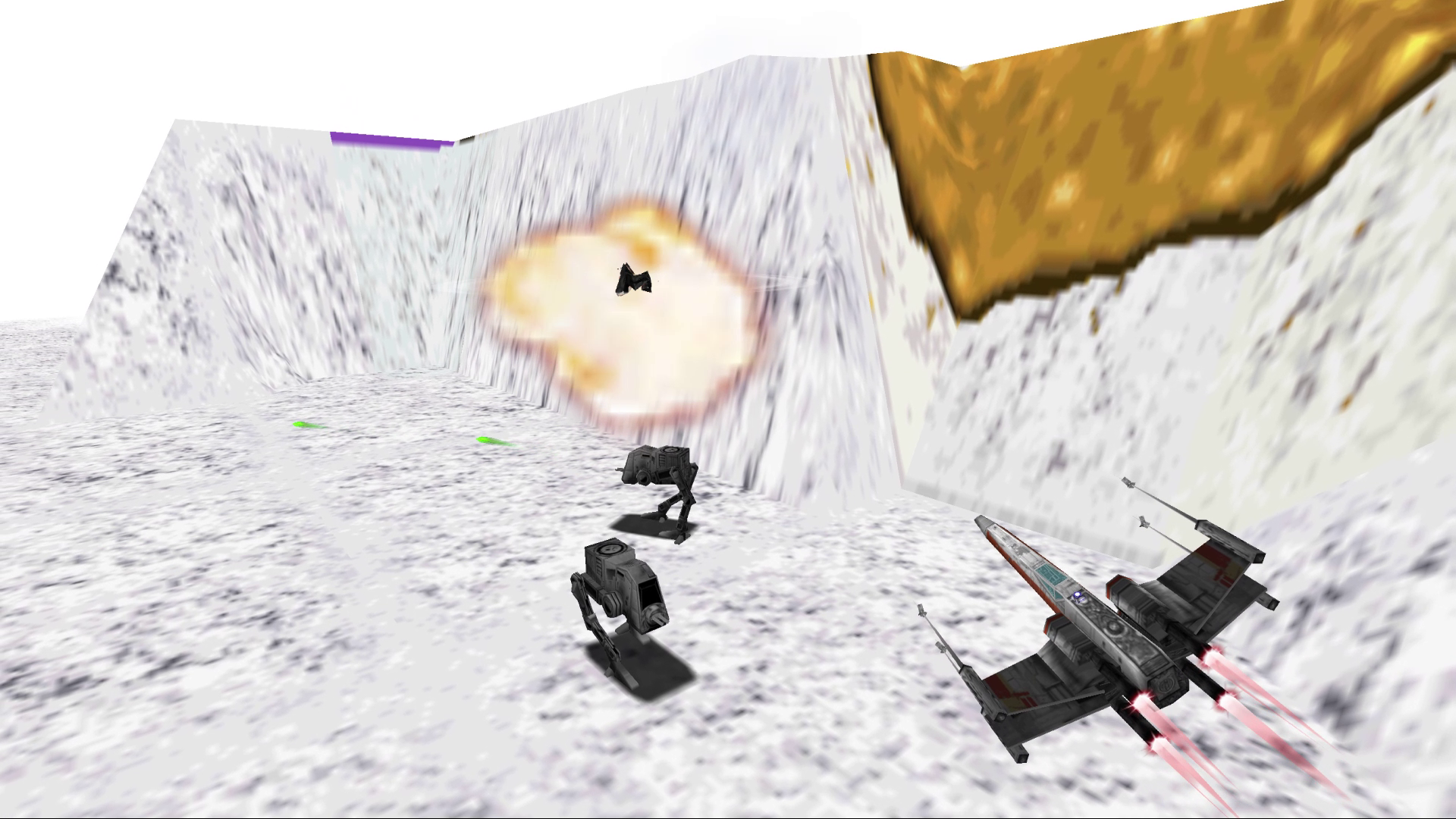 | 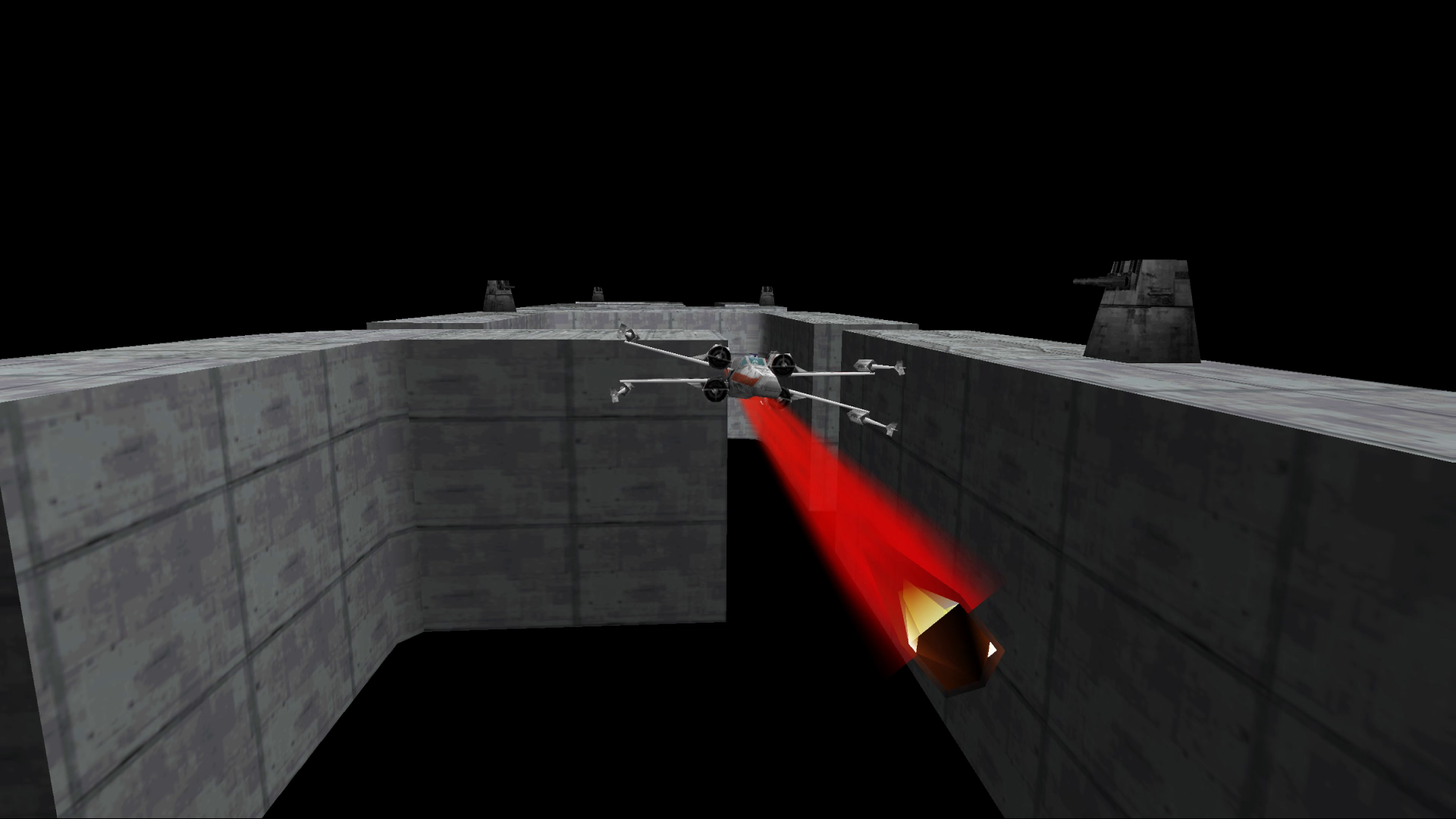 | 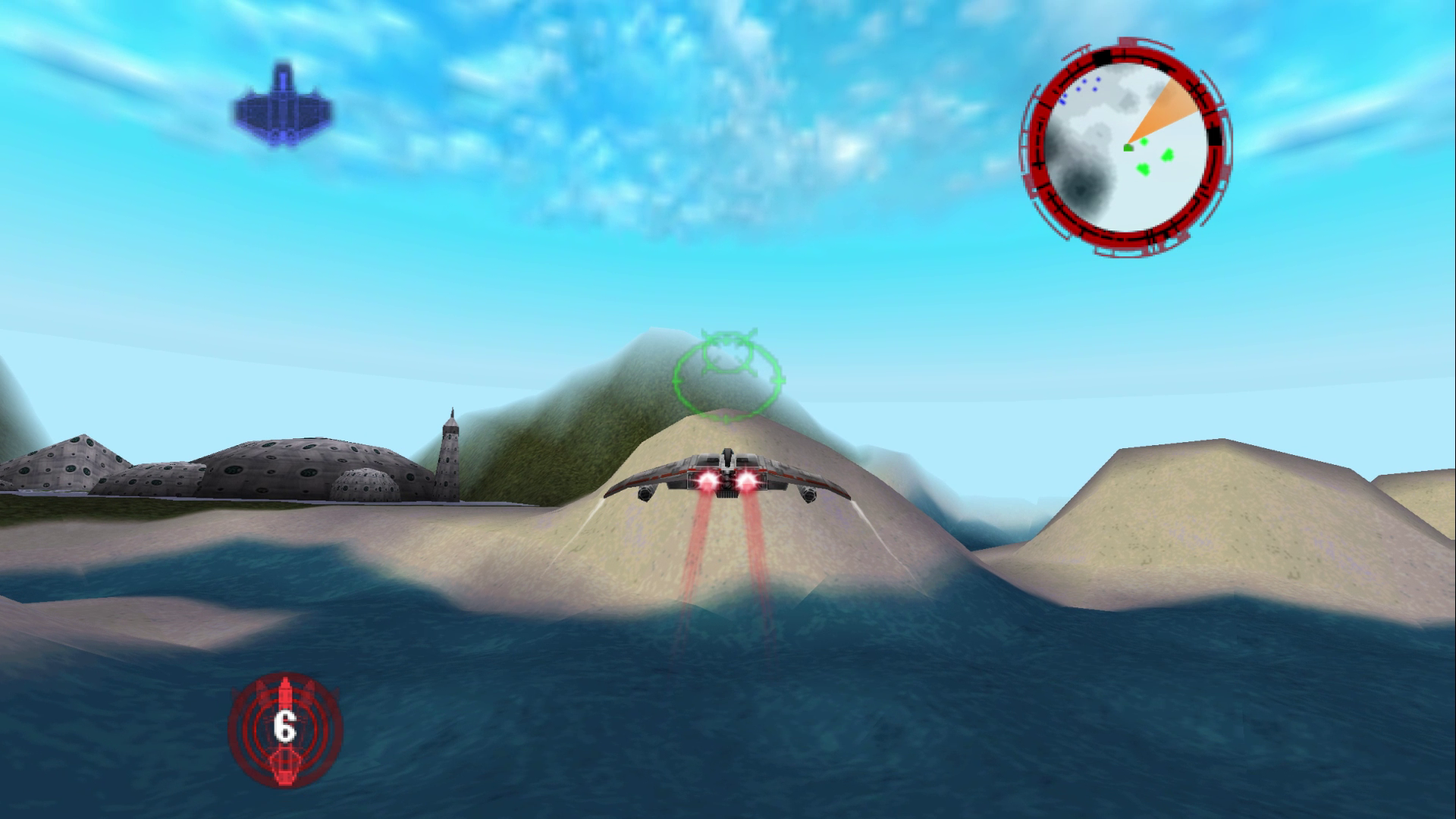 |  |
|---|---|---|---|
 |  |  | 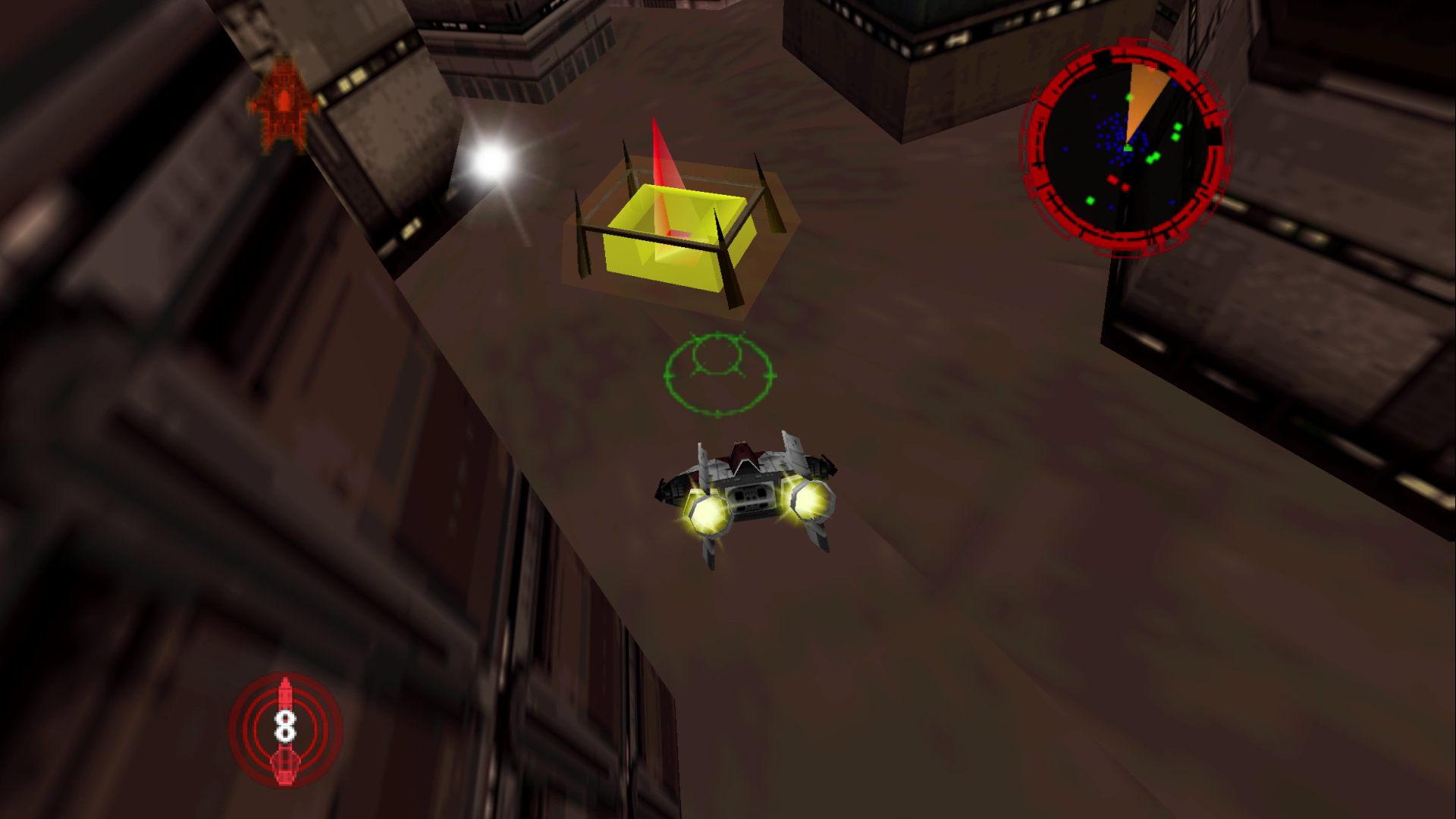 |
Minimum Requirements
<div align="center">| Requirement | Details |
|---|---|
| ROM | Star Wars: Rogue Squadron (USA v1.0) .z64, .v64 or .n64 (xxHash3-64 0x6B66A44153594DEA) |
| OS / Platform | Graphics Backend |
|---|---|
| Windows 10+ x64 | Vulkan, D3D12, D3D11, D3D10 |
| Windows 10+ x86 (32-bit) | Vulkan, D3D12, D3D11, D3D10 |
| Linux x64 (glibc 2.38+) | Vulkan |
| Linux arm64 / armhf (glibc 2.38+) | Vulkan |
| Linux x86 (32-bit)** (glibc 2.38+) | Vulkan |
| Android 9+ arm64 | Vulkan 1.1 |
| macOS 11+ arm64 (Apple Silicon)* | Metal |
| macOS 11+ x86_64 (Intel)* | Metal |
*macOS builds but hasn't been run on a Mac yet (see macOS)
**The 32-bit x86 Linux build has only been tested on a 64-bit PC with software Vulkan.
Per-platform minimum requirements.
Features
Graphics
- High resolutions: high resolution options, with optional MSAA, SSAA or FXAA anti-aliasing & HDR.
- Widescreen: extends the screen (and camera FOV) beyond the old 4:3 aspect ratio.
- Longer draw distance: see much farther away by up to 8x the original, set with the DRAW DISTANCE slider in Display Settings. Has some caveats.
- Frame Interpolation: smooths the game's native ~30 fps to match your monitor's refresh rate.
- Support for Texture packs: RT64 texture-replacement packs load at startup.
- Ray Tracing Support: reflections, shadows, dynamic lights from lasers and explosions, and light shafts through fog. experimental.
Input
- Keyboard and mouse: fly with the mouse and fire with the mouse buttons.
- Menu navigation with the Mouse: ability to seamlessly select and control menu navigation exclusively with the mouse via cursor placement, LMB (Start) & RMB (Back)
- Gamepads: any SDL-supported controller works, with gamepad lightbar support.
- Flight sticks and H.O.T.A.S.: use the throttle lever to set your speed, and twist or rudder roll.
- Rumble: the game's own Rumble Pak effects play on gamepads and force-feedback joysticks. Fully adjustable in
roguesq_input.json. - Full rebinding: press F6 in-game to rebind actions, change sensitivity, adjust deadzones, and rumble settings OR use the Control Settings Mod. See Controls.
- Touch controls on Android: tap menu and in-game buttons and fly with an on-screen stick. You can move and resize the buttons, and turn on 'gyro steering' to help fine tune your aim.
Languages
- English (en), German (de) and French (fr): picked under OPTIONS > LANGUAGE. Affects menus, mission text and subtitles while voice acting remains in English.
Multiplayer (experimental)
- Online two-player co-op: host or join from a MULTIPLAYER page on the main menu.
- Co-op over Steam using the
steam-relaymod (Desktop ONLY): with Steam running, HOST GAME lists your game on Steam, and JOIN GAME shows the open games to pick from (locked ones ask for their password). Steam sees the game as Spacewar (app id 480).- The Steam API library is not included: download the Steamworks SDK (version 1.65, from partner.steamgames.com, any Steam login) and copy
redistributable_bin/win64/steam_api64.dll(Windows),redistributable_bin/linux64/libsteam_api.so(Linux) orredistributable_bin/osx/libsteam_api.dylib(macOS) intomods/steam-relay/. Without it, or with Steam closed, the MULTIPLAYER will default to using direct connections. - Linux needs the native Steam package (Flatpak and Snap Steam are not supported); on Steam Deck, add the Linux build as a non-Steam game; on macOS, remove the download quarantine with
xattr -d com.apple.quarantine mods/steam-relay/libsteam_api.dylib.
- The Steam API library is not included: download the Steamworks SDK (version 1.65, from partner.steamgames.com, any Steam login) and copy
- Co-op using a self-hosted relay server: anyone can run
rs64_relay, a small console server for Windows and Linux, and players type its address into the MULTIPLAYER address box, just like a friend's IP. The game remembers the server, HOST GAME lists games there and JOIN GAME shows them. Setup is in docs/guides/relay-server.md. - See docs/guides/multiplayer.md for more details.
[!NOTE] Steam-Relay mod on Linux, Steam Deck and macOS are untested.
Mods
- Mod support: turn mods on and off in the Mods panel of the F6 window. (some might require resetting the game)
- Developers can use mods/platforms.json to automatically include mods in builds based on platform.
- See docs/guides/modding.md for modding info.
- Included mods:
- Display Settings: 'Display Settings' UI in the main menu under 'Options' -> 'Game Settings' and in the pause menu. Also contains the Ray Tracing and Fullscreen toggle.
- Control Settings: new Controls UI allowing the adjustment of sensitivity, acceleration, deadzone, rumble and Input Bindings. All while using in-game UI.
- Multiplayer: online co-op (see above).
- Larger Object Pool: doubles the number of ships, lasers, and explosions the game can track at once, so busy missions stop resetting pooled objects.
- Long Tow Cable: the snowspeeder's tow cable is long enough to wrap an AT-AT several times.
- Quit Prompt: a prompt in the main menu asking if you want to quit.
- Invincibility: your craft takes no damage.
- Any Craft, Any Mission: fly any ship on any level.
Running
Put rogue_squadron.z64 (or rogue_squadron.v64 / rogue_squadron.n64) in the working directory (the executable's folder when you double-click it) and launch. The ROM hash is checked and the ROM is imported on first launch.
Controls
Keyboard, mouse, gamepad, and flight sticks / HOTAS all work; no controller is required. The keyboard and joystick defaults for the most part follow the PC version (Rogue Squadron 3D).
Actions are for the game's default Luke controller setting. The other controller presets in Options rearrange them.
<div align="center">| Action | Keyboard | Mouse | N64 | Gamepad | Joystick / H.O.T.A.S. |
|---|---|---|---|---|---|
| Steer | <kbd>↑</kbd>,<kbd>↓</kbd>,<kbd>←</kbd>,<kbd>→</kbd> (<kbd>A</kbd>/<kbd>D</kbd> turns) | Mouse X/Y | Analog stick | Left stick | Stick X/Y |
| Fire blasters | <kbd>Space</kbd> | <kbd>LMB</kbd> | B | X | Button 1 (trigger) |
| Fire secondary | <kbd>Alt</kbd> | <kbd>RMB</kbd> | C-Left | Back | Button 2 |
| Fire mode | <kbd>X</kbd> | — | C-Down | B | Button 6 |
| Thrust | <kbd>W</kbd> | — | A | A | Button 3 |
| Brake | <kbd>S</kbd> | — | Z | Left trigger | Button 4 |
| Speed (positional) | — | — | — | — | Throttle lever |
| Roll | <kbd>E</kbd> | — | R | Right shoulder | Button 7 + twist joystick |
| Special | <kbd>F</kbd> | — | C-Right | Guide | Button 5 |
| Cockpit | <kbd>C</kbd> | — | D-Pad Up | D-Pad | — |
| Standard | <kbd>V</kbd> | — | D-Pad Down | D-Pad | — |
| Close view | <kbd>B</kbd> | — | D-Pad Right | D-Pad | — |
| Switch view | <kbd>N</kbd> | — | L | Left shoulder | Button 8 |
| In-Game Profiler HUD | <kbd>F5</kbd> | — | — | — | — |
| Look around | <kbd>Q</kbd> | — | C-Up | Y | Hat |
| Drop camera | <kbd>Z</kbd> | — | D-Pad Left | D-Pad | — |
| Menu confirm | <kbd>Enter</kbd> | — | A | A | Button 3 |
| Back | <kbd>Backspace</kbd> | — | B | X | Button 1 |
| Pause | <kbd>Esc</kbd> | — | Start | Start | — |
-
Mouse flight steering: mouse cursor is automatically captured when the game window is focused.
- Mouse motion steers the craft, left click fires blasters, right click fires the secondary weapon.
- The cursor displays when the window loses focus, the (F6) Controls window is open, or when RT64's (F1) inspector is up.
-
Rumble: the game's own Rumble Pak effects (hits, collisions, terrain scrapes, weapons, the death spiral, and crashing) play on gamepads and on joysticks supporting rumble or force feedback.
- Hits get stronger with the damage taken, and the rumble keeps going through the death spiral.
- Rumble and its individual effects can be tuned in the (F6) Controls window, or in the
rumblesection ofroguesq_input.json.
-
Flight sticks and H.O.T.A.S.: any devices named "joystick" will be bound as a joystick.
- A stick with exactly three axes, or a device named "throttle", gets its lever bound to Throttle.
- The throttle sets your speed by position: full back is the craft's slowest, full forward is fastest, and middle is normal speed.
- Other axes can be bound from the Controls window (F6)
-
Lightbar support via DualShock 4 & DualSense: light bar color will change depending on the state of the game.
- Colors configurable from the
lightbarsection inroguesq_input.json
- Colors configurable from the
[!TIP] When binding the throttle, move the lever to the opposite position, click Rebind on 'Throttle', then push/pull it forward/back.
Twist grip or rudder pedals can do one of two things depending on how you bind them. Bind them to StickLeft/StickRight and they'll add to
stick Xsince inputs on the same stick direction add together.Bind them to RollLeft/RollRight and they'll give a dedicated roll axis. Hold the 'Roll' button then twist to roll.
Function Hotkeys
| Key | Action | Builds |
|---|---|---|
| <kbd>F1</kbd> | RT64's ImGui overlay (configuration, texture dumping, per-call debugger, render-target view) | Debug |
| <kbd>F2</kbd> | Toggle ray tracing | All |
| <kbd>F3</kbd> | ViewRDRAM mode | All |
| <kbd>F4</kbd> | Texture replacement | All |
| <kbd>F5</kbd> | In-game profiler HUD | All |
| <kbd>F6</kbd> | Controls window (rebinding, joysticks, rumble, mouse) | All |
| <kbd>F9</kbd> / <kbd>Shift</kbd>+<kbd>F9</kbd> | Step forward / back through the ray tracing debug views | All |
| <kbd>F12</kbd> | Write a crash dump to dumps/crash-dumps/ (Windows only) | All |
| <kbd>Print Screen</kbd> | RenderDoc frame capture (set ROGUESQ_RENDERDOC=<path to renderdoc.dll>, Windows only) | All |
- The current ray tracing debug view is named in a notice at the bottom right.
- Set
ROGUESQ_FULL_DUMP=1for a full-memory crash dump. - With RenderDoc loaded, F12 also takes a capture alongside the crash dump. Launching from RenderDoc works too, without
ROGUESQ_RENDERDOC. - F1 needs RT64 developer mode, on by default in Debug (
ROGUESQ_HLE_DEV_MODE=1turns it on in Release). - In Debug builds the RT64 inspector owns the ImGui overlay, so press F1 before F6.
Rebinding controls
Rebind in-game under Options > Controller Settings (the Controls Menu mod, on by default), which lists the actions for the keyboard, gamepad or joystick you open it with. Or press F6 for the Controls window:
- Click Rebind or Add on an action, then press a key or button or move an axis. Clear removes the selected binding.
- Joysticks / H.O.T.A.S. shows each joystick's axes live, with invert and deadzone settings.
- Rumble holds the rumble settings, plus mouse sensitivity and axis invert.
Bindings are saved to roguesq_input.json next to the executable.
Status
[!NOTE] The game is completely playable from beginning to end.
Recomp. specific Issues
-
Ray Tracing is implemented but has some issues:
- There are situations where light 'sticks' to the player and begins to flicker
- Odd shadows in places
- Incorrect shadow reflections
- Some/parts of objects not reflecting in the water at all
- Incorrect shadow reflection culling when look at the water from and obleak angle
-
Cutscenes don't seem to use the water plane or new terrain renderer during cutscenes.
-
When using base setting + no mods homing missiles don't attract to targets like normal (This an caused from the draw distance changes?) In turn would a larger draw distance affect homing missile tracking in general for both the player and the turret/enemy like the turret being able to track the player farther than usual?
-
World devestators show signs of 'flickering in place' especially by the feet (and the feet's top segment) of the devestator when frame interpolation is on.
-
When Draw distance is at Max I've seen what looks like a red laser streak across the whole screen when playing the calamari mission. (Issue with interpolation + object pooling?) Specifically can be seen after taking out the 2nd devestator and flying towards the city.
-
A few firework effects (maybe 1 or 2 types?) don't display during the end cutscene. Could be an object pooling issue but not sure.
-
Frame rate seems to drop temporarily when the game initially loads into the Profile Select menu (menu transition coming in looks choppy) due to things like glpyhs, graphics amd music loading on the fly.
Game specific Issues
-
Some CPU performance hitching and slowdown (~20fps) in spots (although not as bad as the real N64 game). This is expected since the game is very CPU heavy with a lot of systems running off of counters based on a variable timestep. CPU heavy in the sense that the game has it's own internal scheduler meaning majority of the time it's actually waiting on a counter or something to 'finish'.
-
Cutscenes have screen sizes of varying widths, which could genuinely be an issue with the game itself. (Some cutscenes have black bars on the sides or additional padding, but some don't)
-
Shooting at the lava or colliding against the ground in Raid on Sullust produces fire balls that look dim/muted compared to the other bigger lava explosion effects in the level
-
Terrain tile and normal textures don't align perfectly and seem to have a slight cut off.
-
The starfield in the background used during the credits sequence is really that blurry with visible artifacts everywhere.
-
Lasers + missiles popping out of existance due to the number of them being generated at once. This is normal game behaviour based on pre-defined budget. There's a larger-object-pool mod that extends this limit.
Draw distance Caveats
- Buildings, turrets and units the game hasn't woken yet show in their starting pose, frozen until you get within the game's own range (about
1.5x). - With LEGACY TERRAIN on (Display Settings > ADVANCED), the draw distance is capped at
1.3x.
Roadmap
- RS64 Explorer Fixes & Improvements
- Terrain texture painting
- Path authoring
- Level event & objective scripting
Building
Build Requirements
<div align="center">| OS/Platform | Requirement |
|---|---|
| Windows 10+ | CMake 3.20+, MSVC with the ClangCL toolset with a MIPS Toolchain* |
| Linux | CMake 3.20+, Clang or GCC |
*Uses mips64-elf-gcc.exe and mips64-elf-ld.exe to compile the patches ELF (patches/).
1. Clone with submodules
git clone --recurse-submodules https://github.com/MikeSemicolonD/RogueSquadron64Recomp.git
cd RogueSquadron64Recomp
lib/ holds forks of N64ModernRuntime and rt64, forked because the upstream libraries don't support Factor 5's custom microcode. N64ModernRuntime also contains a forked/modified version of N64Recomp.
enet6 and miniupnp are used exclusively for the multiplayer co-op mod.
[!NOTE] A setup script can do steps 2 - 4 for you.
It'll ask for the ROM, check for missing tools, then create a Release build.
Re-run it after a
git pull:powershell -ExecutionPolicy Bypass -File tools\setup\setup.ps1 # Windowsbash tools/setup/setup.sh # Linux
2. Produce the decomp ELF
The recompiler needs an ELF of the game: the ROM's code with every function named and its bounds. You make it from your ROM with the companion rogue_squadron64 decomp, cloned next to this repo. From this repo (using Python 3.11+):
git clone https://github.com/MikeSemicolonD/rogue_squadron64.git ../rogue_squadron64
cp path/to/rogue_squadron.z64 ../rogue_squadron64/   # the ROM goes in the decomp's root
python tools/re/make_elf_from_syms.py                   # writes ../rogue_squadron64/build/roguesquadron.elf
rogue_squadron.toml reads the ROM and the ELF from exactly those two paths.
The script uses the decomp's tools/make_elf.py to write the ELF, but takes the function names from this repo's syms/rogue_squadron.syms.toml, so they match rogue_squadron.toml and the mods. Only data symbols and unnamed func_ names come from the decomp.
The decomp's own build (splat split roguesquadron.yaml && python tools/make_elf.py) is only for renaming symbols in the decomp. If its names are behind this repo's, N64Recomp fails with this error:
Function ... is stubbed out in the config file but does not exist!
3. Generate the recompiled C
The recomp's CMake needs RecompiledFuncs/, and the recompiled boot and audio microcode, so build N64Recomp and RSPRecomp first. Why is this needed? Because the game contains custom boot/audio microcode, requiring its own recompilation process.
cmake -S lib/N64ModernRuntime/N64Recomp -B build-tools -DCMAKE_BUILD_TYPE=Release # Configure the tools
cmake --build build-tools --config Release --target N64RecompCLI RSPRecomp        # Build N64Recomp and RSPRecomp

# From the repo root. Windows (Visual Studio puts the tools in build-tools/Release/)
build-tools/Release/N64Recomp.exe rogue_squadron.toml          # RecompiledFuncs/
build-tools/Release/RSPRecomp.exe rsp/factor5_boot_rsp.toml    # build/factor5_ucode/factor5_boot_recompiled.c
build-tools/Release/RSPRecomp.exe rsp/musyx_rsp.toml           # build/factor5_ucode/musyx_audio_recompiled.c

# Linux / macOS (Ninja or Make put them in build-tools/)
build-tools/N64Recomp rogue_squadron.toml
build-tools/RSPRecomp rsp/factor5_boot_rsp.toml
build-tools/RSPRecomp rsp/musyx_rsp.toml
The recomp's build process then fixes up both microcode files in place (tools/fixup_factor5_ucode.cpp). Re-run RSPRecomp only when a config under rsp/ changes.
4. Build
Can specify 'Debug' in config when debugging. 'Release' provides MUCH better performance.
# Windows (Visual Studio + ClangCL)
cmake -B build -T ClangCL -DN64RECOMP_EXE=build-tools/Release/N64Recomp.exe
cmake --build build --config Release

# Windows 32-bit
cmake -B build-x86 -A Win32 -T ClangCL -DN64RECOMP_EXE=build-tools/Release/N64Recomp.exe
cmake --build build-x86 --config Release

# Linux / macOS
cmake -B build -DCMAKE_BUILD_TYPE=Release -DN64RECOMP_EXE=build-tools/N64Recomp
cmake --build build
After that, the regen_funcs target (cmake --build build --config Debug --target regen_funcs) regenerates RecompiledFuncs/. Re-run it when rogue_squadron.toml, the symbols, or the decomp ELF changes.
| CMake option | Default | Purpose |
|---|---|---|
N64RECOMP_EXE=path | N64Recomp in the build dir (Debug/ for Visual Studio) | Recompiler used by regen_funcs and the patches build |
ROGUESQ_NO_ITER_DEBUG=ON | OFF | Disable MSVC debug iterators across the whole build for faster Debug runs (Windows) |
Debug builds compile in the D3D12 debug layer; turn it on at runtime with ROGUESQ_D3D12_DEBUG=1 (ROGUESQ_D3D12_GPUVAL=1 adds GPU-based validation).
Linux
Builds and can run on Ubuntu 24.04, Linux Mint 22.3 Cinnamon and under WSL2 (GCC 13 / Ninja); native Linux should behave the same with a real Vulkan driver.
Install the dependencies, do steps 1-3 above, then configure and build the game target:
sudo apt install build-essential cmake ninja-build python3 zip libsdl2-dev libvulkan-dev libgtk-3-dev gcc-mips-linux-gnu binutils-mips-linux-gnu
cmake -B build -G "Ninja Multi-Config" -DN64RECOMP_EXE=build-tools/N64Recomp
cmake --build build --config Debug --target RogueSquadron64Recomp
Ninja Multi-Config puts the game in build/Debug/ and build/Release/ as on Windows, so the VS Code build, run and test tasks work on Linux too (Configure (Linux) runs the configure line). Copy the ROM next to the executable.
The MIPS GCC builds the patches ELF and .nrm code mods; CMake finds mips-linux-gnu-gcc on its own.
- Wayland: if the window stays black and the log shows
fault caught ... lib=.../libdecor-gtk.so, SDL's GTK decoration plugin crashed. Run through XWayland withSDL_VIDEODRIVER=x11.
About WSL2
[!NOTE] This section on WSL2 can be ignored unless you're looking to try to debug/run a Linux build on Windows.
Do not use this method to profile and judge performance since a virtualized Linux machine will not run anywhere near as well as running on bare metal.
- Keep the build directory on the Linux filesystem (e.g.
~/rs64-build), not under/mnt/…— CMake's compiler checks can fail withOperation not permittedon the Windows drive mount. Source can stay on/mnt. - WSLg supplies the display, PulseAudio (sound), and keyboard/mouse, so the game runs directly. A physical gamepad needs
usbipd-winto route the USB device to WSL; the keyboard works out of the box. - WSL's default Vulkan is llvmpipe (software) — it runs but hitches. For GPU acceleration, build Mesa's Dozen (
dzn) driver (Vulkan → D3D12 → the real GPU via/dev/dxg). If the game doesn't detectdznit'll default to software (CPU) rendering. - The
tools/release/run-wsl-gpu.shhelper and theConfigure/Build/Run (Linux/WSL, GPU via dzn)VS Code tasks wrap this. (dznhas no ray-tracing extensions — irrelevant to the current raster path.)
Android
Builds as an arm64 APK and runs on a Snapdragon 8 Gen 3 (Adreno 750, Android 16) phone; other arm64 phones with Vulkan 1.1 should work, but driver quality varies. The Gradle project in android/ builds the same CMakeLists.txt with the NDK.
Needs Android Studio (for its SDK, bundled JDK and adb) with NDK 29.0.14206865; Gradle fetches SDL 2.32.10 and installs its CMake itself. Run the Windows Debug build first: the Android build reuses the generated RecompiledFuncs/, src/game/state_table.inl and build/factor5_ucode/*.c.
$env:JAVA_HOME = "C:\Program Files\Android\Android Studio\jbr"
cd android
.\gradlew.bat assembleRelease   # app\build\outputs\apk\release\RogueSquadron64Recomp-release.apk
adb install -r app\build\outputs\apk\release\RogueSquadron64Recomp-release.apk
- Use the Release APK. The Debug APK compiles the recompiled game code at
-O0and it stutters a lot. Release is signed with the debug key, so it installs over a Debug build and keeps your data. The VS Code tasksBuild (Android): APK (Release)andInstall + Run (Android, Release)wrap the commands above. - ROM: on first launch the system file picker asks for
rogue_squadron.z64(.v64and.n64also work); the ROM is checked and imported once. (Pushing it to/sdcard/Android/data/com.rs64recomp.app/files/withadb pushalso works.) - Touch Controls: on by default, tap menu buttons directly, swipe carousels, and fly with virtual joystick stick and N64-style buttons. A paired gamepad will hide the touch overlay.
- Move and resize the touch buttons by using the gear button in the bottom left corner of the screen when navigating menus or by selecting TOUCH LAYOUT (Requires touch-layout mod) in the pause menu.
- GYRO STEERING (Requires gyro-toggle mod) in Game Settings turns on tilt steering to allow for fine mouse-like aiming.
- Touch settings live in
roguesq_touch.json.
- Mods: the APK will build and include the mods listed under
androidin mods/platforms.json installing them into the app'smods/folder. - Debugging: logs go to logcat under the tag
RS64(theLogcat (Android)task filters it). Environment variables go oneNAME=VALUEper line inroguesq_env.txtin the app's files folder.
macOS
[!IMPORTANT] Untested on a Mac.
The release has a universal
RogueSquadron64Recomp.app(Apple Silicon and Intel, macOS 11+) cross-built from Windows with compiled Metal shaders.It isn't notarized: run
xattr -dr com.apple.quarantine RogueSquadron64Recomp.apponce before opening it.
On a Mac, the Linux / macOS commands above should apply (Xcode Command Line Tools + brew install cmake ninja sdl2)
Without a Mac, the game cross-compiles from WSL2 / Linux with osxcross:
-
Download Command Line Tools for Xcode 16.4 (
.dmg) from developer.apple.com/download/all -
Build the toolchain and its Darwin runtime (
libssl-dev cpio libxml2-devneeded):git clone https://github.com/tpoechtrager/osxcross ~/osxcross && cd ~/osxcross ./tools/gen_sdk_package_tools_dmg.sh /path/to/Command_Line_Tools_for_Xcode_16.4.dmg mv MacOSX15.5.sdk.tar.xz tarballs/ UNATTENDED=1 SDK_VERSION=15.5 OSX_VERSION_MIN=11.0 ./build.sh ./build_compiler_rt.sh # no need to run the install commands it prints -
Install Apple's Metal Developer Tools for Windows (search "Metal Developer Tools" at developer.apple.com/download/all). The script compiles the Metal shaders with it; without it the build links but can't render. A different install folder than
C:\Program Files\Metal Developer Toolsgoes inMETAL_TOOLS_DIR(the WSL path of itsbinfolder).- On native Linux the tools run under Wine (
sudo apt install wine64): copy theMetal Developer Toolsfolder from a Windows install and pointMETAL_TOOLS_DIRat itsbinfolder. Wine makes byte-identical metallibs, a few seconds per shader slower.
- On native Linux the tools run under Wine (
-
Run a native Windows or Linux build first: the cross-build can't run its own build tools, so it reuses that build's generated
state_table.inland fixed-up audio ucode. -
Build the game with
tools/release/macos/cross-build.sh [arm64|x86_64] [Debug|Release], or theBuild (macOS cross, WSL/osxcross)VS Code task. The script builds the host tools and SDL2 on first run. Output:~/rs64-build-macos-<arch>/RogueSquadron64Recompfor Debug,~/rs64-build-macos-<arch>-<config>/(lowercase, e.g.-release) otherwise. -
Package with
tools/release/macos/package.sh <out.zip> <arm64-build-dir> [x86_64-build-dir], or thePackage (macOS .app, WSL/osxcross)VS Code task: two build dirs make a universal.app.
- Duplicate symbols: Apple's
ld64has no--allow-multiple-definition, so the runtime functions this game overrides are declared weak on Apple (ULTRAMODERN_OVERRIDABLEin the N64ModernRuntime fork).
Architecture
How the port is put together (recompiled code, the forked RT64 and N64ModernRuntime, frame pacing, audio and the override layer) is in docs/reference/game-architecture.md. docs/README.md indexes the rest of the engine docs, including debugging, native mods and co-op.
Browser based tools
RS64 Explorer
tools/web/rs64-explorer: Using the original ROM, users and developers alike can view the game at a level never seen before.
A MASSIVE extension to the foundational work originally done by Dávid Pethes and jrra.
- View fully textured Models and sprites along with their animations.
- Fully view the makeup of whole Levels down to the individual triggers, paths and scripted events that make this game come to life.
- View all Visual Effects from complex explosions to simple animated sprites.
- Sound Effects and Voice lines including subtitles.
- MIDI Music Playback with timeline scrubbing allowing you to view the layers of instrument samples Chris Huelsbeck used to masterfully assemble and recreate the Star Wars score.
- WebMCP Support for agentic usage.
Save editor
A save editor also exists in tools/web/save-editor as an HTML page, allowing a user to easily edit and export a save into any of the following formats: .bin, .eep, .srm, .sra and .raw
'Proper' AI Agent Usage
Using an AI Agent properly comes down to handing it the right set of tools, the right resources/knowledge to perform the work and instructions. AGENTS.MD provides the baseline instructions for your agent to make changes to this project. In addition to that, skill files (just like AGENTS.MD) are used to provide instructions for things like tools, specific tasks and/or processes. MCP servers/tools can further augment existing applications by giving handles/methods for agents to better perform tasks.
This repo already provides AGENTS.MD and skill files. MCP servers are configured and set up by the user themselves and is something we can't force/mandate. Beyond MCP are things called harnesses which can be a tool to perform tasks or orchestrate agents to perform a set of tasks at once. This repo contains some harnesses in tools to perform tests, perform multiple runs to verify robustness or drive an agent to a particular menu to chase a bug.
Once your agent is set up, tasks that would've taken weeks/months/years to do can be done in a single day/week. (This reason alone is why trillions are being spent in this sector)
Here's a list of MCPs that could be useful for this project:
- rs64-mcp (in this repo,
tools/debug/mcp/rs64_mcp.py, set up in the local.mcp.json) lets an agent launch the game, pause on an exact frame, and inspect draws, textures, framebuffers, RDRAM and screenshots. The game side is built into Debug by default. For Release, configure with-DRS64_MCP=ON(or run the VS Code task "Build: RogueSquadron64Recomp (Release, MCP)") - renderdoc (Requires RenderDoc source code and Python 3.11 to compile the
renderdoc.pydthat this MCP needs; the.pydloads only in the Python version it was built with, so the MCP server must run on that same 3.11) - windows-screenshot-mcp-server (Requires go 1.25.2)
[!CAUTION]
windows-screenshot-mcp-serverusage can be finicky.While Claude (as of September 2026) can view pixels in the screenshots, it can miss things that are visually obvious to a human like visual glitches or rapidly flickering artifacts.
(Good enough to be useful, not good enough to trust blindly)
Tooling
RenderDoc to debug graphics/rendering issues.
rizin to assist in validating/checking the game's assembly.
pj64 to pull memory dumps for checks and comparisons. (Development builds are recommended since they provide more ways to debug/validate even though it performs slower)
Contributors
- terminalcommand: Assisted in improving the Linux build process, fixed missing tool calls in the CMakeLists, fixed Wayland crashes on Linux and added borderless fullscreen argument.
Acknowledgements
- Dávid Pethes: the rerogue tools and the satd.sk write-up documenting the PC build's HOB, HMT, HMP, and MORT formats, which the N64 build shares.
- jrra: a community fork of rerogue.
- Tmcg2: started the companion decomp project.
License
The code in this repository (the host runtime, patches, hooks, mods, tools and docs) is licensed under GPL-3.0.
The license covers only that code. The game itself is not part of this project and is not covered by it: this repository contains no ROM data, no game code and no game assets. The recompiled code is generated from the ROM at build time and is never committed. Release builds include that compiled code but no ROM data or game assets. You need a legally obtained copy of the game.
Star Wars and Rogue Squadron are trademarks of Lucasfilm Ltd. This is an unofficial hobby project with no association with, sponsorship by or endorsement from Nintendo, Disney, Lucasfilm (including Lucasfilm Games, formerly LucasArts), "Factor 5, Inc."/"Factor5 GmbH" or "Eggebrecht, Engel, Schmidt GbR".