
Super Mario World Recompiled
Super Mario World
OriginSuper Nintendo
TechnologyStatic recompilation (native C/C++)
Available forWindows, Linux
View official projectAbout the project
Super Mario World es un videojuego de plataformas desarrollado por Nintendo EAD y publicado por Nintendo para la consola Super Nintendo Entertainment System (SNES). Salió a la venta en Japón en 1990, en Norteamérica en 1991 y en los territorios PAL en 1992. El jugador controla a Mario en su misión para salvar a la princesa Peach y a Dinosaur Land del antagonista de la serie, Bowser y los Koopalings. La mecánica es similar a la de los anteriores títulos de Super Mario: se maneja a lo largo de una sucesión de niveles en los que el objetivo es llegar a la meta situada al final.
4 versions of Super Mario World
You're viewing: Super Mario World Recompiled
Super Mario World Recompiledgithub.com/mstan/SuperMarioWorldRecompSMW Revgithub.com/snesrev/smwSuper Mario World (Hummer Team NES port)github.com/palaceswitcher/SMW-NES-DisassemblySuper Mario World Remastered Plus (Switch)github.com/delsonazevedo/Super-Mario-World-Remastered-Plus-SwitchOfficial project information
SuperMarioWorldRecomp
This recompilation is a byproduct of developing snesrecomp — the games are the proving ground, the framework is the goal. These are in-development previews, not finished ports — expect rough edges, and depth will keep landing over months, not days. My time for any one title is limited, so I ask for your patience. Contributions are welcome — testing, issues, and PRs to the game or framework all help and will accelerate this game's polish. More on the why at: Recomp + AI: 5 Months Later »
Static recompilation of Super Mario World (SNES) into native C,
using the snesrecomp framework.
This repo is the per-game side: the runtime, the recompiled C output,
the per-game .cfg, and the build glue.
What "static recompilation" means here
The 65816 CPU code from the ROM is statically translated to C — every
function the game runs on the SNES's main CPU is a real generated C
function in src/gen/. The rest of the SNES is not recompiled —
it's hardware. PPU rendering, the APU / SPC700 audio coprocessor, DMA
and HDMA channels, hardware register I/O, and bank-mapping all run
through a C reimplementation of the SNES hardware in
snesrecomp/runner/src/snes/ — a LakeSnes-derived
core (the same emulator family the snesrev
reverse-engineered ports use), with individual algorithms credited to
snes9x. This is the same model other static-recomp projects (N64Recomp,
snesrev/zelda3, etc.) use: recompile the CPU, emulate the silicon. If
you expected the PPU and APU to be recompiled
too, they aren't — and a static recompiler can't recompile them
because the SNES PPU has no instruction stream and the SPC700 is a
separate processor with its own firmware that the cartridge uploads
to a separate chip.
Current status: believed fully playable
Hand-verified end-to-end through:
- Yoshi's Island (World 1) including Iggy's castle boss.
- Donut Plains (World 2) end-to-end.
- Vanilla Dome (World 3) in progress at time of writing.
No catastrophic visible regressions surfaced through these worlds.
Two runtime tripwires (the M/X claim verifier and the
async-cpu->m_flag/x_flag-write detector) are armed at boot and have
not latched on the verified worlds. An off-rails event was captured
in BufferScrollingTiles_Layer1_VerticalLevel_M1X1 during Donut
Plains castle (bank-out-of-range pointer read; runtime mirrors the
read to a safe location and gameplay continues) — see
ISSUES.md for the bucketed capture and the
offrails_get TCP query.
Worlds 4–7 and special content (Star Road, Special World) are not
yet hand-verified but are expected to play similarly. If you hit a
visible regression, please open an issue with a savestate and the
offrails_get / mx_async_check_get JSON snapshots.
Active development; expect:
- Some branches don't build; only
mainis guaranteed to build. - Internal docs (
ISSUES.md,ENHANCEMENTS.md) assume context. - APIs and recompiler output change without notice.
See RELEASE.md for the latest release notes.
Quick start (pre-built release)
- Download the Windows ZIP or Linux AppImage from Releases. Extract the ZIP, or make the AppImage executable.
- Run
SuperMarioWorldSNESRecomp.exeor the AppImage. On first launch a file picker asks for your legally-obtained Super Mario World (USA) ROM (.sfc/.smc). The path is remembered inrom.cfgnext to the exe. - Edit
keybinds.ini(auto-generated next to the exe on first run) to remap keys, then restart.
The ROM is never redistributed — supply your own dump.
To play as Captain Falcon, enable Captain Falcon on the launcher's Mods page, select your Super Smash Bros. (USA) v1.0 ROM, and press Play. The included helper prepares Falcon's assets in your user cache on first use. No Python installation or environment setup is required.
Optional Lua scripting
The Windows/Linux packages include an opt-in localhost Lua server and
a lua/ folder with a 100-fireballs-per-second hold-to-fire example.
See lua/README.md for activation and controls. Nothing runs or
listens during ordinary play. Source builds enable this with
-DSNESRECOMP_ENABLE_LUA=ON; the framework option defaults OFF.
Widescreen
Enable SMW Adaptive Widescreen in the launcher's Mods page. Its two controls are Aspect ratio (Fit to screen by default, plus fixed 4:3 through 100:9 choices) and Enemy spawn behavior (Screen-based by default, or Original 4:3 activation). The HUD anchors automatically: lives and bonus counters left, reserve item centered, TIME/coins/score right.
This experimental host renderer replaces the former PPU-expansion mod. Fit follows the live window or fullscreen aspect, with native pixel proportions and 224 lines; 100:9 renders 2134 columns without wrapping enemy coordinates. Title screens, the overworld, transitions, and unsupported PPU modes retain their native view. The original enemy-slot pool still limits how many enemies can be active across very wide views.
See the renderer guide for building, isolated
playtesting, architecture, checks, and current limitations. Old Widescreen
and WidescreenHud INI fields no longer control this mod.
Online netplay
Open Netplay → Online Netplay in the standard launcher and sign in with Discord. Online rooms require sign-in. Choose Host Lobby, enter a room name, and select Create. The other player joins the room from the lobby browser. Both players must use the same build. LAN / Direct IP remains available without an account.
For simultaneous play, enable SMW Native Co-op (Experimental) and choose 2 Player in the original game menu. See the prototype notes below.
Experimental native simultaneous co-op
Playable prototype ? experimental and disabled by default. Mario (P1) and Luigi (P2) play together on one screen using the normal executable and an unmodified Super Mario World (USA) ROM.
- Assign both players' controllers or keyboard bindings in the recomp UI.
- Open Mods, enable Simultaneous co-op (Experimental) in SMW Native Co-op (Experimental), then press Play.
- Use the original save-file menus and select 2 Player. Co-op saves and save states are stored separately from regular play. 1 Player retains ordinary solo behavior.
The prototype includes independent movement, powerups, reserve items and ordinary Yoshi riding; shared enemy outcomes and rewards; recovery bubbles; and a shared camera. The reserve boxes use the original artwork with M/L badges. It also works with SMW Adaptive Widescreen. The overworld and special scenes use the original single lead.
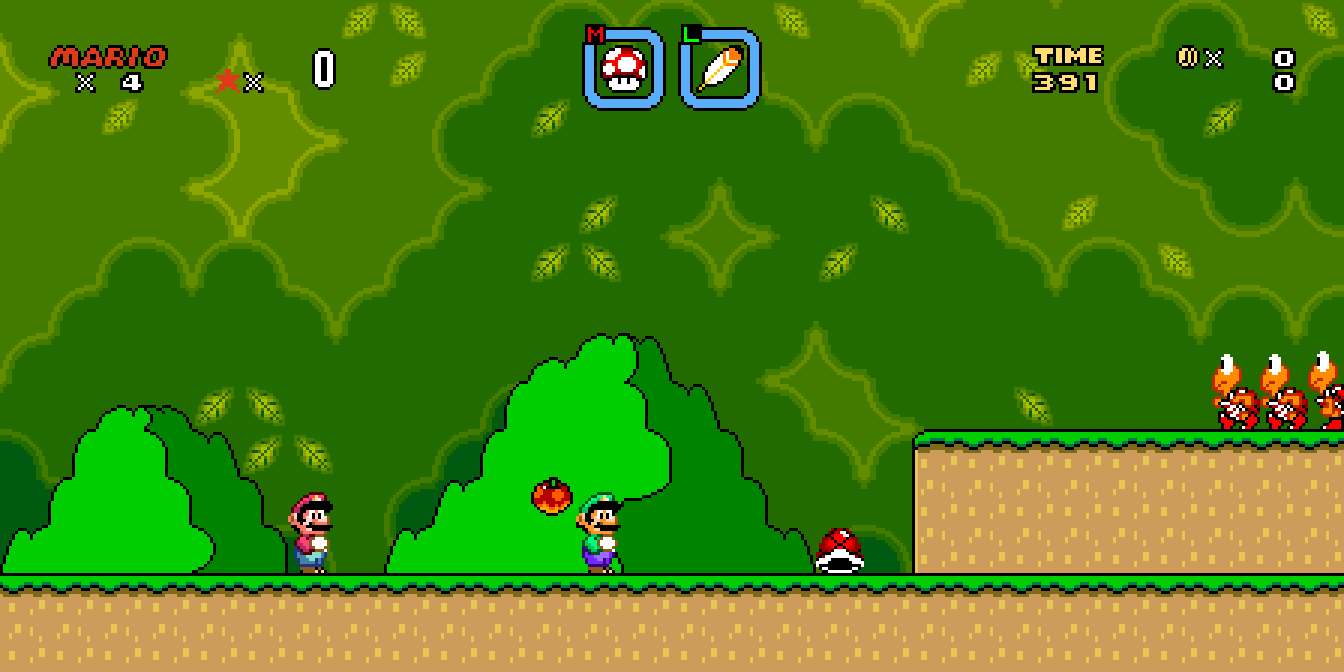
Mario and Luigi together in an adaptive widescreen view.
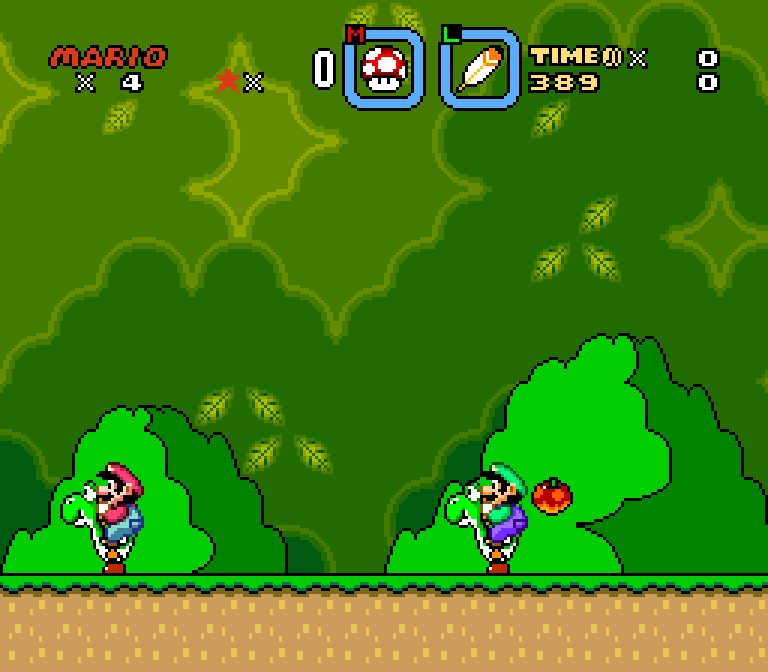
Separate riders and reserve items in the native view.
This is an early prototype, with representative common interactions tested and owner playtesting completed. Some unusual combinations can still behave incorrectly. A known example is bubble recovery interrupting a Yoshi berry bite. Full campaign coverage, rare Yoshi/ability combinations, special platforms, exceptional transitions and broader boss/controller/platform qualification remain follow-up work. Please report bugs with reproduction steps, your build version and a co-op save state when possible.
See the implementation and product rules, validation evidence and known issues and deferred checks.
The older separate IPS-based executable and its netplay instructions are archived in Legacy IPS co-op.
Controls (default keybinds.ini)
| SNES button | Default key |
|---|---|
| D-Pad | Arrow keys |
| A | X |
| B | Z |
| X | S |
| Y | A |
| L | C |
| R | V |
| Start | Enter |
| Select | Right Shift |
Player 2 is unbound by default — fill in keys in keybinds.ini to enable a
second keyboard player. With the experimental native co-op mod enabled and
2 Player selected, the two bindings control Mario and Luigi simultaneously.
Xbox / PlayStation / Switch Pro controllers are auto-detected via
SDL_GameController (XInput on Windows). Plug it in before launching,
or hot-plug after. Default Xbox mapping is position-true: the
physical button position matches a SNES pad — so Xbox A (south face)
sends SNES B, Xbox B (east face) sends SNES A. To rebind, edit the
[GamepadMap] section of config.ini (auto-generated next to the exe
on first run); the recognized names and the full mapping table are
in CONTROLLER.md.
System shortcuts (configured in config.ini's [KeyMap] section):
| Action | Default |
|---|---|
| Save state 1-10 | Shift+F1..F10 |
| Load state 1-10 | F1..F10 |
| Toggle pause | P |
| Reset | Ctrl+R |
| Toggle fullscreen | Alt+Enter |
| Turbo (fast-forward) | Tab |
| Toggle renderer | R |
| Display perf | F |
Building from source
For the native co-op prototype, use the standard stock-ROM CMake target
described in the adaptive renderer build guide.
The --coop/SMW_BUILD_COOP options below select the legacy IPS executable.
Prerequisites: Windows 10+, Visual Studio 2022 (with C++ desktop
workload), Python 3.9+ on PATH, and rustup for regeneration.
git clone --recurse-submodules https://github.com/mstan/SuperMarioWorldRecomp
cd SuperMarioWorldRecomp
Regenerate the desired variant from your legally obtained stock ROM, then build it. The generated C is intentionally untracked:
# Normal stock-ROM build (the default)
bash tools/regen.sh --stock
msbuild smw.sln /p:Configuration=Production /p:Platform=x64 /m

# Legacy IPS co-op build (optional)
bash tools/regen.sh --coop
msbuild smw.sln /p:Configuration=CoopProduction /p:Platform=x64 /m
The normal configuration remains smw.exe; the additive configuration creates
SuperMarioWorldCoopSNESRecomp.exe in its own output directory and copies
smw_coop.ips beside it. CMake builds the normal target by default; configure
with -DSMW_BUILD_COOP=ON to make both targets available in one build tree.
The legacy netplay-enabled IPS co-op target uses CMake so it can link recomp-net. A sibling engine worktree can be selected without replacing the checked-in submodule:
$engine = 'F:\path\to\snesrecomp-worktree'
$ui = 'F:\path\to\recomp-ui-worktree'
$sdl3 = 'F:\path\to\SDL3'
$env:SNESRECOMP_ROOT = $engine
bash tools/regen.sh --coop --no-tests
cmake -S . -B build-netplay -DSMW_BUILD_COOP=ON `
  -DSNESRECOMP_ROOT="$engine" -DRECOMP_UI_ROOT="$ui" `
  -DCMAKE_PREFIX_PATH="$sdl3" `
  -DSMW_NETPLAY_ICE=ON
cmake --build build-netplay --config Release `
  --target SuperMarioWorldCoopSNESRecomp --parallel
SDL3 is the default desktop backend. To build the maintained compatibility
fallback, configure a separate tree with
-DSNESRECOMP_SDL_BACKEND=SDL2.
Regenerating the recompiled C (contributors)
If you change anything under recomp/bank_*.cfg, the snesrecomp
framework, or otherwise need to re-run the recompiler:
- Drop a legally-obtained
smw.sfcat the repo root (.gitignoreexcludes it). - Run
bash tools/regen.sh --stockfor the normal build and/orbash tools/regen.sh --coopfor the legacy IPS build. Stock emits tosrc/gen/from the vanilla SMW (USA) ROM. Co-op applies the bundled IPS to a throwaway verified ROM, layers the small CFG fragments inrecomp/coop/, and emits independently tosrc/gen-coop/. It builds and requires the fast native analyzer by default; setSNESRECOMP_ANALYSIS_BACKEND=pythononly to use the slower reference path. - Rebuild as above.
(Build and run instructions are not yet stable — see scripts under
tools/ and notes in docs/ for the current shape, but expect them
to drift.)
MSU-1 audio
The normal 1P build supports CD-quality MSU-1 streaming music using a stock
SMW (USA) ROM. Regeneration no longer applies Conn's audio-only "SMW MSU-1"
patch; the preloaded MSU-1 Audio Mods package activates trusted host-side code
that observes SMW music commands and drives the runner's MSU-1 device directly.
At runtime, no pack means authentic SPC audio; a matching PCM pack plus the
MSU-1 Audio mod means streamed music. Packs for SMW MSU+ or SMW MSU-1 Plus
Ultra are not interchangeable with this audio-only track map. Full credit and
pack details are in recomp/msu1/ATTRIBUTION.md.
MSU-1 is disabled in the legacy IPS co-op executable for now.
Repo layout
src/— runtime C (CPU state, runtime helpers, hand-written bodies for things the framework doesn't yet recompile).src/gen/— recompiler output (do not hand-edit).src/gen-coop/— separate co-op recompiler output (do not hand-edit).recomp/— per-bank.cfgfiles describing what the framework cannot yet derive from the ROM (data regions, calling conventions, rare hints).recomp/coop/— co-op CFG overlays, distributed IPS, and attribution.snesrecomp/— pinned framework submodule.tools/— build, regen, audit, and triage scripts.docs/— design / debugging notes (internal-facing, may be stale).third_party/— vendored deps with their own licenses.
Acknowledgements
This port did not start from scratch. It stands on prior reverse-engineering and emulation work, and we're grateful for it:
- IsoFrieze/SMWDisX — the
Super Mario World disassembly used as the basis for this port. SMWDisX
is the source of the symbol names, the RAM/variable map, and the
per-bank function boundaries, and it serves as the differential
conformance oracle for the recompiled output (see
tools/smwdisx_compare.pyand the vendoredSMWDisX/clone). SMWDisX in turn credits mikeyk's original 2013 disassembly and loveemu's SPC700 sound-engine work. - snesrev (
snesrev/smw,snesrev/zelda3) — the runner and surrounding ecosystem were heavily based on the snesrev reverse-engineered ports: the "port the CPU code to C, emulate the rest of the silicon, verify against a reference emulator" model, the C runtime structure, and the SPC-image audio path. - The C SNES hardware core under
snesrecomp/runner/src/snes/derives from LakeSnes (elzo-d), the emulator snesrev's projects vendor, with algorithms credited inline to snes9x.
See the snesrecomp framework README for the full framework-side attribution.
Discord
Raster snapshot storage
The adaptive renderer retains exact immutable VRAM versions across unchanged scanlines. Palette, OAM and registers remain per-line; IRQ/native uncertainty and callbacks retain byte comparison. This changes host storage, preserving the guest's PPU work and stock presentation fallback.
For reference builds, use -DSMW_RASTER_FULL_COPY=ON; for exact comparisons
without the scoped write shortcut, use -DSMW_RASTER_TRACK_WRITES=OFF.
tools/test_adaptive_renderer.py accepts --full-copy and --byte-compare
for the corresponding renderer checks.
The 2026-10-22 original/candidate three-aspect route checks matched all 21 captured images and common frame/sprite telemetry. On an i5-4670, three balanced audio-enabled headless pairs saved median CPU time of 21.14% at 16:9 and 15.93% at 32:9 on that menu/YI2/death/map-return route. These measure route headroom; gameplay FPS depends on scene and hardware. Static storage is approximately 14MiB smaller, with version-dependent heap highwater. The owner approved the combined SMW, MMX and Super Metroid playtests.
The subsequent current-main integration starts at 6c773d6 and retains its
co-op renderer. It uses the engine's existing Ppu.vramWriteCount rather than
adding another revision counter. Engine pin 4c5c7dc backports only the shared
snapshot helper, also landed in snesrecomp PR #209. Fresh stock generation was
byte-identical across two passes. Tracked, byte-compare and full-copy standalone
renderer checks pass, including the real extra-object compositor. Current-main
full-copy/optimized route checks match 21 BMPs, draw lists, sprite telemetry
and 4000 semantic frame rows per aspect at 4:3, 16:9 and 32:9. Production Mods
Fit/adaptive spawning also matches seven captures and 4000 trace rows.
Current-build file loads match the tested functional partitions; ordinary
loads re-anchor clocks, so this is not a full-chip rollback-byte claim. These
are correctness reruns; the i5-4670 timings above belong to the earlier
human-approved baseline, not a new current-main benchmark.
License
PolyForm Noncommercial 1.0.0. See LICENSE. Code in this repo is original
except where noted in Acknowledgements above; vendored dependencies under
third_party/ (and the SMWDisX/ disassembly clone) retain their own
licenses.
The SMW ROM and any data extracted from it are not in this repo and are not licensed for redistribution.
<p align="center"> <sub><b>R.A.I.D. — Retro AI Development</b> · a Discord for AI-assisted retro reverse-engineering, decomp & recomp</sub> </p> <p align="center"> <a href="https://discord.gg/Ad9BwSzctP"><img src=".github/raid-discord.png" alt="Join the Retro AI Development (R.A.I.D.) Discord" width="200"></a> </p>