Virtual Hydlide (PC)
Virtual Hydlide
OriginSega Saturn
TechnologyNative C/C++ port (engine reimplementation)
Available forWindows
View official projectAbout the project
El término null, nulo o nil es a menudo utilizado en la computación para hacer referencia a la nada. Su significado y uso varía según el lenguaje de programación.
Official project information
pc-virtualhydlide
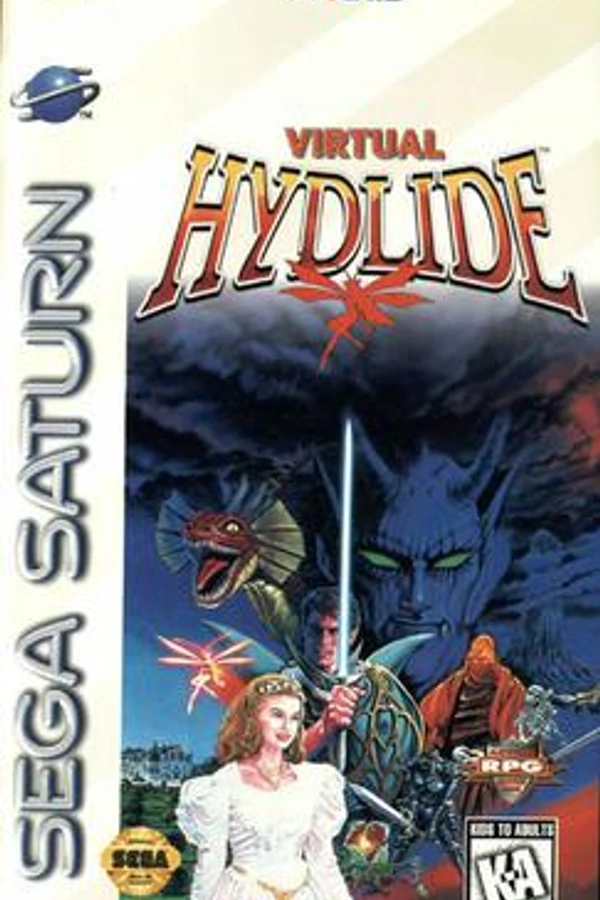
Toward a native PC port of Virtual Hydlide (Sega Saturn, T&E Soft / Sega, 1995), the 3D remake of the 1984 action RPG, with its randomly generated field, digitised actors as sprites, and a frame rate that collapses whenever the field fills up. It was never re-released. The goal is the game running natively on PC, and running smoothly: the frame rate is the first thing a port has to fix.
This repository documents the disc, its formats and its code, and grows
the tooling for the port. Alongside it grows saturnkit, a
game-agnostic toolkit for Saturn reverse engineering: everything the port
needs that is not specific to Virtual Hydlide. It is taken here as a
submodule: clone with --recursive, or run git submodule update --init.
BYOA — Bring Your Own Assets
This repository contains documentation and tools only. No game data, no executables, no assets. You need your own original disc. The work is done on the European release, MK-81380 (V1.000, 1995-06-30), as a Redump-style .cue/.bin set.
Layout
docs/            disc, format and code analysis, and the plan
tools/           Virtual Hydlide-specific data and tools: names-m_chi.tsv, recomp.py, run.py, oracle.py
tools/game/      the game layer: C++ built into the runtime, working through recompiler hooks
saturnkit/       game-agnostic Saturn toolkit (submodule)
iso/, build/     your disc and everything derived from it (ignored by git)
Tools
The Python tools need only Python 3.8+ and no dependencies. Building the
recompiled C++ needs CMake, Ninja, clang and SDL3 (MSYS2's mingw64, found at
C:\msys64\mingw64\bin). The oracle needs RetroArch with the Beetle
Saturn core, and ffmpeg on the PATH for its recordings. Run from the
repository root.
CUE="iso/Virtual Hydlide (Europe).cue"

# the disc: IP.BIN, the ISO 9660 volume, the 28 tracks; extract it
python -m saturnkit.disc "$CUE" --info
python -m saturnkit.disc "$CUE" --list
python -m saturnkit.disc "$CUE" --extract build/extract
python -m saturnkit.disc "$CUE" --audio build/audio

# the code: where each executable loads, a function, who builds an address
EXE=build/extract/HYDLIDE/EXEC/M_CHI.BIN
python -m saturnkit.sh2 $EXE --find-base
python -m saturnkit.sh2 $EXE --base 0600B000 --at 0603E714 --count 40   # the slave SH-2's loop
python -m saturnkit.sh2 $EXE --base 0600B000 --refs 25D00000:25D00018   # VDP1 registers
python -m saturnkit.hw 25D00002 06000310

# functions and code/data; names from M_CHI carried to another program
python -m saturnkit.recomp.discover $EXE --base 0600B000 --report
python -m saturnkit.recomp.match $EXE@0600B000 build/extract/HYDLIDE/EXEC/M_KYU.BIN@0600B000 --names tools/names-m_chi.tsv --out build/names/M_KYU.tsv

# run a guest function: the SHC unsigned division, 100 / 7
python -m saturnkit.sh2emu $EXE --base 0600B000 --call 060224DC --regs r1=100,r0=7

# all 15 programs to C++, built with clang (MSYS2) and checked against the interpreter
python tools/recomp.py --build --test

# play it: a window with sound, the keyboard (arrows, Enter, Z X C, A S D, Q W) or a gamepad
python tools/run.py --play
python tools/run.py --play --interp        # 60 pictures a second: the fields between the game's frames drawn moving

# headless: boot to the first field, then the hardware log; pictures at chosen VBlanks
python tools/run.py
python tools/run.py --report
python tools/run.py -- --shot 600,1300,7200
python tools/run.py -- --wav build/run/run.wav     # the run's sound

# the oracle: Beetle Saturn in RetroArch, pressed and photographed from here
python tools/oracle.py --at 30:START,35.3:shot
python tools/oracle.py --at 20:START --record      # and its sound, for comparison
Status
Session 2: the code map. The game caps itself at one frame every 5
VBlanks (12 fps, 10 on a European Saturn); its clocks run on elapsed
time, which made the port's 60 fps look like one constant
(docs/03-executables.md, docs/06-attack-plan.md; session 6 found
otherwise). saturnkit can now find the functions of the
stripped programs, match the engine across all 15, and run guest code in
an interpreter.
Session 3: the recompiler. All 15 programs are C++ (10 256 functions, 1.5
million instructions) that compiles, links, and agrees with the
interpreter on 51 448 recorded calls (docs/09-recompiler.md).
Session 4: the runtime core. The recompiled game runs on saturnkit's
Saturn, still with no screen: it boots, plays its opening movie, loads
HYDSYS, goes through the title menu and reaches the first field, whose
frame loop holds its cap of 12 frames a second (docs/11-runtime.md).
Session 5: on screen. VDP1 and VDP2 in software and a window: the
opening movie, the title, the menus and the field are drawn and look like
Beetle Saturn's, and the game is played with the keyboard or a gamepad
(docs/12-video.md).
Session 6: sound and 60 fps. The game's own sound drivers run on an
emulated 68000 beside an emulated SCSP: music, effects and the movie's
voice, matching Beetle Saturn's recording (docs/13-sound.md). The frame
cap can be lowered, but everything that moves is stepped per frame, so
the port keeps the game's 12 frames a second and draws the fields between
them instead: --interp, one frame behind, with a game layer that tells
the renderer which shape is which (docs/14-frame-rate.md). Played by
the user, sound and all. Next: the last glitches of --interp, then the
rest of the game's areas (docs/07-next-session.md).
Documentation
- 00-sessions.md — what each session did
- 01-disc-layout.md — IP.BIN, tracks, the file tree
- 02-data-formats.md — first look at the game's files
- 03-executables.md — memory map, program swapping, the slave SH-2, interrupts, BIOS services, the frame limiter
- 04-curiosities.md — things found on the way
- 05-open-questions.md — what is not known yet
- 06-attack-plan.md — feasibility, route, phases, the frame-rate strategy
- 07-next-session.md — the next session's list
- 09-recompiler.md — the programs as C++: the generated code, the counts, the self-test
- 11-runtime.md — the runtime core: the run to the field, how the Saturn is built, the hardware touched
- 12-video.md — VDP1 and VDP2 on screen: what each screen uses, the window, the oracle
- 13-sound.md — the 68000 and the SCSP: what is heard, against Beetle, how it is built
- 14-frame-rate.md — the frame cap, what steps per frame, the fields in between
- 10-saturnkit.md — what this port gave saturnkit
Licence
MIT — see LICENSE. Virtual Hydlide is © 1995 T&E Soft / Sega; this project contains none of it.