Ace Combat 5 (Linux Performance Fork)
Ace Combat 5: The Unsung War
OrigenPlayStation 2
TecnologíaRecompilación Estática (C/C++ nativo)
Disponible paraLinux
Ver proyecto oficialSobre el proyecto
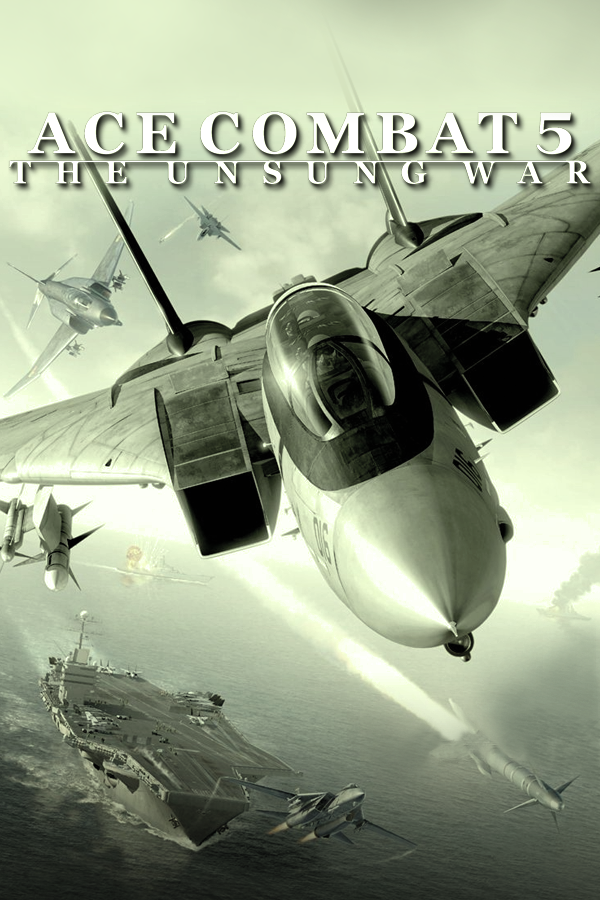
Ace Combat 5: The Unsung War, lanzado como Ace Combat: Squadron Leader en Europa, es un videojuego basado en la aviación militar para la plataforma PlayStation 2. Es la quinta entrega de la saga Ace Combat y narra los hechos posteriores al Ace Combat Zero, de la guerra ficticia Circum-Pacífica. El videojuego fue lanzado al mercado entre 2004 y 2005, dependiendo en cada país.
2 versiones de Ace Combat 5: The Unsung War
Estás viendo: Ace Combat 5 (Linux Performance Fork)
Información oficial del proyecto
Ace Combat 5 — Static Recompilation (Linux Performance Fork)




A static recompilation of Ace Combat 5: The Unsung War (USA) for Linux, forked from sal063/Ace-Combat-5-Static-recompilation with a focus on performance, frame pacing, and lower CPU usage.
⚠️ No game files are included. You need a legally dumped copy of Ace Combat 5 (USA)
SLUS_208.51to use this project.
Fork Improvements
This fork focuses on reducing CPU overhead and improving frame stability on Linux systems:
- Bulk GS uploads — batched Graphics Synthesizer transfers to reduce per-tag overhead.
- Redundant upload skipping — identical GS packets are detected and skipped before they reach the GPU queue. Cuts ~50% of texture upload bytes in typical scenes.
- Texture cache cleanup — tighter VRAM management; fewer cache invalidations.
- VBlank synchronization — replaced busy-wait loops with condition variables, reducing CPU usage during idle frames and improving frame pacing.
- VU1 recompilation — all VU1 microprograms used by the game are lifted to C ahead of time (100% coverage). See Recent updates.
- GS draw state cache — 256-slot direct-mapped cache; hit rate up from 45% to 88%.
- EAGLE FIVE launcher (Qt6 / PySide6) — graphical settings editor with ISO validation, preset management, save backup/restore, and integrated console.
Requirements
| Minimum | Recommended | |
|---|---|---|
| CPU | x86-64 v2 (SSE4.2) | x86-64 v3 (AVX2) |
| GPU | Vulkan 1.2 | Vulkan 1.3+ |
| RAM | 4 GB | 8 GB |
| OS | Linux (X11 or Wayland) | — |
| Game | Ace Combat 5 (USA) SLUS_208.51 | — |
Build dependencies:
- CMake 3.20+
- GCC 15+ or Clang 13+ (needs
[[gnu::musttail]]for correct codegen) - SDL3
- Vulkan SDK (for
glslc) - Python 3.10+ (for the recompiler and launcher)
- PySide6 (for the launcher)
Building
git clone https://github.com/Harold0777/eagle_five_recomp.git
cd eagle_five_recomp

# 1. Recompile the game ISO into C source (one-time, ~30 min)
python3 -m ps2recomp /path/to/AC5.iso -o generated

# 2. Configure and build
cmake -B build -DCMAKE_BUILD_TYPE=Release
cmake --build build -j$(nproc)
Recent updates
VU1 recompilation at 100% coverage
All 13 distinct VU1 microprograms the game runs are now lifted to C ahead of
runtime. Previously only 1 of 13 was captured by the census; the other 12 fell
back to the interpreter whenever the native rn_vp_* handlers declined a run.
Regenerating the census with PS2_RN_VP=0 (so the interpreter sees every
microprogram) and running tools/vurecomp produced 11 lifted programs
(2 deduplicated) covering 100% of interpreted work:
| CRC | Work share | Note |
|---|---|---|
bdb8edb3a90e | 39.7% | new |
32411bda3d49 | 22.4% | previously captured (3A6610) |
3e3aca578a0d | 17.5% | new |
ca8f017c71da | 12.5% | new |
| other 7 | ~8% | new |
Result: the run summary now reports vu1 recompiled: N runs, 0 interpreted (100.0% recompiled),
up from 32.3% before.
The generated file generated/ps2_vu1_progs.inc is shipped even though
generated/ is gitignored, because reproducing it requires playing the game
with census mode on. To regenerate it:
PS2_RN_VP=0 PS2_VU_CENSUS=1 ./build/ac5 ...   # play through the game, then exit
python3 -m tools.vurecomp --programs out/vu_programs -o generated/ps2_vu1_progs.inc
GS draw state cache
The draw state cache was being invalidated by every GS register write that
changed value, including registers fill_state_compute never reads. Two
changes:
- Writes are now filtered to the ~15 registers that actually affect the
computed state (
gs_reg_affects_state[]). This cuts invalidations by 84%. - The single-slot memo became a 256-slot direct-mapped cache keyed on
gs_prim & 0xFF, so alternating primitive types no longer evict each other.
Result per session:
| Metric | Before | After |
|---|---|---|
| Cache hit rate | 45.2% | 87.7% |
fill_state_compute calls | 7.95M | 0.91M |
FPS is unchanged because fill_state was not the bottleneck at 4x internal
resolution — the remaining cost is Vulkan draw submission and GPU fragment
work. Diagnostic counters (fs_miss_*) are printed in the run summary to
identify which condition of the memo check fails.
3x and 6x removed from the settings menu
The settings menu now only offers Auto, Native, 2x, 4x, 5x, and 8x. See Known issues for the reason.
Benchmarks
All numbers were measured on one machine (Ryzen 7 7735HS, Radeon 680M with RADV, CachyOS, GCC 16.2.1, Release build, hot files at -O3).
Method
gsreplay replays a recorded capture (out/capture.gscap, 42 fields) deterministically and checks that every field matches the recorded run. It does not compile the generated guest code, so it measures the runtime (VIF, GIF, GS, texture decode) only.
- Native internal resolution,
PS2_PRESENT_MODE=immediate, power profileperformance, lsfg-vk layer disabled. - Each result is the median ms/field over 10 passes, discarding pass 1.
- Binaries are compared A/B, alternating, in the same session. Run-to-run noise across sessions is about 6%, so only same-session comparisons count.
- A change is accepted only with 0 fidelity divergences and a lower median in 3 consecutive A/B rounds.
Results
Baseline: about 11.0 ms/field (about 90 fields/s) in gsreplay.
| Change | Result | Kept |
|---|---|---|
| PSMT8H texture decode fast path | 0.32 to 0.45 ms/field lower (about 3 to 4%), 3 of 3 rounds, 0 divergences | yes |
-march=znver3 | 0.07 to 0.24 ms/field slower | no |
| Global LTO | within noise (-0.01 to +0.09 ms) | no |
| V4-32 UNPACK fast path in the VIF | within noise | no |
| Deferring the epoch bump on identical uploads | not implemented: a diagnostic showed at most 165 of 1449 texture invalidations (11%) could be avoided | no |
Real game
One 125 s session at internal resolution 2, 1920x1080, present mode immediate: 7464 fields at 59.8 fields/s, 3 fields dropped (all in the first 600), and the EE never waited on a full graphics ring. The graphics thread averaged 3.99 ms/field of the 16.68 ms budget.
Caveats: a single capture and a single session. Gains on other game phases or other hardware may differ.
Known issues
3x internal resolution artifacts
Setting internal_resolution = 3 (3x) or 6x produces visible artifacts in
volumetric effects (clouds, smoke, contrails). The bug is not present at 2x, 4x,
or 5x.
The cause is still under investigation. The shader math is identical between
3x and 4x for dtex, downsample, and the rt_up block, so the divergence is
likely downstream of the shader — possibly in how RADV handles image tiling for
non-power-of-2 render targets sampled with VK_SAMPLER_ADDRESS_MODE_REPEAT.
Workaround: use 2x, 4x, or 5x. All work correctly. The 3x and 6x options
have been removed from the settings menu so the bug cannot be selected by
accident, rather than silently promoting 3x to 4x. The PS2_UPSCALE=3
environment variable still works if you need it for investigation.
The High preset uses 4x. No fix is currently planned.
Downloads and AppImage
Two builds are available on the v0.3.0 release page:
ac5-recomp-v0.3.0-linux-x86_64.tar.gz: portable tarball.EagleFive-x86_64.AppImage: single file with the graphical launcher (tools/ac5_launcher.py).
Neither build includes the game. You need your own legally dumped ISO of Ace Combat 5 (USA, SLUS_208.51).
Running the AppImage
chmod +x EagleFive-x86_64.AppImage
./EagleFive-x86_64.AppImage
Pick your ISO in the launcher and press play. On the first run the launcher extracts the game executable from the ISO and creates ps2_image.bin in ~/.local/share/eagle_five/generated/. Saves and settings also live in ~/.local/share/eagle_five/.
Requirements: python3 with PySide6 or PyQt (the launcher uses Qt and the AppImage does not bundle Python) and a Vulkan driver. The system libvulkan is used, not a bundled one.
Running the tarball
The tarball does not include ps2_image.bin. Create it once from your ISO with the helper script in this repository, then run ac5 from the extracted folder:
git clone https://github.com/Harold0777/eagle_five_recomp
python3 eagle_five_recomp/tools/make_image.py /path/to/AC5.iso generated
./ac5 --data generated --disc /path/to/AC5.iso
Building the AppImage yourself
Needs the generated sources (generated/), GCC 15+ or Clang 13+, SDL3 and the Vulkan SDK (glslc):
./tools/make_appimage.sh