
Black & White
Sobre el proyecto
Black & White es un videojuego creado por Lionhead Studios, con Peter Molyneux a la cabeza. Fue lanzado en 2001 para Windows, y distribuido por la compañía Electronic Arts. Inicialmente también iba a tener versión para PlayStation y PlayStation 2, de las que se llegaron a ver vídeos e incluso demos para la prensa. Inexplicablemente, fue cancelado
2 versiones de Black & White
Estás viendo: Black & White
Información oficial del proyecto
Black & White — Static Recompilation Project
"I am merciful... but I am also bored of Windows XP compatibility hacks." — Your Conscience, probably
What Is This?
Black & White (2001) by Lionhead Studios is one of the most ambitious, bizarre, and beloved god games ever made. You raise a giant creature, hurl villagers into the sea, and micromanage belief systems — what's not to love?
The problem: it barely runs on anything made after 2005. DirectX 7 quirks, ancient threading models, 32-bit assumptions, and installer DRM from a civilization that has since collapsed. Patches exist but they're duct tape on a leaking dam.
Lionhead is gone. Peter Molyneux is off doing... Peter Molyneux things. A sequel or remaster isn't coming. So we're doing it ourselves.
This project is a static recompilation of Black & White — taking the original x86 binary apart, understanding it, and rebuilding it as clean, portable C/C++ that runs natively on modern systems.
The Vision
- Native Windows (32-bit today, 64-bit + Linux/macOS later) support
- Modern graphics backend (OpenGL now, Vulkan/D3D12 later)
- No emulation layers, no compatibility shims, no crying into WinXP VMs at 2 AM
- Same gameplay, same hand-slapping-villagers goodness — just actually functional
Current Status
630 headers | 282 implementations | 51 viewer files | ~72,000 lines of C++ | 17 test suites | 388 commits
The viewer ticks the entire game loop end-to-end: terrain renders, CHL scripts drive entity spawning, the LHVM dispatches ~430 wired native functions, villagers play real ANM skeletal animations from AllAnims.anm, real MP2 voice/dialogue decodes and plays, spell casts throw camera-facing particle FX, and the camera follows whatever the script tells it to.
A second decompiler toolchain (tools/decomp/) now drives faithful translation: it recovers original method pseudocode from the v1.0 binary via RTTI vftable walking (IDA idalib primary), which is how the native save serializer and the creature AI below were rebuilt. The binary has RTTI but no symbol table (17,627 functions, 5 named), so classes are reachable only through their ??_7...@@6B@ vftable symbols.
Two habits did most of the work. First, whole class families share a vtable shape and one slot tends to hold constant returns or self-describing editor registrations, so a schema falls out mechanically rather than one class at a time — that is where the particle engine's 210 named parameters and the full attribute schema came from. Second, IDA leaves large regions unanalysed, and xrefs/callees only see inside known functions, so a search can come back clean because the code was never parsed: forcing analysis over a range (mkfunc) turned a 1,914-line initialiser readable and settled 31 save types in one go.
What works right now
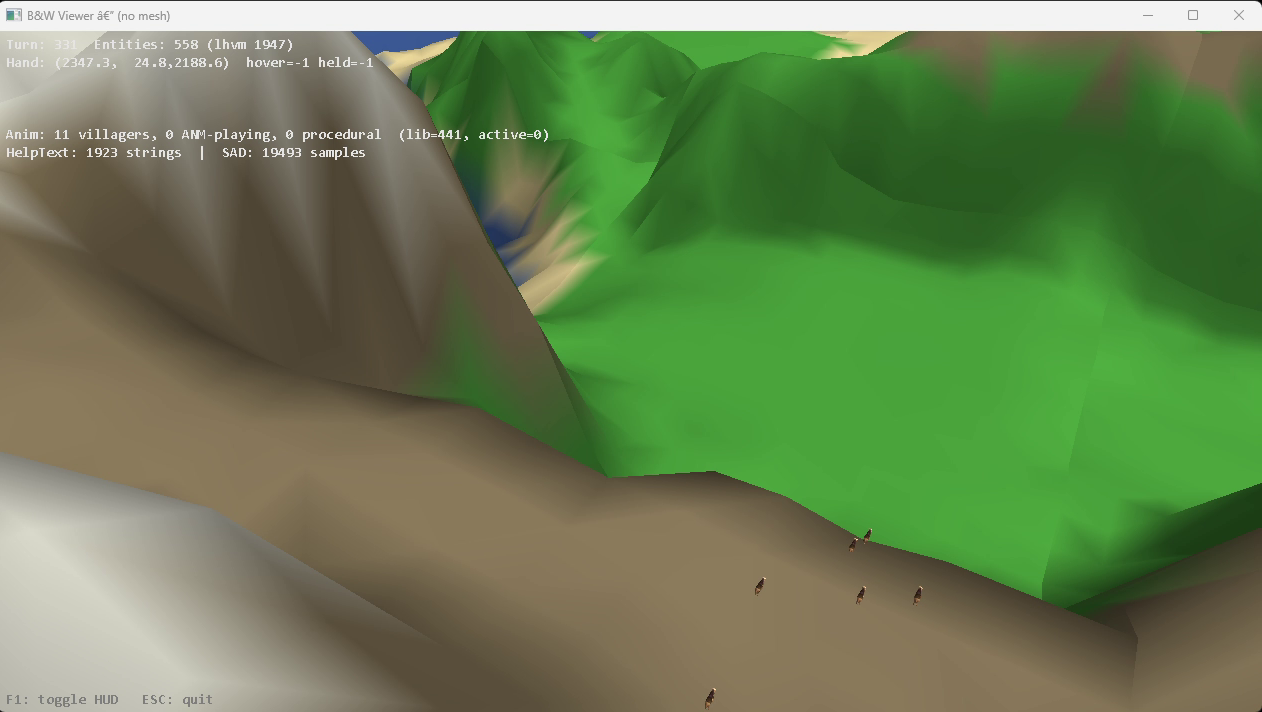
World (native level loader)
- Land scripts load through the game's own command table and handlers (
docs/level-loader.md): Land 1 builds 6 towns, 57 abodes owned by their towns, 29 villagers housed in the homes the script names, fields, fish farms, trees, animals and features, 1,946 objects in all, each with itsinfo.datrecord (docs/info-dat.md) - Play mode draws that world and the turn processes it: towns, then every object
- Every campaign land script (Land 1-5 and the tutorial) is fully handled: flocks, forests, streams, mist, arenas, climates, citadels, worship sites, spell dispensers
Physics (v1.0's rigid-body engine)
- The game's own rigid body (
docs/physics.md): contact springs, friction, drag, the sea (things float, take on water and sink), coming to rest; materials fromPhysicsConstants.txt - The physics pool runs 20 substeps of 5 ms each game turn; the hand's throws go through it
- The land under it is v1.0's own height function, cell triangles and all (it also exposed that the viewer had been drawing every landscape mirrored, now fixed)
- Bodies meet: points are cast onto another body's faces, a moving body wakes what lies in its path, and a thrown tree that lands on a village store is taken in as wood
Rendering
- L3D mesh loader (bind pose + bones preserved for runtime CPU skinning)
- G3D archive loader (622/626 meshes, 111K verts, 101K tris with DXT1/DXT3 textures)
- LND terrain renderer (heightmap, altitude colouring, 17×17 cell blocks)
- Per-entity OpenGL render with hover/selected tinting
- HUD overlay (Consolas bitmap font) showing turn, entity counts, hand state, dialogue ids, library counts
- Subtitle text at the bottom of the screen
- Click marker / spirit pointer beam / coloured influence rings — all driven by LHVM state
- Spell visuals: camera-facing additive billboard particles (
psys_fx) with per-family behaviours (fire fountain, heal chakra helix, water droplets, lightning column, shield sphere) — replaces the old placeholder rings
Animation
- L3D refactored to keep bind-pose vertices + bones separately for runtime skinning
- Procedural per-bone idle / walk / animal-idle / bird-flap modes with proper parent-frame composition
- Full ANM file decoder for both individual
Anims/*.anmfiles and theAllAnims.anmPack archive - Per-bone 4×3 affine matrices decoded into
BoneMatrixand applied via CPU skinning - Adjacent-keyframe linear interpolation for smooth playback
- Tolerant skeleton-overlap remap: an animation drives the overlapping leading bones over a bind-pose base (BW's L3D/ANM have no bone names — correspondence is by index), so meshes with extra bones still animate
- Script-driven animation selection via
PLAY_GESTUREresolves to person-only (M_P_*) clips, so a villager never plays an animal animation - Library indexed by source-name (e.g.
M_P_Conduct_Meeting) and integer id
LHVM scripting
- 464/465 typed native functions (only
NONEis a no-op stub) - ~430 of those have real bodies in
LHVMObjects.cpp(8 chunks, ~3,900 lines):- Chunk 1: object handle table + 50 entity-touching natives (GET/SET_POSITION, OBJECT_DELETE, THING_VALID, IS_OF_TYPE, GET/SET_PROPERTY, hand/click, resource ops, status flags, ...)
- Chunk 2: real
CREATE→EntityFactory dispatch, flock subsystem, container iteration, position-cinematic helpers - Chunk 3: per-creature CreatureMind side-table — desires, agenda, knowledge, leash, fight queue, name/home/sound/temple flags
- Chunk 4: spell records with expiry, weather + climate state, spirit advisor state, BUILD_BUILDING, GAME_THING_HIT → real ReduceLife
- Chunk 5: audio/dialogue/UI text/fade/widescreen/time, hand demo
- Chunk 6: camera follow + cinematic + dual-camera + computer-player AI + ally relationships
- Chunk 7: GET_INFLUENCE walks real sources, timers, calendar, walk paths, dance, animation modify, AVI sequence
- Chunk 8: mini-games (arena/football), immersion, fades, save slot, per-object extras
- Sim throttled to BW's 10 Hz via accumulator-based main loop
- CHL v7 loader: the shipped
Challenge.chlparses to its last byte (514 scripts, 156,778 instructions), variables resolve as the compiled code addresses them. Until 2026-10-03 the loader hung on this file, so no story script had ever run; the opcode semantics are still unverified against the game's interpreter (docs/chl-format.md) - Auto-start scripts tick each frame
Host integration (viewer ↔ bw_core)
- Hand position + clicks → LHVM (
GET_HAND_POSITION/STATE,GAME_THING_CLICKED,POSITION_CLICKED) - Script-spawned entities (CREATE, FLOCK_CREATE, LOAD_CREATURE, etc.) appear in the viewer's render list with sensible default meshes from
SCRIPT_OBJECT_TYPE - Camera follows LHVM
FOCUS_FOLLOW/POSITION_FOLLOWtargets with lerp + shake - Thrown objects fly through the core physics (
physics::Throw), carrying the hand's status so a store they land on credits the right player SET_HEADING_AND_SPEEDimparts real movement on living units (villager/animal/creature) — sets the MobileWallHug goal + speed and entersMOVE_TO_POSsoMoveToGoalwalks them there (safeLivingdowncast gated onGetScriptObjectType)- Hand interaction phase state machine reports the correct
HAND_STATEScode (Invisible/Normal/Holding) toGET_HAND_STATE
Audio
- Full SAD audio bank decoder — LionHead Pack format with
LHFileSegmentBankInfo/LHAudioWaveData/LHAudioBankSampleTableblocks - 227 samples extracted from
Guidance.sadplus everything underSFX/andAudio/ - PCM samples play through
PlaySoundA(SND_MEMORY) - MP2 voice/dialogue now decodes for real — BW stores voice as
WAVE_FORMAT_MPEG(tag 0x0050 = MPEG Layer II, not MP3); decoded to PCM via vendored kjmp2 and cached per sample (verified onvillagers.sad: 22050 Hz, real signal) - Music:
START_MUSICplaysintro.wavlooped viaPlaySoundA
Subtitle text
HELP_TEXT_<KEY>_<NN>keys extracted from SAD sample names → humanized into readable strings ("Death in village"etc.) and indexed by sample id- Subtitle path first checks the HelpText pool, then falls back to LHVM data-section literals
Persistence
- Slot-based binary snapshot (
BWSVmagic, v1) with section tagsGTRN/ENTS/HAND/LGLB/LINF - F5 saves slot 0, F9 loads it
SAVE_GAME_IN_SLOTscript native fires real serialization viag_save_slot_func- Native save format (toward loading retail
.sav):GameOSFilereproduces the on-disk byte format and the running checksum rule (buf[0] + sizeper op, folded at 0x214). The per-class fan-out is done as data rather than 200 hand-copied method pairs — everySavebody in the binary has the same shape, so vtable slots 58/59/60 across all 200 savable classes were parsed into a generated field table (152 rows, 908 field ops, 178 save-type ids) that one chain walker replays in both directions. Pointers are an object graph: an object is written inline the first time it is referenced, by ordinal thereafter. 122 of 178 save types have a chain recovered exactly; the rest are refused rather than half-written.test_saveloadcovers the round trip, the checksum, and a shared object coming back as one pointer rather than two copies.
Creature AI — recovered from the binary
- Attributes — the 24 feature extractors a decision tree branches on, with their real thresholds (a town is big at 40, a forest at 20 trees, alive is above 20% health). Ids cross-check against chlasm's CC0 enum.
- Belief vectors — what the creature can notice about each kind of thing. A creature can learn that burning houses matter because
OnFireis in the abode vector, and can never learn anything about a burning forest, because it is not in the forest one. - Learning — greedy decision-tree induction with gain ratio (C4.5, per creature, at runtime). Impurity blends two entropies, weighting whether it liked a thing double against how much.
test_learningshows a creature shown burning and intact houses discoveringOnFireunaided. - Opinions — the 11-level −1…+1 scale, read from
.rdatarather than inferred. The bands overlap, which biases every opinion one step down and makes the top level unreachable: a creature can hate something completely and never quite love it that much. - CreatureMind reader — parses the four saved minds the game ships (Khazar/Lethys/Nemesis, "Matey"; ComputerControlledCreature, "Richard"), giving 40 desires with their sources. Validated by enum alignment: desire 0's sources come out as exactly the
IMPRESS_*ones, desire 1's theCOMPASSION_*, and so on. - Desire dynamics — per-tick decay, per-source-type decay, and the 40×40 dependency matrix that couples every desire to every other. Getting hungry making a creature less playful is one signed number in that matrix.
- Plans and actions — 95 action names and 32 dispatch slots decoded out of an inlined initialiser IDA never made a function.
Particle engine (PSys scope-A)
- The atom/rule engine:
Atom(304 bytes, offsets asserted), the shared 8-slot rule interface with its condition gate, five appearance rules, six event conditions, three emitters — with 210 parameters recovered under their real names from the rules' own editor registrations.
Hand (6C-faithful)
- Real polymorphic
HandStateobjects owned by aHandMachine, Exit-then-Enter transitions, and the three virtualsHandStateHoldingadds that the vendor header was missing entirely.
Phase 0: Reconnaissance — COMPLETE
- Acquire original game files
- Strip SafeDisc 2.10.030 copy protection
- Ghidra disassembly + RTTI scan (14,626 functions, 936 classes)
- Vendor reference integration (bw1-decomp — 569 struct headers)
Phase 1: Build System & Type Hierarchy — COMPLETE
- CMake build system (Visual Studio 2022, 32-bit x86)
- All 569 vendor types rebuilt as C++ with correct vtable layout
- 500+ method bodies translated from Ghidra
- Building lifecycle, resource management, living state machine
- Map operations, creature AI subsystem structs, GUtils
Phase 2: Rendering Pipeline — COMPLETE
- L3D / G3D / LND loaders
- DXT1/DXT3 texture rendering
- Mesh browser, world viewer
Phase 3: Game Loop & Interaction — COMPLETE
- Level script parser
- God hand with picking + throwing physics
- LHVM scripting engine with 464/465 typed natives
- ~430 native bodies wired through LHVMObjects.cpp
- Host integration: hand/click input, spawn render bridge, sim throttle
- HUD overlay with bitmap font
- Animation pipeline (bind pose, procedural, ANM playback, keyframe lerp, script selection)
- Camera follow + shake
- SAD audio bank decoder + PCM playback
- Save/Load (host format)
- HelpText subtitle pipeline (humanized SAD keys)
Phase 4: Polish & Full Game — IN PROGRESS
- MP2 decoder so BW voice samples actually play (kjmp2; Layer II, tag 0x0050)
- Spell particle visuals — billboard FX (
psys_fx) replace placeholder rings (scope-B; faithful 128-class Atom/Rule engine port is a later exactness pass) - Animation remap so meshes with differing bone counts still play (index-overlap; BW format has no bone names)
- Person-only villager gesture selection (no more animal clips on villagers)
-
SET_HEADING_AND_SPEED→ real bw_core movement on living units - Hand interaction phase state machine → correct
GET_HAND_STATE - Decompiler pipeline (
tools/decomp/) — RTTI-vftable class extractor (IDA primary, Ghidra cross-check) - [~] Native BW save format via
GameOSFile— serializer, generated field table and chain walker all done and tested; 122 of 178 save types exact, the remaining 56 are container walks (Town, Citadel, the Spell family, the footpath graph) needing per-class translation - Full polymorphic
HandStatedispatch — real state objects underHandMachine, Exit-then-Enter transitions - Particle engine scope-A —
Atom/rule interface with 210 parameters under their real names (rule graphs are code-built, not data, and remain untouched) - Creature AI — attributes, belief vectors, C4.5 learning, opinion scale, mind-file reader, desire dynamics, plans/actions
- Native level loader — every campaign land script fully handled
- [~] Physics — rigid body, pool, game-turn step, land height, body-to-body contacts and the tree-into-store path done; a building's own impact damage, the creature's
ThrowInPileand host mesh faces remain - Multiplayer / network stack — LAN-only, planned for a separate private repo + server emulator
- Computer player AI behaviour
Formerly blocked, now resolved:
- The creature's plan chooser — found at
sub_4AC5F0/sub_4D1CC0once the desire→action table was placed at 0xB881D0; its predicate tables are.bssfilled through registers, recovered by emulating their initialisers. Translated incore/CreaturePlanChooser.cpp(docs/creature-chooser.md). info.datreader — the whole 580,710-byte payload is now read (docs/info-dat.md).
How to Build & Run
On the build farm (preferred). recomp-netlab
builds bw with clang-cl on its Linux builders and runs the tests on a Windows test VM,
so your own machine isn't loaded. The recipe is netlab's projects/bw.env:
./netlab check bw --on testbox    # build on the farm, then every test on the test VM (tools/run_tests.cmd)
./netlab qa bw --on testbox       # tests only, against the last build
The build comes back to build-farm/. The test VM has no game data, so the tests that
need it print note: ... skipped and netlab reports SKIP, not PASS. Run
tools\run_tests.cmd build-farm locally to include them.
Locally:
# Build (requires Visual Studio 2022, CMake 3.20+)
cd src
cmake -G "Visual Studio 17 2022" -A Win32 -S . -B build
cmake --build build --config Release

# View a mesh
build/Release/bw_viewer.exe game_data/A_horse_boned.l3d

# Browse all 626 meshes (Left/Right arrows)
build/Release/bw_viewer.exe game_data/AllMeshes.g3d

# View terrain
build/Release/bw_viewer.exe game_data/Land1.lnd

# World viewer (terrain + entities)
build/Release/bw_viewer.exe game_data/Land1.txt

# Game mode — interactive with god hand + bw_core entities + script execution
build/Release/bw_viewer.exe game_data/Land1.txt --play
Controls (game mode):
- Mouse — move hand cursor
- LMB on entity — pick up (queries real
CanBePickedUpfrom bw_core; also latches a script click) - Release LMB while moving — fling entity (syncs back to bw_core MapCoords + fires
ReactToPhysicsImpact) - RMB while holding — throw forward
- LMB drag (empty space) — orbit camera
- RMB drag — zoom
- Scroll wheel — zoom
- WASD — pan (camera-relative)
- Tab — wireframe toggle
- F1 — HUD overlay toggle
- F5 — quicksave (slot 0)
- F9 — quickload (slot 0)
- R — reset camera
- C — make a creature at the hand, with a brain (debug; it acts on its own; the first is player 0's)
- G / B — stroke / slap the creature nearest the hand (it learns from what it just did)
- Esc — quit
Project Structure
bw/
├── README.md                  ← this file
├── CLAUDE.md                  ← Development memory + architecture notes
├── src/
│   ├── CMakeLists.txt         ← Builds bw_core lib + bw_viewer exe
│   ├── include/black/         ← 601 C++ headers (entity classes, vtable layout)
│   │   ├── LHVMObjects.h      ← Script ↔ Object bridge declarations
│   │   └── ...                ← All 569 vendor entity types
│   ├── core/                  ← 254 implementation files
│   │   ├── LHVMObjects.cpp    ← ~430 wired LHVM native bodies (3,900 lines)
│   │   ├── EntityFactory.cpp  ← Creates real entities from level data
│   │   ├── Terrain.cpp        ← Terrain height service
│   │   ├── LHVM.cpp           ← 2700-line VM with 31-opcode dispatch
│   │   ├── Game.cpp           ← GGame::ProcessTurn game loop
│   │   ├── GameOSFile.cpp     ← Native save serializer (byte format + checksum)
│   │   └── ...                ← All 569 entity type implementations
│   └── viewer/                ← OpenGL viewer/game application
│       ├── main.cpp           ← Win32+OpenGL window, render, input, HUD
│       ├── game_loop.cpp      ← Game state, bw_core bridge, hand interaction
│       ├── l3d_loader.*       ← L3D mesh parser with bind-pose preserved
│       ├── g3d_loader.*       ← G3D archive parser (meshes + DXT textures)
│       ├── lnd_loader.*       ← LND terrain heightmap parser
│       ├── script_parser.*    ← Level script entity placement parser
│       ├── animator.*         ← Procedural skeletal animation
│       ├── anm_loader.*       ← ANM file parser (single + Pack archive) + CPU skinning
│       ├── audio.*            ← Audio dispatch (SAD playback + fallback beeps)
│       ├── sad_loader.*       ← LionHead SAD audio bank decoder (+ kjmp2 MP2)
│       ├── psys_fx.*          ← Billboard particle FX for spell visuals
│       ├── helptext.*         ← Subtitle string pool
│       ├── save_state.*       ← Slot-based binary save/load (host snapshot)
│       ├── third_party/kjmp2.* ← Vendored MPEG-1/2 Layer II decoder (zlib licence)
│       ├── test_save.cpp      ← GameOSFile roundtrip + checksum test
│       └── mesh_names.h       ← 626 mesh name lookup
├── tools/
│   └── decomp/                ← RTTI-vftable decompiler pipeline (IDA + Ghidra)
│       ├── bw_decomp.py       ← IDA idalib class→pseudocode extractor (primary)
│       ├── bw_probe.py        ← IDA naming/RTTI sanity probe
│       ├── GhidraDumpClass.java ← Ghidra cross-check (same vftable walk)
│       └── README.md          ← Pipeline docs + the no-symbol-table constraint
├── vendor/
│   └── bw1-decomp/            ← 569 decompiled struct headers (reference)
└── game_data/                 ← Your own game data (not included)
    ├── AllMeshes.g3d          ← 626 meshes + 110 textures
    ├── AllAnims.anm           ← ~11k animation frames (Pack archive)
    ├── Land1-5.lnd            ← Campaign terrain files
    ├── Land1-5.txt            ← Level scripts
    ├── Quests/Challenge.chl   ← Compiled script bytecode
    ├── Guidance.sad           ← Voice + SFX audio bank (LionHead Pack)
    └── *.L3D                  ← Individual creature meshes
Licence
The code written for this project — src/ (excluding src/viewer/third_party/),
tools/, work/ — is MIT. See LICENSE.
The tree also carries third-party code that MIT does not and cannot cover:
| Component | Terms | Built? |
|---|---|---|
vendor/bw1-decomp — 569 struct headers | CC0-1.0 (public domain) | reference only |
src/viewer/third_party/kjmp2 — Layer II decoder | zlib | yes |
vendor/SafeDiscLoader2 | GPL-3.0 | no |
vendor/SafeDiscLoader | no licence stated | no |
THIRD-PARTY-NOTICES.md has the detail, including
which parts of src/ were written from openblack's format documentation.
Legal
This project contains no copyrighted game assets. You need your own copy of Black & White to use this. We're reimplementing the engine, not distributing the game.
Black & White is © Lionhead Studios / Electronic Arts. The translated method
bodies in src/core/ derive from the behaviour of the original executable; the
MIT grant covers the expression of that translation as written here, not the
original game.
Acknowledgments
- Lionhead Studios — for making something truly special
- openblack — for file format documentation (L3D, G3D, LND, CHL, ANM, Pack/SAD)
- bw1-decomp — for 569 decompiled struct headers + chlasm enum tables, released CC0
- The Black & White community — still keeping the faith after 25 years
"We cracked it open. We stripped its armor. We read its soul. Now we rebuild it."