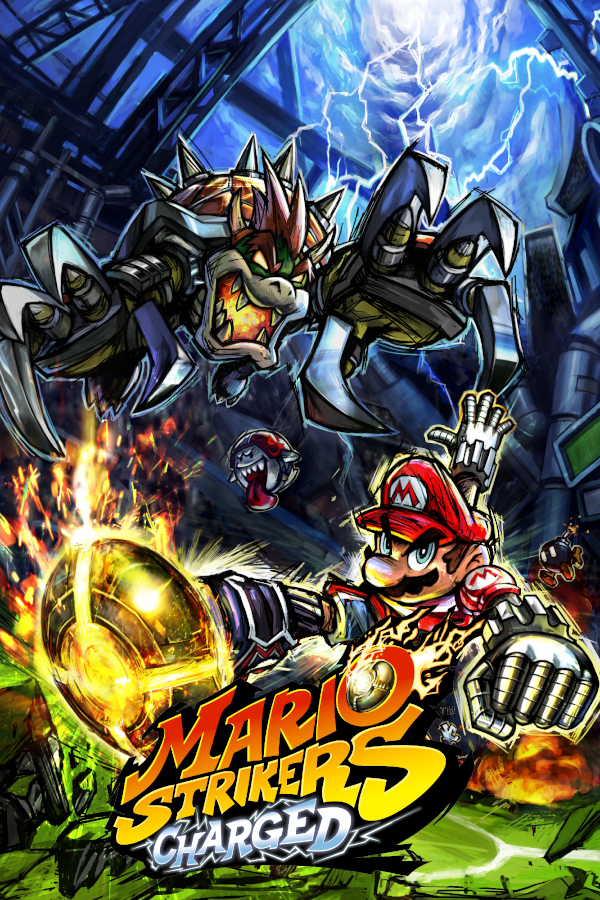
Mario Strikers Charged
Sobre el proyecto
Mario Strikers Charged es un videojuego de fútbol desarrollado por Next Level Games y publicado por Nintendo para la consola Wii. Llegó al mercado el 25 de mayo de 2007 en Europa, el 30 de julio de 2007 en Norteamérica y el 20 de septiembre de 2007 en Japón. Es el segundo juego de la saga Mario Strikers, teniendo la misma temática que su predecesor Super Mario Strikers con algunas modificaciones en la jugabilidad.
4 versiones de Mario Strikers Charged
Estás viendo: Mario Strikers Charged
Mario Strikers Chargedgithub.com/yannicksuter/mscharged-decompMSCharged Port (yannicksuter)github.com/yannicksuter/MSCharged-PortMario Strikers Charged (WiiCompiled)github.com/BlackAndBlue95/Strikers-WiiCompiledMario Strikers Charged Recompiledgithub.com/previouslevelgames/rechargedInformación oficial del proyecto
Mario Strikers Charged



<!--
Replace with your repository's URL.
-->
<!--
decomp.dev progress badges
See https://decomp.dev/api for an API overview.
-->
<!--
Replace with your Discord server's ID and invite URL.
-->
[!IMPORTANT] This repository does not provide a new way to play Mario Strikers Charged. It is not a modern recompilation ("recomp") or a port. For completed versions, 100% code and linking means the reconstructed source compiles into an executable byte-for-byte identical to the original retail Nintendo Wii release.
Recompilations and ports based on this work are maintained separately and are outside the scope of this repository. Please do not ask for recompilations or ports in the decompilation Discord, as producing and supporting them is not the focus of this community.
A work-in-progress matching decompilation of Mario Strikers Charged for Nintendo Wii, developed by Next Level Games and published by Nintendo.
[!NOTE] Version 1.0.0 of the native PC port has been released and is available now. Based on this decompilation, the port uses the decompiled source directly and does not rely on recompilation ("recomp"). This approach enables bug fixes and modding.
This repository does not contain game assets or the original executable. You must provide your own legally obtained copy of the game.
Supported versions
| Regional Wii release | Version | Region and title | Revision | Status | main.dol SHA-1 |
|---|---|---|---|---|---|
| 2007-05-25 | R4QP01_rev1 | Europe - Mario Strikers Charged Football | Rev 1 | Complete: 100% code / 100% linked | 0a066b755b469648a371d1cfc2d1bcad315b2b4a |
| 2007-05-25 | R4QP01_rev2 | Europe - Mario Strikers Charged Football | Rev 2 | Complete: 100% code / 100% linked | c39e1eda1942aa2fc96a6a71bfef051698e23516 |
| 2007-07-30 | R4QE01 | USA - Mario Strikers Charged | Rev 1 | Complete: 100% code / 100% linked | e96d2298067b70652752145b4e63644e6e1b1560 |
| 2007-09-20 | R4QJ01 | Japan - Mario Strikers Charged | Rev 0 | Complete: 100% code / 100% linked | 74be723403329158b1645d9961a3cd6be755cdb8 |
| 2010-03-18 | R4QK01 | Korea - Mario Power Soccer | Rev 0 | Complete: 100% code / 100% linked | c2f893aa71911c4ad4dcead1474e517e8e598fcb |
Dates are the original regional Wii releases, sorted chronologically. Separate release dates for the EU disc revisions have not been verified; both EU rows show the regional launch date. The linked Nintendo release information and Nintendo Korea announcement provide the date sources.
R4QE01 remains the default. All five versions link entirely from reconstructed
source and reproduce their retail executables. Each version has its own
symbols, splits, progress report and retail DOL hash. The revision numbers
above are the revision bytes recorded in the disc headers.
The former R4QP01 configuration is now named R4QP01_rev2. For an existing
checkout, move the local files from orig/R4QP01 into orig/R4QP01_rev2 and
configure again. Revision 1 needs its own disc image; the two EU revisions are
not interchangeable.
comparison.md compares the five builds in detail: disc and system data, build stamps, SDK versions, executable layout, version-specific code and disc assets. It shows that EU revision 2 takes part of the US fixes, that the Japanese build is US code with interface fixes, and that the 2010 Korean build is a separate rebuild with its own title logo and goalie tuning.
Decompilation
Decompilation is the process of reverse-engineering compiled machine code back into human-readable source code. Unlike disassembly, which produces assembly language, decompilation aims to reconstruct high-level code (like C or C++) that closely matches what the original developers wrote. This process involves analyzing the binary executable, understanding its structure and behavior, and translating it back into source code that compiles to produce identical machine code. In this project, the goal is not just a close match, but a 100% match—the decompiled source code must compile to produce byte-for-byte identical machine code to the original. This is why diffing (see the Diffing section below) is an essential piece of the process, as it allows us to verify that our decompiled code produces exactly the same binary output as the original game. Decompilation projects like this one enable deeper understanding of game mechanics, facilitate modding and preservation, and serve as valuable learning resources for understanding how games were built.
Progress

Track the project decompilation progress and explore the interactive graph on decomp.dev.
Dependencies
- Python 3
- Ninja
The build downloads pinned versions of decomp-toolkit, the compiler, binutils, objdiff-cli, and wibo when needed.
Building
Place a supported disc image in orig/<version>: orig/R4QE01 for USA,
orig/R4QP01_rev1 for EU revision 1, orig/R4QP01_rev2 for EU revision 2,
orig/R4QJ01 for Japan, or orig/R4QK01 for Korea.
ISO, RVZ, WIA, WBFS, CISO, NFS, GCZ, and TGC images
are supported. Use the disc revision listed above.
Then configure and build:
python3 configure.py
ninja
To select another version:
python3 configure.py --version R4QP01_rev1
ninja

python3 configure.py --version R4QP01_rev2
ninja

python3 configure.py --version R4QJ01
ninja

python3 configure.py --version R4QK01
ninja
Running python3 configure.py without --version selects USA again. Build
outputs are kept separately in build/<version>; build.ninja and
objdiff.json describe the currently selected version.
On the first build, decomp-toolkit extracts sys/main.dol from the disc image
and performs the initial analysis. Once extraction succeeds, the disc image can
be removed from orig/<version> to save space.
For USA, Europe and Japan, Ninja also generates the disc-message image include
from that version's main.dol. The generated DiscMessageImages.inc stays in
the build directory and is ignored by Git, including when using --build-dir.
Korea uses its separate source implementation in
src/RVL_SDK/dvd/R4QK01/dvdFatal.c.
The reconstructed config/<version>/symbols.txt and
config/<version>/splits.txt are checked into the repository. Disc images,
extracted game files, split objects and build outputs must remain untracked.
A successful USA build ends with:
build/R4QE01/main.dol: OK
Each version checks its own build/<version>/main.dol in the same way.
The build prints code matching and source-linking percentages and writes
build/<version>/report.json. A verified DOL can still contain extracted
objects; the linking percentage counts only code linked from source.
To generate a linker map for the reconstructed ELF, configure with --map:
python3 configure.py --map
ninja
The result is written to build/<version>/main.elf.MAP. It describes the
reconstructed link rather than an original development map and is intentionally
ignored by Git.
Diffing
After configuration, open the project directory in
objdiff. It reads the generated
objdiff.json automatically and rebuilds changed objects with Ninja.
Some retained template definitions are provided by another compiled source
object. objdiff_weak_providers lists those sources for a unit. Ninja creates
its comparison object in build/<version>/compare/, preserving the local
object's definitions and adding missing weak definitions from the providers.
The ordinary compiled objects remain the linker inputs. This accounts for
shared method matches; source-linking a TU still requires matching its layout.
Source review and regional verification
Matching the executable and reviewing the source are separate checks. A matching DOL verifies the retained instructions and data; it does not establish original names, types or source organization. Source review continues after a version reaches 100% matching and linking.
For a source cleanup or regional change:
- Build the unchanged revision and preserve its report and affected compiled objects as the baseline.
- Read the implementation, declarations, callers and referenced data. Check behavior, ABI, layout, lifetime and ownership against the relevant retail executable. Use descriptive names supported by those uses; keep an uncertain identity neutral. Reconstructed names are not recovered original symbols.
- Update definitions, owning headers, consumers and the applicable regional symbol files together. A file move also updates its build entry and splits. Compiler-generated pools, alignment gaps and anonymous labels do not need invented source names. Keep changes to algorithms separate from naming work.
- Rebuild every affected consumer, including indirect users of shared headers. For a naming cleanup, compare allocated bytes, section alignment, symbol positions and bindings, and relocation targets after accounting for the intended renames. Preserve each existing function and data result, rather than relying on an aggregate percentage.
- Verify that the linker consumes the compiled source objects, generate fresh reports, and require the retail DOL hash for every affected version. Shared source changes require all five regional checks; USA and both EU revisions must preserve their established behavior and matching results.
With the extracted originals available for every version, run the build matrix from the repository root:
set -e
for version in R4QE01 R4QP01_rev1 R4QP01_rev2 R4QJ01 R4QK01; do
    python3 configure.py --version "$version"
    ninja all_source
    ninja
done
Keep comparison reports and build artifacts under the ignored build directory. Document the affected scope and verification results with the change. Low-level SDK and runtime code can use assembly; a byte match alone does not prove its historical source form or justify a construct used only to force code generation.
Contributing
Contributions are welcome. Read CONTRIBUTING.md before starting work so that changes follow the repository's matching, style, and asset-handling rules.
Related projects
smstrikers-decomp is the sibling decompilation project for Super Mario Strikers, the Nintendo GameCube predecessor first released in November 2005.
Acknowledgements
This project is based on encounter/dtk-template and uses decomp-toolkit. Thanks to the GameCube/Wii decompilation community for the tools and documentation that make projects like this possible.
License
The repository's original source contributions are dedicated to the public domain under CC0 1.0. Third-party source retains its own terms; see LICENSES. Game assets and other copyrighted material are not covered and must not be committed.