Jet Set Radio Future Recompiled
Jet Set Radio Future
About the project
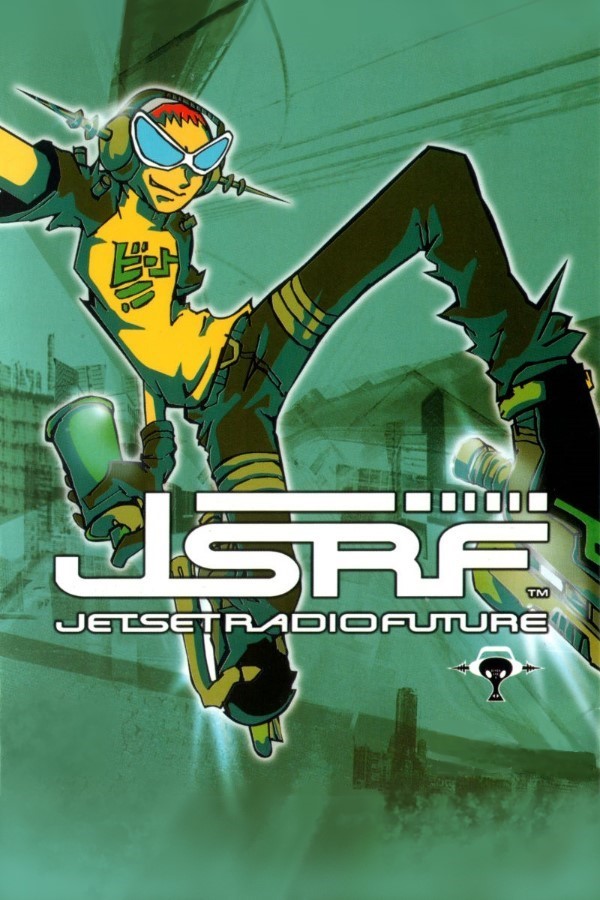
Jet Set Radio Future es un videojuego de acción de 2002 desarrollado por Smilebit y publicado por Sega para Xbox; es una secuela del juego de Dreamcast Jet Set Radio (2000). Como una nueva versión del juego original, presenta mecánicas de juego refinadas, gráficos actualizados, entornos de mundo abierto más grandes, nuevos personajes, una trama alterada, una nueva banda sonora y un modo de juego multijugador.
2 versions of Jet Set Radio Future
You're viewing: Jet Set Radio Future Recompiled
Official project information
Jet Set Radio Future — static recompilation
Turning the original Xbox release of Jet Set Radio Future into a native macOS binary by recompiling its x86 code to C, rather than emulating it.
Built on sp00nznet/xboxrecomp by sp00nz (MIT). The recompiler, the Xbox kernel replacement, the NV2A graphics model and the MCPX audio model all come from that project; this repository is a fork specialised to get one title running, with the general fixes sent back upstream where they belong.
Work in progress, not a release. As of 26 September 2026 the game is playable into chapter 2 at a steady 60 fps on Apple Silicon: story missions, cutscenes, graffiti, music and the controller all work, and every chapter can be entered. What is still wrong, and what has not been checked yet, is listed below and in docs/jsrf/STATUS.md.
You need your own copy of the game
No game data is contained in this repository, and none will be. Not the
executable, not the assets, not the generated C — that last one is mechanically
derived from the game's own code and is rebuilt locally by regenerate.sh,
never committed. You supply a dump of a disc you own; the repository supplies
the machinery that runs it. Save files and pad recordings are yours too and
stay out of the repository.
Where it stands
Works (each confirmed in a player session unless marked):
-
Boot, menus, Load and character select, the Garage and the tutorial.
-
Story progression through chapter 1 into chapter 2 (Shibuya Terminal, Dogenzaka Hill, Rokkaku-dai Heights), with tags, graffiti souls and characters joining; the save's progress decodes and round-trips exactly.
-
Stage music streams for whole sessions on the host audio path (the DSOUND lift): 23-minute sessions with the track read in real time to the end.
-
Rokkaku-dai's city, fog and cel-shaded characters (fixed 24 Sep: the city was discarded by an alpha test on a padding byte; characters were white because two 16-bit texture formats were never decoded on the GPU).
-
Cutscenes no longer lose the whole scene for a frame once a second (fixed 25 Sep: the recompiler's
frndintignored the x87 rounding mode, so the game'sfloor()/ceil()rounded to nearest and animation read past its key table). Verified unattended on the chapter-2 intro: 11 dropped frames → 0. -
Every chapter can be entered unattended (
RECOMP_CHAPTER_JUMP); chapters 2 and 5 were entered and played without a fault. -
Roboy's graffiti studio paints, and Rokkaku-dai's water is drawn with its bump-environment mapping (both confirmed 26 Sep).
-
60 fps. With the Direct3D lift (below) a player session on 26 Sep ran at 17.1 ms a frame against the 16.7 ms vsync cap, p99 19.5 ms. Uncapped, in free play:
stage NV2A model Direct3D lift Garage 18.2 ms 8.5 ms Rokkaku-dai Heights 21–23 ms 8.5 ms Shibuya Terminal 29.0 ms 11.5 ms Sky Dinosaurs 35–37 ms 12.7 ms
The Direct3D lift
The game talks to the Xbox GPU only through Direct3D 8. Instead of decoding
the push buffer Direct3D writes and modelling the NV2A register by register,
the lift follows Direct3D's own calls and draws them on the host GPU, from
Direct3D's own derivations (texture stage modes, the pixel shader's final
combiner, point sizes, bump matrices). It now draws 99.3–99.6% of every frame;
the one draw left to the NV2A model is Direct3D's own swap-copy quad. Every
change is checked against the NV2A model per draw (RECOMP_D3D8_HOST_VERIFY)
and per whole frame at the same moment of a stage
(gametools/frame_match.py): the lift and the model differ by under 1% of
pixels, which is lighting rounding and animation phase.
It is opt-in in the engine, and on in a bundle built with
JSRF_APP_LIFT=1 packaging/make_app.sh …; paths.conf can turn any part
off. The plan and the measurements are in
docs/jsrf/goals/JSRF_GOALS_2026-09-25_EVENING_FINISH_THE_LIFT.md.
Still wrong or unknown:
- A 4-second freeze on first opening the graffiti studio (the host waiting
on the pipeline-archive queue) is fixed in the lift bundle
(
RECOMP_METAL_ASYNC_HOST_VSH, 26 Sep); the studio itself is to be re-tested in play. - A thin grey line above some speech-box letters; measured to be the shipped font's bilinear bleed, so probably authentic, pending an xemu comparison.
- Elements missing from the Poison Jam chase cutscenes.
- Chapters 3–9 have been entered but not played through; a sweep of all 74 cutscenes that can be reached unattended is in progress.
- The lift is not yet the engine's default, only the app bundle's.
- Windows: the MinGW cross-build links again at the current tree (26 Sep) and runs under CrossOver. A Direct3D 11 host renderer for the lift draws 99.4% of the attract demo there; it has not yet been compared frame by frame, because the Windows NV2A-model arm hangs at boot in CrossOver. CrossOver can judge its picture, not its speed.
Build and play
Requirements: macOS on Apple Silicon, CMake, a C toolchain, and a Python 3
with capstone (/usr/bin/python3 -c 'import capstone'; pass PYTHON= to
regenerate.sh if your first python3 lacks it).
# 1. translate the guest XBE to C (hundreds of MB, gitignored)
PYTHON=/usr/bin/python3 diagnostics/jsrf_first_fault/regenerate.sh

# 2. build and test
cmake -S diagnostics/jsrf_first_fault -B build -DRECOMP_GEN_DIR=<gen dir>
cmake --build build -j
ctest --test-dir build

# 3. a double-clickable app with its libraries bundled (JSRF_APP_LIFT=1: the
#    Direct3D lift on, which is what reaches 60 fps)
JSRF_APP_LIFT=1 diagnostics/jsrf_first_fault/packaging/make_app.sh build/jsrf_first_fault <dest dir>
JSRF.app reads ~/Library/Application Support/JSRF/paths.conf for the game
directory (JSRF_GAME_DIR, the folder holding default.xbe), the emulated
HDD (JSRF_HDD_ROOT) and any RECOMP_* switches, and writes its log to
last-run.log beside it (the previous one is kept as last-run-previous.log).
Do not pipe make_app.sh into head: SIGPIPE leaves a truncated bundle.
Debugging it
The work is driven by evidence from the running game, and most of the tooling exists to get that evidence without a person at the controller. See docs/jsrf/TOOLS.md for the full guide. In short:
- Reach any scene unattended:
RECOMP_CHAPTER_JUMP=<chapter>:<mission>starts any story mission from the Garage; a catalogue of all 300 cutscene files says which jump plays which (diagnostics/jsrf_first_fault/gametools/). - Catch a glitch as it happens:
RECOMP_FLIGHT_FRAMES=Nkeeps the last N presented frames and every draw in them, written out when you press M;RECOMP_GLITCH_WATCH=1finds one-frame dropouts by itself. - Read the game's own state: a save decoder/editor, mission and event parsers, and guest memory dumps at harness captures.
- Drive the game: a stage harness (
diagnostics/jsrf_first_fault/stage_harness) boots, navigates, replays recorded pad input and captures frames.
There are a few hundred RECOMP_* switches; enumerate them rather than
guessing:
grep -rhoE 'RECOMP_[A-Z0-9_]+' src diagnostics | sort -u
How the work is done here
Every claim in docs/jsrf/ is supposed to have a measurement behind it, and
several of the notes are retractions of earlier claims that did not. The rules
in CLAUDE.md were each paid for with a wrong conclusion:
- Measure, don't infer. Runtime behaviour is not deducible from reading generated C.
- Read a counter's trigger before trusting its value. Several counters here have lied.
- Every absence-measurement needs a positive control.
on=0means "nothing happened" or "the instrument is dead", and only a control separates them. - Reach the scene before theorising about it. A night of guesses about Rokkaku-dai ended the moment the harness could get there unattended.
The current plan is the newest file in docs/jsrf/goals/; docs/jsrf/README.md explains how the notes are laid out.
Upstream
General fixes go back to xboxrecomp as pull requests from a fork: ten have
been merged so far (lifter flag semantics, rotates, SHLD/SHRD, movsd
dispatch, APU mix-down, an SVOD reader). Open as of 26 Sep:
| PR | what |
|---|---|
| #130 | indirect calls name their site; sites with a small recorded target set become guarded direct calls |
| #129 | function detection follows a switch through a measured jump table |
| #126 | frndint honours the x87 rounding mode (the cutscene dropouts above) |
| #124 | REPE CMPS/SCAS carry flag, and ZF at a zero count |
| #121 | ADPCM's reserved header byte and step-index clamp |
| #117 | an untranslated instruction reports itself at run time |
| #89 | bounds checks on guest buffers |
The Direct3D lift is not upstream: it is tied to this title's XDK build (4134). The method -- follow the title's Direct3D calls, draw them on the host, check every draw and frame against the NV2A model -- is general.
Licence and credit
MIT, inherited from xboxrecomp — see LICENSE, © 2026 sp00nz. Upstream's own README is preserved at docs/upstream/README.xboxrecomp.md, and the sp00nznet recomp Discord is where the wider project happens.
Function and structure names for the title come from KeybadeBlox's JSRF-Decompilation symbol table, and file formats from their GG-Notebook (WTFPL). xemu is the reference for NV2A behaviour and the oracle the renderer is checked against.
Jet Set Radio Future is © SEGA. This project is not affiliated with or endorsed by SEGA, and distributes none of their material.