
MK64 Portable (Mario Kart 64, PSP)
Mario Kart 64
About the project
Mario Kart 64 es un videojuego de carreras para la Nintendo 64 (N64). Desarrollado y publicado por Nintendo, es la segunda entrega de la serie Mario Kart tras Super Mario Kart de 1992. Conserva la mecánica de su predecesor: el jugador, que controla a un personaje de la franquicia Mario, compite contra sus rivales en circuitos basados en escenarios de los plataformas de Super Mario. Contienen obstáculos para frenarlo y cajas de objetos que le proporcionan potenciadores para ayudarle a avanzar.
12 versions of Mario Kart 64
You're viewing: MK64 Portable (Mario Kart 64, PSP)
MK64 Portable (Mario Kart 64, PSP)github.com/beckerd/psp_mk64_portableMario Kart 64github.com/n64decomp/mk64Mario Kart 64 - MarioKart64Recompgitlab.com/sonicdcer/MarioKart64RecompMario Kart 64 (3DS Port Complete)github.com/Epic0522/MarioKart64-3DSPort-Complete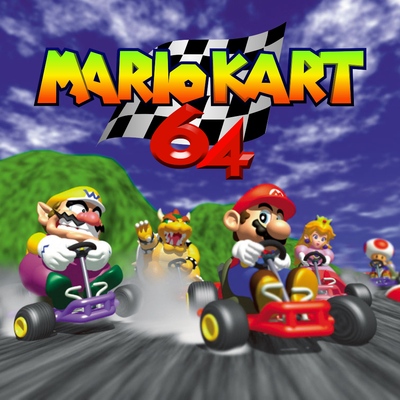 Mario Kart 64 (3DS)github.com/EstebanPdN/mario-kart-64-3dsMario Kart 64 (jnmartin84)github.com/jnmartin84/mk64-dcMario Kart 64 (MK64Recomp)github.com/arefdsg/MK64RecompMario Kart 64 (MKart360, Xbox 360)github.com/sirdankz/MKart360Mario Kart 64 (Xbox)github.com/Team-Resurgent/Mario-Kart-64-XMarioKart 64: Recompiledgithub.com/sonicdcer/MarioKart64RecompSpaghettiKartgithub.com/HarbourMasters/SpaghettiKartSpaghettiKart (Android)github.com/izzy2lost/SpaghettiKart
Official project information
MK64 Portable
A native PSP port of Mario Kart 64 running at 60 FPS in single-player races and 30 FPS in Adhoc multiplayer -- built on the n64decomp/mk64 decompilation. The game's C code runs directly on the PSP's MIPS CPU; the N64-specific layers (libultra, the RSP graphics microcode, the RSP audio microcode) are replaced by a port layer that drives the PSP's Graphics Engine and audio hardware.
The EBOOT contains no game data. On the first start it reads a Mario Kart 64 (USA) ROM that you provide and builds the game data from it. This is an unofficial fan project, not affiliated with or endorsed by Nintendo.
This was created using Claude Fable 5.1. If you do not want AI code on your PSP, this is not a project for you.
<p align="center"><img src="icon/MK64-PIC1.png" alt="" width="480"></p>Features
- 60 fps in single-player races on every PSP model, including the PSP-1000 (32 MB); the game simulates exactly what the N64 did and shows a picture after every simulation step. Heavy stretches drop to 30 fps for a moment rather than run slow. Menus, split screen and the results screen run at 30 fps.
- Hold Start + Select for 1 second to switch single-player races between Performance Mode (60 fps) and Classic Mode (locked 30 fps). The mode name appears briefly and your preference is saved for the next launch. Performance Mode is the default; multiplayer stays at 30 fps in both modes.
- All cups and courses: Grand Prix, Time Trial, VS and Battle
- Ad hoc multiplayer: two to four PSPs race or battle over ad hoc WLAN, each
showing its own player full screen (2P/3P/4P GAME, then HOST or JOIN;
see
docs/adhoc.md). All PSPs need the same build. - The sound is mixed on the PSP's second processor, the Media Engine, which leaves the main CPU to the game
- True widescreen: the 3D view is rendered with a 16:9 field of view, showing more of the track instead of stretching the 4:3 picture; the HUD and menus keep their proportions, anchored to the screen edges
- Music, sound effects and the announcer, mixed on the PSP
- Hardware-accelerated rendering: the N64 display lists are translated to the PSP's Graphics Engine, which does the vertex transform and rasterisation
- Saves (Grand Prix progress, ghosts) kept in the game's
data/folder, with a backup copy so an interrupted save cannot wipe your progress
Installing
You need a PSP that can run homebrew (custom firmware such as ARK-4) and your
own copy of Mario Kart 64 (USA) as an N64 ROM image (.z64, .n64 or
.v64 — any byte order works; the file name does not matter).
- Create
ms0:/PSP/GAME/MK64Portable/on the Memory Stick and copyEBOOT.PBPinto it. - Copy your ROM into the same folder.
- Start MK64 Portable from the XMB.
The first start shows a progress screen while the game data is built from the
ROM and cached (about 13 MB). Everything the port writes — the cache, the save,
the log, and mk64k.prx, the small kernel helper that starts the Media Engine —
goes into a data/ folder next to the EBOOT. Later starts skip the
extraction. If the ROM is missing, is another game, or is not the USA version,
the port says so and returns to the XMB; nothing is cached from a bad ROM.
Only the USA (NTSC) version is supported. Deleting the data/ folder forces a
fresh extraction on the next start (you lose the save in it).
Controls
| PSP | Game |
|---|---|
| Analog nub or D-pad | Steer (the D-pad gives full deflection) |
| Cross | A — accelerate |
| Square | B — brake / reverse |
| Circle or L | Z — use item |
| R | R — hop / drift |
| Triangle | C-up — look behind |
| Start (tap) | Start / pause on release |
| Select (tap) | C-right — cycle the race HUD: map, positions, speedometer |
| L / R on the game select screen | Open OPTION / DATA (the N64 L and R) |
| Hold Select for 3 seconds | Show or hide the FPS counter |
| Hold Start + Select for 1 second | Switch Classic / Performance Mode (saved; 1P races only) |
Building from source
Requirements: the pspdev toolchain, GNU make 4
(gmake on macOS), CMake and Ninja for the asset extractor, Python 3 with
Pillow, and a Mario Kart 64 (USA) ROM.
git clone --recursive <this repository>
cd psp_mk64_portable
cp /path/to/your/rom.z64 baserom.us.z64

# host tools and asset extraction (once)
gmake -C tools mio0 n64graphics displaylist_packer n64cksum tkmk00 extract_data_for_mio
python3 extract_assets.py us
cmake -S tools/torch -B tools/torch/cmake-build-release -G Ninja \
      -DCMAKE_PROJECT_INCLUDE="$PWD/tools/psp/torch_fmt_fix.cmake" && cmake --build tools/torch/cmake-build-release
tools/torch/cmake-build-release/torch code   baserom.us.z64
tools/torch/cmake-build-release/torch header baserom.us.z64

# the PSP build
export PATH="$HOME/pspdev/bin:$PATH"
gmake -f Makefile.psp -j8            # -> build/psp/EBOOT.PBP (ad hoc play and the Media Engine mixer included)
gmake -f Makefile.psp release        # clean build + player README -> release/MK64Portable/ and its zip
Run the result in PPSSPP or on a PSP exactly like a release: put a ROM next to
EBOOT.PBP. The stock Makefile still builds the original N64 ROM.
How the port works
| N64 mechanism | Port replacement |
|---|---|
| libultra (threads, message queues, DMA, VI/AI/SI, EEPROM) | src/port/ultra_shim.c — single-threaded, non-blocking queues; the save is a file |
| RSP graphics microcode (F3DEX display lists) | src/port/gfx/gfx_pc.c, an F3DEX interpreter, driving src/port/psp/gfx_scegu.c (sceGu) with the GE doing transform and lighting |
| RSP audio microcode | src/port/audio/mixer.c, a C mixer fed by the game's own synthesis.c, run as jobs on the Media Engine (src/port/psp/me.c, tools/psp/mekprx); src/port/psp/audio_out.c resamples to the PSP's 32 kHz output |
| Two VI retraces per game frame | split frames: one picture per simulation tick in 1P races (docs/fps60.md) |
| Segmented addressing | src/port/segments.c plus generated offset-to-symbol tables |
Shipping without game data
The objects that hold ROM-derived data are linked into a region the executable
carries no bytes for. At build time, tools/psp/make_assets.py extracts that
region from a companion link and tools/psp/derive_recipes.py works out, for
every one of its 20,703 symbols, how the bytes derive from the ROM — a raw
range, a compressed block, a byte-order or field pattern, or a slice of a
course's packed display lists. The result (tools/psp/recipes.json, numbers
only) is compiled by tools/psp/emit_recipes.py into a table that rides in the
EBOOT's DATA.PSAR. On the first start src/port/psp/assets_gen.c executes
that table against the player's ROM using the game's own decoders, checks the
result against a CRC, and caches it. gmake -f Makefile.psp assets-recipes
regenerates the recipes when the set of assets changes; a build with
EXTRA_CFLAGS=-DPORT_ASSETS_VERIFY compares an extraction symbol by symbol
against the build-time archive.
License
The port layer, its tooling and the artwork are released under the MIT License
(see LICENSE). The decompiled game code inherited from n64decomp/mk64 is
Nintendo's copyrighted work and carries no license; it is distributed for
preservation and interoperability, and no game assets are included.
Acknowledgements
- n64decomp/mk64 — the decompilation this port is built on
- sm64-port — the F3DEX interpreter and audio mixer this port started from
- SpaghettiKart and Torch — the asset extraction and a reference for the game's audio commands
- pspdev — the PSP toolchain and SDK
Mario Kart 64 is a trademark of Nintendo. This project is not affiliated with or endorsed by Nintendo, and it does not include any of the game's assets.