
ZeldaAlttPSNESRecomp
The Legend of Zelda: A Link to the Past
OriginSuper Nintendo
TechnologyStatic recompilation (native C/C++)
Available forWindows, Linux, macOS
View official projectAbout the project
The Legend of Zelda: A Link to the Past, conocido en Japón como Zelda no Densetsu: Kamigami no Triforce , también conocido como Zelda 3 y Zelda III, es un juego de acción y aventuras desarrollado y publicado por Nintendo para la consola Super Nintendo Entertainment System y años después a la Game Boy Advance junto a The Legend of Zelda: Four Swords, siendo lanzado el 3 de diciembre del 2002, siendo la tercera entrega de la saga de videojuegos The Legend of Zelda.
9 versions of The Legend of Zelda: A Link to the Past
You're viewing: ZeldaAlttPSNESRecomp
ZeldaAlttPSNESRecompgithub.com/mstan/ZeldaAlttPSNESRecomp A Link to the Past (3DS)github.com/EstebanPdN/zelda-alttp-3dsThe Legend of Zelda: A Link to the Pastgithub.com/YeOldPress/alttp-dxMoon Pearlgithub.com/DoutorRaposo/moonpearlZ3R Launcher (xander-haj)github.com/xander-haj/Z3R-LauncherZelda 3 Launcher (RadzPrower)github.com/RadzPrower/Zelda-3-Launcherzelda3github.com/snesrev/zelda3Zelda3 (Android)github.com/samyost1/zelda3-androidZelda3Launchergithub.com/Waterdish/zelda3-android
Official project information
ZeldaAlttPSNESRecomp
This recompilation is a byproduct of developing snesrecomp — the games are the proving ground, the framework is the goal. These are in-development previews, not finished ports — expect rough edges, and depth will keep landing over months, not days. My time for any one title is limited, so I ask for your patience. Contributions are welcome — testing, issues, and PRs to the game or framework all help and will accelerate this game's polish. More on the why at: Recomp + AI: 5 Months Later »
Static recompilation of The Legend of Zelda: A Link to the Past (SNES)
into native C, using the snesrecomp
framework. This repo is the per-game side: the runtime, the recompiled C
output, the per-game .cfg, and the build glue.
What "static recompilation" means here
The 65816 CPU code from the ROM is statically translated to C — every
function the game runs on the SNES's main CPU is a real generated C
function in src/gen/. The rest of the SNES is not recompiled —
it's hardware. PPU rendering, the APU/SPC700 audio coprocessor, DMA and
HDMA channels, hardware register I/O, and bank-mapping all run through
an embedded copy of snes9x's emulator core
(snesrecomp/runner/snes9x-core/). Same model as N64Recomp and similar
projects: recompile the CPU, emulate the silicon.
The ROM is never redistributed — you supply your own legally-dumped copy.
New: Seamless World is available as an experimental launcher mod, with live expanded worlds, zoom and connected dungeon floors. Download the Windows experimental release.
Current status
Hand-verified end-to-end through:
- Boot → attract demo → file select → in-game.
- Module 09 (Overworld) reachable and traversable.
- Module 07 (Dungeon) including sword combat — the bug from v0.1.0's release-note investigation (camera axis-swap on sword hit) is fixed.
- Audio (HLE SPC upload of the cartridge's stock sound engine) plays through title, gameplay, sword/item SFX, and music transitions.
The original route checks above cover the early game. Seamless World also has focused later-game, Dark World and dungeon checks, described below and in its validation notes. These checks do not establish a complete playthrough or an audit of every quest and boss. If you hit a visible regression, please open an issue with reproduction steps and a current-build savestate.
Active development; expect:
- Some branches don't build; only
mainis guaranteed to build. - Internal docs (
ISSUES.md) assume context. - APIs and recompiler output change without notice.
Quick start (pre-built release)
- Download the latest release zip from Releases and extract it.
- Run
ZeldaALttPSNESRecomp.exe. On first launch a file picker asks for your legally-obtained Legend of Zelda: A Link to the Past (USA) ROM (.sfc/.smc). The expected CRC32 is0x777AAC2F(no-intro canonical USA dump, 1 MiB, LoROM). 512-byte SMC copier headers are auto-stripped before hashing, so headered or unheadered both work. - Edit
keybinds.ini(auto-generated next to the exe on first run) to remap keys, then restart.
The path you pick is cached to rom.cfg next to the exe so subsequent
launches skip the picker.
Controls (default keybinds.ini)
| SNES button | Default key |
|---|---|
| D-Pad | Arrow keys |
| A | X |
| B | Z |
| X | S |
| Y | A |
| L | C |
| R | V |
| Start | Enter |
| Select | Right Shift |
Player 2 is unbound by default — fill in keys in keybinds.ini to
enable a second keyboard player.
Xbox / PlayStation / Switch Pro controllers are auto-detected via SDL_GameController (XInput on Windows). Plug it in before launching, or hot-plug after.
System shortcuts (configured in config.ini's [KeyMap] section):
| Action | Default |
|---|---|
| Save state 1-10 | Shift+F1..F10 |
| Load state 1-10 | F1..F10 |
| Toggle pause | P |
| Reset | Ctrl+R |
| Toggle fullscreen | Alt+Enter |
| Turbo (fast-forward) | Tab |
Adaptive widescreen
Enable Adaptive view in the launcher, or set Widescreen = 1 under
[Graphics] in config.ini. The logical height remains 224 pixels while the
logical width follows the live window or fullscreen aspect ratio. Resizing a
window wider therefore reveals more of the overworld or dungeon instead of
stretching a fixed 16:9 image. At the native aspect the renderer returns to the
authentic 256-pixel view; at 16:9 it is about 398 pixels wide.
The status HUD's left and right groups remain anchored to their respective edges. Room bounds still win over the requested width, so areas without valid terrain pillarbox rather than exposing wrapped tile data. The maximum logical width is 446 pixels because wider views cannot represent every sprite safely in the SNES's 9-bit OAM coordinate space.
Building from source
Prerequisites: Windows 10+, Visual Studio 2022 (with C++ desktop
workload), Python 3.9+ on PATH, and rustup for regeneration.
git clone https://github.com/mstan/ZeldaAlttPSNESRecomp
git clone https://github.com/mstan/snesrecomp
cd ZeldaAlttPSNESRecomp
The snesrecomp/ directory is a sibling repo
accessed via a junction/symlink to the clone next to this repo.
Build:
# From a Developer Command Prompt for VS 2022, or with MSBuild on PATH:
msbuild zelda.sln /p:Configuration=Oracle /p:Platform=x64 /m
The recompiled C in src/gen/ is not committed — contributors must
regenerate it from a local ROM before the first build. See the next
section.
Regenerating the recompiled C (contributors)
- Drop a legally-obtained stock
zelda.sfcat the repo root (.gitignoreexcludes it). - Run:
This applies the bundled MSU-1 patch to a throwaway copy of your stock ROM (bash tools/regen.sh # add --no-tests to skip the framework suitetools/apply_msu_patch.py), regeneratessrc/gen/from the patched image, and syncsrecomp/funcs.h. Your stock ROM is left untouched and is what you load at runtime. The script builds and requires the fast native analyzer; setSNESRECOMP_ANALYSIS_BACKEND=pythononly to run the slower reference implementation. - Rebuild as above.
Seamless World (experimental)
Explore beyond the original screen boundaries. Seamless World presents the Light World and Dark World as live, continuous maps, and shows connected rooms on the current dungeon floor. Zoom out to see more of the game while enemies, items and projectiles continue to run using the game's native routines.
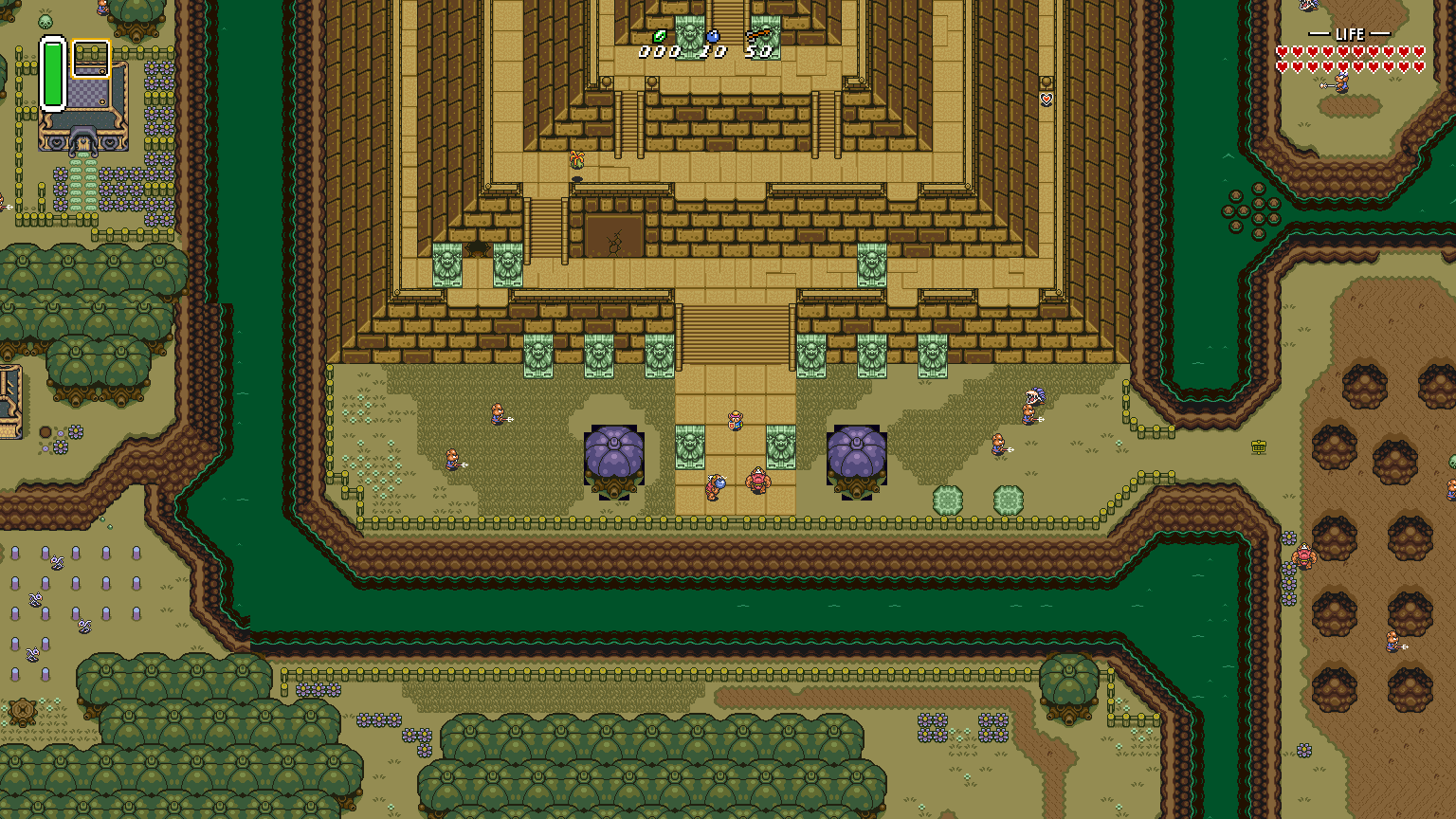
Enable Seamless World in the launcher's Mods page in the Windows experimental release. It is marked Experimental and disabled by default. Supply the stock USA ROM; no ROM patch or separate map download is needed.
- Continuous overworld: ordinary area crossings keep the camera moving with Link. Actors retain their state across crossings, with combat, pickups, carried objects and projectiles working across area boundaries.
- Connected dungeon floors: see neighboring rooms together while native doors, keys, shutters and pressure plates retain their behavior. Stairs and pits still take their authored routes between floors and rooms.
- Adjustable view: resize the window to reveal more in either direction, use the mouse wheel to change zoom, or press F4 to toggle the whole current world or dungeon floor. F4 is separate from the game's original map.
- Native presentation and travel: the HUD follows the actual viewport; inventory, dialogue and the original game map keep their controls. Caves, special entrances, warps and Light/Dark World changes keep native routing.
F4 reveals the whole current world. This is the live game view; visible terrain and actors come from the supplied ROM.
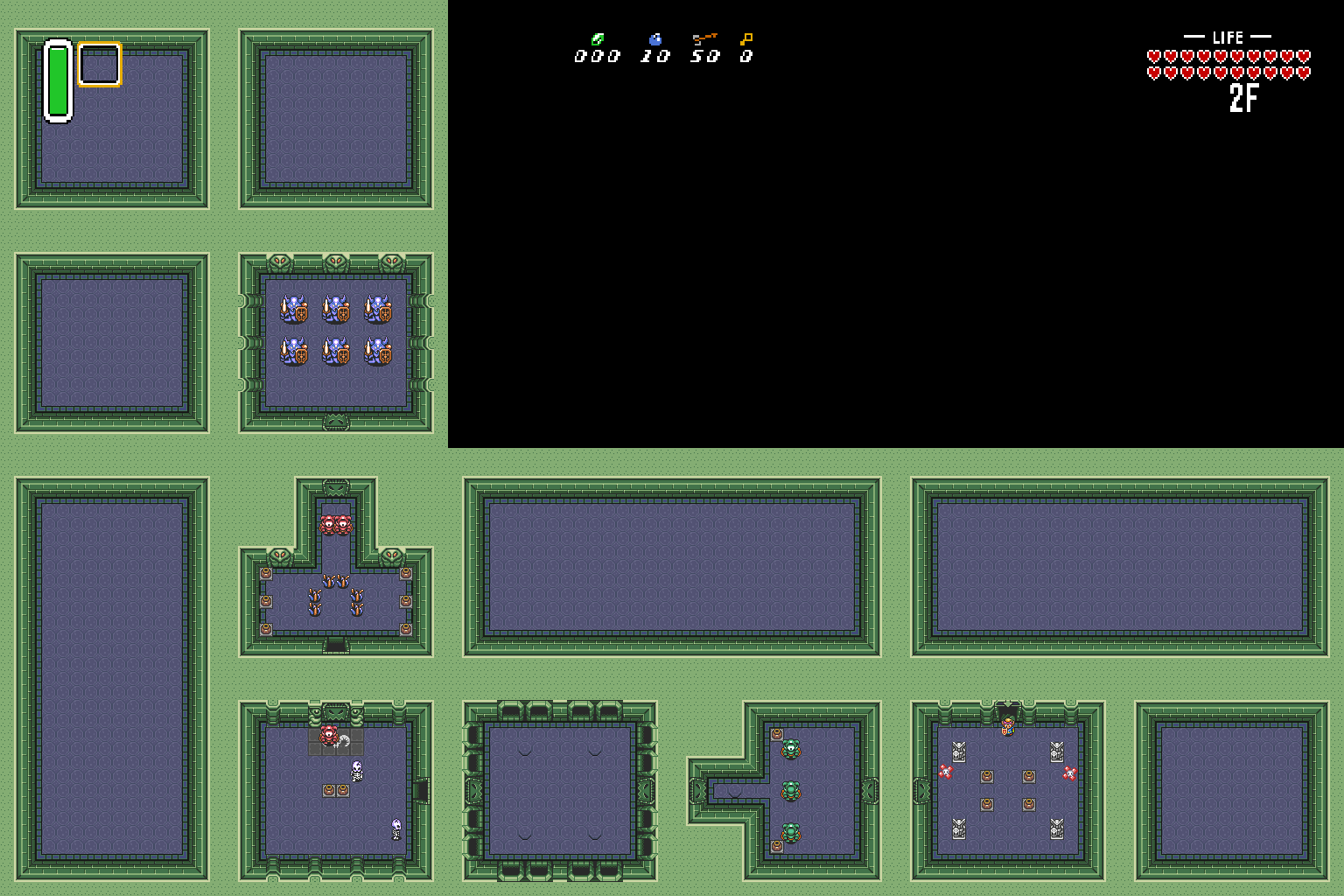
A connected dungeon floor. Native stairs change the current floor.
In the camera-following view, visible areas and a surrounding halo simulate; other areas retain their state. The whole-map view activates the entire current world or floor, so large views can slow down. Full-map 60 FPS is not a requirement for this experiment.
This preview is for local play. Representative checks cover terrain, rendering, boundary interactions, weapons, NPCs, puzzles, dungeon travel and current-build save/load and replay. Full-game coverage, every enemy/quest variant, netplay and Linux/macOS runtime qualification remain open. See the burndown and validation notes for specific limits. Native in-game saves remain separate from build-specific save states. Stock presentation, adaptive widescreen and MSU-1 remain available.
MSU-1 audio
This build supports MSU-1 — CD-quality streaming music in place of the SPC soundtrack — and you still just use your stock A Link to the Past (USA) ROM.
You don't patch anything. The MSU-1 audio driver lives in an
expansion bank the game's ROM doesn't normally have, so it has to be
present when the recompiler runs. Instead of asking you for a patched
ROM, the regen step applies the bundled, MIT-licensed MSU-1 patch
(recomp/msu1/) to your stock ROM in a throwaway file
and recompiles from that. The driver ends up compiled into the binary,
so at runtime you still load your stock ROM — it plays the normal SPC
soundtrack by default, and switches to MSU-1 streaming when a music pack
is present.
Regen does this automatically; see "Regenerating the recompiled C" above
(it runs tools/apply_msu_patch.py for you). The patch targets the US
1.0 ROM — if your ROM's hash doesn't match, regen warns that patching may
fail but proceeds.
Add a music pack — point SNESRECOMP_MSU1 at it:
# A folder: the pack base is auto-detected from its <name>-<N>.pcm files
SNESRECOMP_MSU1=/path/to/alttp_msu_pack  zelda.exe zelda.sfc
Without a pack (or with the env unset) you get the normal SPC music —
the driver detects no MSU-1 and falls back. Sound effects always stay on
the SPC. Packs are the standard <name>-<N>.pcm set (44.1 kHz stereo);
you supply your own. The launcher recognizes the stock and MSU-patched
images; any other ROM still loads, with a warning.
Thanks
The MSU-1 driver is not ours — it's qwertymodo's ALttP MSU-1 patch,
building on Conn's original work, shared freely under the MIT license. We
bundle it with gratitude; see recomp/msu1/ATTRIBUTION.md.
Repo layout
| Path | Purpose |
|---|---|
src/ | Runtime C (CPU state glue, NMI orchestration, hand-written bodies for things the framework doesn't recompile). |
src/gen/ | Recompiler output (gitignored; regenerated from ROM). |
recomp/bank*.cfg | Per-bank function declarations + hardware hints the framework cannot derive from the ROM alone. |
recomp/funcs.h | Auto-regenerated by tools/regen.sh; never hand-edit. |
snesrecomp/ | Symlink to a sibling clone of the snesrecomp framework. |
third_party/ | Vendored deps (gl_core, stb_image) with their own licenses. |
zelda.sln + src/zelda.vcxproj | Visual Studio build glue. |
config.ini | The config. Generated next to the exe on first run if missing. |
License
PolyForm Noncommercial 1.0.0. See LICENSE. Code in this repo is
original; vendored dependencies under third_party/ retain their own
licenses.
The Legend of Zelda: A Link to the Past ROM and any data extracted from it are not in this repo and are not licensed for redistribution.
<p align="center"> <sub><b>R.A.I.D. — Retro AI Development</b> · a Discord for AI-assisted retro reverse-engineering, decomp & recomp</sub> </p> <p align="center"> <a href="https://discord.gg/Ad9BwSzctP"><img src=".github/raid-discord.png" alt="Join the Retro AI Development (R.A.I.D.) Discord" width="200"></a> </p>
Coverage survey and regeneration
Game-owned generation policy is in recomp/generate.toml; the shared framework runs the same hooks for tools/regen.sh and launcher rebuilds. See the 2026-10-18 coverage survey for verified ROM identity, observed scenes, corrections, and remaining validation limits.