
SSX 3 (ssx3-decomp)
SSX 3
Sobre el proyecto
SSX 3 es un videojuego de snowboarding publicado por Electronic Arts y desarrollado por EA Sports BIG, que fue lanzado a finales del 2003. Es la tercera instalación en la serie de juegos SSX, y está aprobado con THX.
2 versiones de SSX 3
Estás viendo: SSX 3 (ssx3-decomp)
Información oficial del proyecto
SSX 3, decompiled
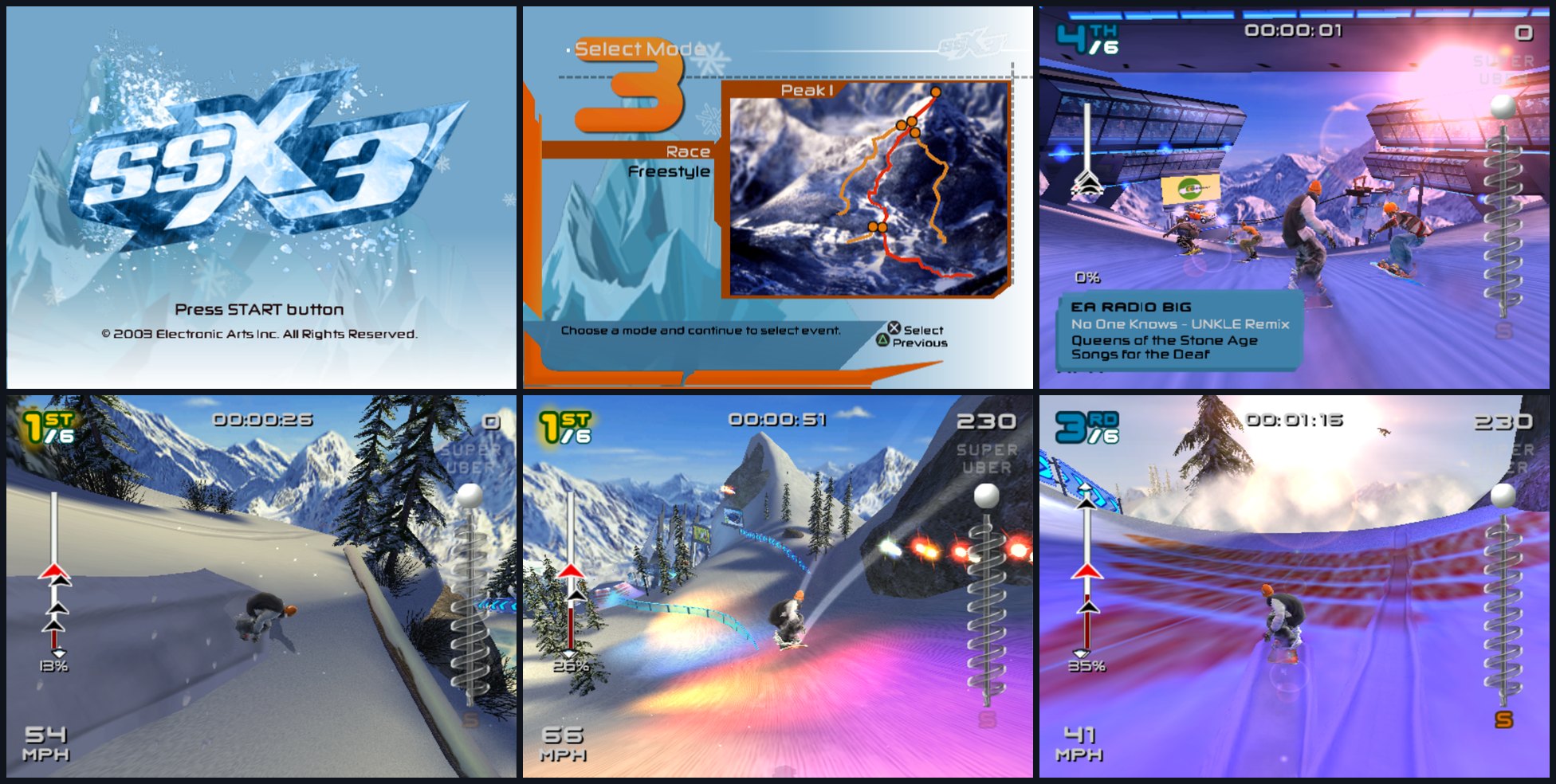
▶ Video
SSX 3 is © Electronic Arts; "SSX" is an EA trademark. This project is not affiliated with or endorsed by EA. The repository contains no game data and no game code. The disc image, the executable and everything translated from them (
orig/,generated/) are produced locally from your own copy of the game, are ignored by git, and must never be committed or shared.
A native Rust port of SSX 3 (USA) (SLUS_207.72, PlayStation 2). The game's code
was statically recompiled to Rust and is being replaced, function by function, with
hand-written Rust. Rendering, movies, sound, files, controllers and the memory card are
native. No emulator runs the game, and no PS2 graphics, video or audio hardware is
emulated.
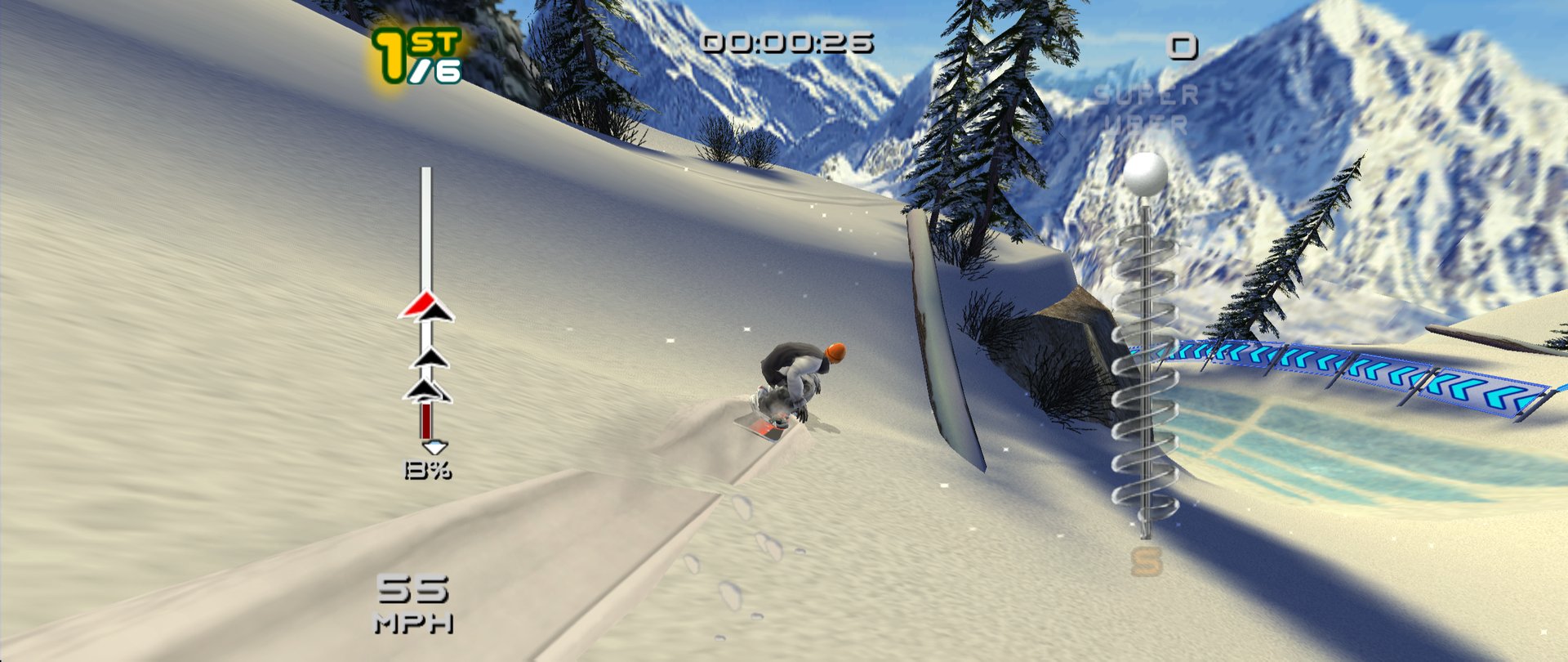
- Fully playable: every race and freestyle event, Conquer the Mountain, music, saves.
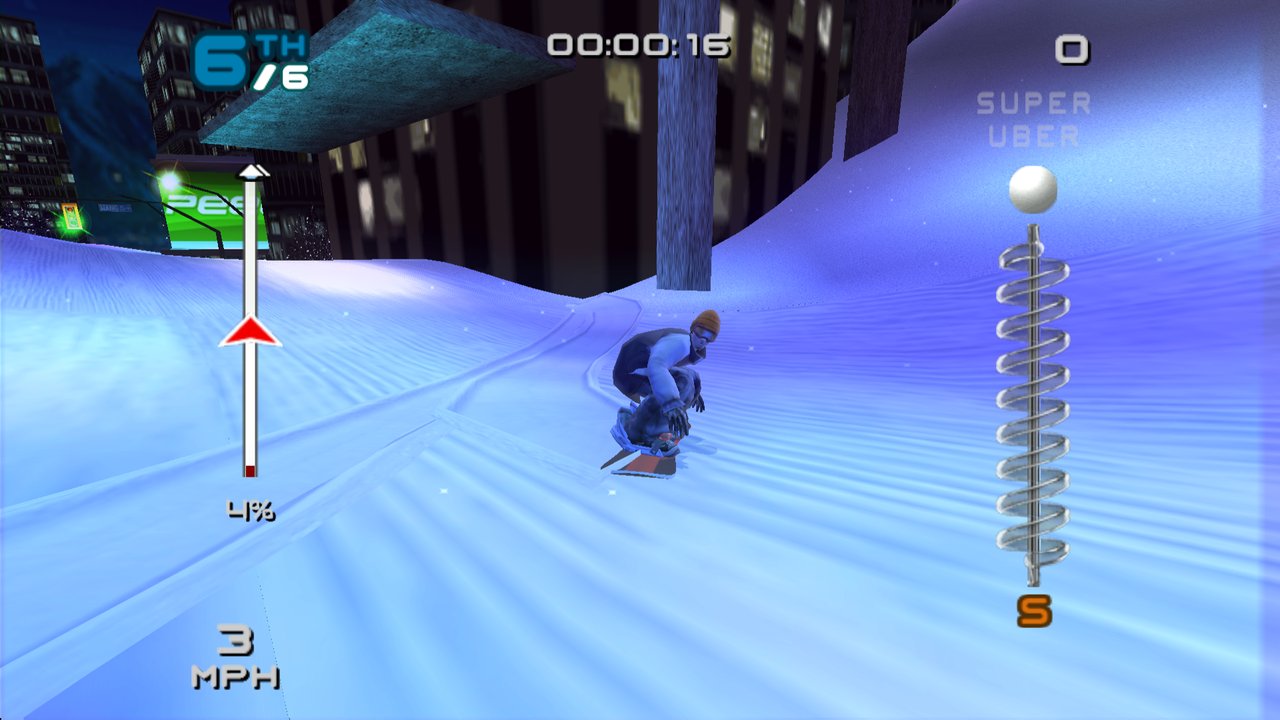
- Native renderer (wgpu): any resolution and aspect ratio, widescreen and ultrawide through the game's own projection, adjustable field of view, texture packs, optional modern graphics (AA, AO, bloom, draw distance).
- Configurable game rate (60/120/144/240 Hz), with no interpolation.
- 5,210 of 11,844 functions are hand-written Rust (about 90% of a race's per-frame work), each checked against the recompiled original. Every function is named.
- Runs on macOS and Windows, builds on Linux, plus an experimental browser build (
crates/ssx3-web).
The guest memory, the EE kernel's threads (coroutines on one host thread) and VU0 macro ops
are still PS2-shaped; see docs/plans/roadmap.md and
known limitations.
Getting started
You need:
- A disc image of SSX 3 (USA) (
SLUS-20772, RedumpSSX 3 (USA), about 3 GB) made from a disc you own. Other regions are not supported; setup checks the executable's SHA-256 (1b49d05ca2793922180851b9e1ce9ae2291d61a7863565ac4e71f12e967af7bc). - Rust (stable, via rustup) and Python 3.
- A GPU with Metal, Vulkan or DX12, and about 7 GB of disk.
- On Linux:
pkg-config,libasound2-dev,libudev-dev. On Windows: the MSVC toolchain (not WSL).
Tested on macOS (Apple Silicon) and Windows. On Linux (Ubuntu 24.04) the setup, tests and build work; playing there is untested.
git clone https://github.com/andersfischernielsen/ssx3-decomp.git
cd ssx3-decomp
cp /path/to/your/image.iso "SSX 3 (USA).iso"   # or set SSX3_ISO
python3 tools/setup.py                         # extract, check, recompile into generated/
cargo run --profile game -p ssx3
Run setup.py again after pulling changes to the recompiler. The first build compiles
about 55 MB of generated Rust; later builds are incremental. The binary is
target/game/ssx3.
Standalone build. python3 tools/bundle.py packs the game data into a build that runs
without the ISO or the repository: dist/SSX3.app on macOS, one executable on Linux and
Windows (tools/bundle/Dockerfile builds the Linux one anywhere). It contains the game: for
your own use only, do not share it.
Playing
A controller is picked up automatically (buttons map by position: bottom ✕, right ○, left □, top △).
| Keyboard | PS2 | Keyboard | ||
|---|---|---|---|---|
| Arrows | D-pad | F10 | Settings (pauses) | |
| X / S / Z / A | ✕ / ○ / □ / △ | F11 | Fullscreen | |
| Q / W, 1 / 2 | L1 / R1, L2 / R2 | F12 | Screenshot | |
| Enter / Right Shift | Start / Select |
Most options are in the settings overlay (F10) and are saved to saves/ssx3-settings.cfg;
saves go to saves/ssx3-mc0.ps2. Every option is also an environment variable, e.g.
SSX3_SKIP_MOVIES=1, SSX3_PAD2=1 (second player), SSX3_TICK_HZ=120,
SSX3_RENDER_SIZE=2560x1080, SSX3_FOV=1.2. SSX3_EVENT=BRA2 SSX3_RIDER=moby
boots straight into an event (here Metro City as Moby), skipping the memory card, the title and the menus. Full list, texture packs and the
emulated reference paths: docs/options.md.
Architecture
| Crate | Role |
|---|---|
ssx3 | Front ends: the windowed ssx3 (winit + wgpu + gilrs + cpal) and ssx3-headless. |
ssx3-game | The hand-written Rust: game functions in src/game/<dir>/<unit>.rs after the C++ source tree, each checked against the generated one; the native draw functions (packetless), native libmpeg (movie.rs), the native file layer, the tick rate (tick.rs). |
ssx3-recomp | The function inventory, the R5900 decoder, and recomp-ee: ~808k instructions in 13.3k functions lowered to structured Rust, sharded into 16 crates under generated/ee/. recomp-iop does the same for the game's IOP modules. See docs/investigation/recompiler-v2.md. |
ssx3-ee-rt | The EE core the generated code compiles against: Cpu, instruction semantics (MMI, bit-exact PS2 float), guest memory, the function table, the Platform trait. Kept small so hardware changes never recompile generated code. |
ssx3-ps2 | The platform (Machine): an HLE EE kernel (threads, semaphores, alarms), the hardware registers the game touches, SIF and the native IOP services, the frame sink and native DMA kick; the emulated GS, VIF and IPU for the reference path. |
ssx3-gfx | The native renderer (wgpu): typed frames from the game's draws, the VU1 programs on CPU/GPU, post passes, modern graphics options. |
ssx3-render | The typed frame (captured draws, the frame build) and the VU1 rendering programs as readable Rust. |
ssx3-mpeg | The native MPEG-2 movie decoder. |
ssx3-snd | The native sound driver (EA's IOP SNDDRV in Rust). |
ssx3-mc | The memory card: the PS2 card filesystem on the raw .ps2 image, answering libmc as MCMAN/MCSERV do (byte-identical saves). |
ssx3-vu | VU0/VU1: registers, pipeline timing, the translated microcode (generated/vu/). |
ssx3-web, ssx3-vuworker | The browser build: the single-thread form of the generated code as WebAssembly, drawn with WebGPU from a Web Worker; VU1 jobs in a worker of their own. |
ssx3-iop, ssx3-gs | Reference paths only: the IOP runtime for the recompiled IRX modules, and the Graphics Synthesizer model (verification builds, emu-gs). |
ssx3-core, ssx3-runtime | Machine-model and execution-state scaffolding (memory map, ISO reading). |
The game's threads run as coroutines (one stack each, corosensei) on the host thread that
drives frames, so a thread switch is a stack switch and a guest call is a plain Rust call.
recomp-ee --unwind generates the single-thread resumable form for the browser, using the
unwind/trampoline model from ps2-web-recomp
(MIT). More in docs/architecture.md.
Tools
Mostly Python 3, run from the repository root.
| Area | Tools |
|---|---|
| Setup and packaging | setup.py (extract, check, recompile; bootstrap.sh and extract-from-iso.sh are the POSIX-shell versions), bundle.py (standalone builds; bundle_icon.py makes the icon from the game's logo, bundle/Dockerfile is a Linux build environment), upscale-textures.py (AI-upscaled texture packs). |
| Porting to hand-written Rust | pick_wave.py (choose the next functions by runtime hotness from a callgraph.py/SSX3_CALLPROF profile), refsrc.py, refbody.py, refindex.py, refdossier2.py (look up the matching C++ decompilation and write per-function dossiers), integrate_wave.py (install ported modules: regenerate, test, build, RAM gate), reorg_modules.py (move ports into the source-tree layout). |
| Verification | scenarios.py (scripted headless scenarios), bisect_overrides.py (find the port that makes a run differ), compare-file-logs.py, vu-diff/ (our VU against ps2-web-recomp's interpreter, step by step), run-headless.sh, contact_sheet.py (a page of headless screenshots). |
| Tick rate | scan_framerate.py, scan_tick_patterns.py (find 60 Hz assumptions), tick_ab.py (the same race at 60 Hz and N Hz, side by side). |
| Ghidra and inspection | export-ghidra-functions.py, export-ghidra-boundaries.py, export-ghidra-disasm.py, import-ghidra-names.py, ghidra_create_discovered.py (keep the function inventory and Ghidra in sync), iso-ls.py (files on the disc), mcls.py (files on a memory card image), pine.py (read and write PCSX2's memory for comparisons). |
Contributing
- Docs:
docs/architecture.md(how it fits together),docs/development.md(headless runs, verification, debugging, Ghidra),docs/plans/(roadmap and active plans). - Porting functions to hand-written Rust:
docs/investigation/phase2-worker-guide.mdandAGENTS.md. Ports live incrates/ssx3-game, are registered inoverrides.txt, and each has a differential test against the generated code. The C++ decompilation DevvyDont/ssx3 is a readability aid; the generated code is the authority. - Exactness is the rule. A scripted headless race must give identical RAM before and
after a change unless the change is meant to alter behaviour
(
python3 tools/integrate_wave.py gate). - CI builds and tests every crate that doesn't need the disc (
python3 tools/setup.py --stubs-onlygives the same setup locally). Changes tossx3-gameor the game itself need the differential tests and the RAM gate, run locally. - Never commit game material: the disc or its files,
generated/code, disassembly, RAM/VRAM dumps, or screenshots of large parts of the game.